
Autopilot Phone Use – How It Impacts Focus and Well-Being
Mak Kordić
,
February 27, 2026


You put your phone down after a quick message, but within minutes your hand reaches for it again, almost without thinking. This familiar impulse is more than just habit - it signals that your device is now driving your actions, not you. Understanding the triggers and core features of autopilot phone use can help you reclaim mental clarity and focus for your most important work. In this guide, you'll discover practical strategies to interrupt the automatic cycle and create healthier digital routines.
Table of Contents
- Defining Autopilot Phone Use And Core Features
- Types Of Autopilot Behaviors In Daily Life
- How Autopilot Use Harms Focus And Health
- Breaking The Cycle: Proven Disruption Methods]
Defining Autopilot Phone Use and Core Features
Autopilot phone use describes the behavior of interacting with your device on autopilot - picking it up, unlocking it, and scrolling through apps without conscious intention or awareness. You're not deciding to check email or social media; your hand simply reaches for the phone while your mind stays elsewhere. This happens so automatically that you often can't remember what you were looking for when you started.
Unlike deliberate phone use for a specific task, autopilot behavior operates with minimal mental engagement. Semi-automated systems that reduce active control create patterns of relaxed monitoring and decreased focus over time. Your brain enters a passive state, similar to highway driving where you arrive at your destination without remembering the drive itself.
Core features of autopilot phone use include:
- Habitual reaching – Touching your phone within minutes of setting it down, without purpose
- App switching – Jumping between apps aimlessly instead of completing one task
- Notification response – Reacting instantly to every ping, buzz, or alert
- Mindless scrolling – Feeding endless content streams without retention or satisfaction
- Ambient checking – Glancing at your screen during conversations or work
The behavior develops through repetition. Your brain learns that checking your phone delivers small hits of novelty and stimulation, so it keeps pulling you back. After weeks of this pattern, the urge becomes automatic - stronger than your conscious decision to put the phone away.
Autopilot phone use differs from intentional phone use in one critical way: conscious choice is absent. When you decide to respond to an email or check a specific app for information, you're in control. With autopilot, your habits control you, stealing focus from work, conversations, and rest.
" The longer you practice autopilot phone habits, the harder they become to break - and the more they erode your ability to concentrate on meaningful tasks. "
Healthy professionals often recognize this pattern after noticing they've lost 45 minutes to their phone without achieving anything. They feel the mental friction of constantly divided attention. They notice conversations interrupted by the urge to check messages. These are signals that autopilot phone use has taken hold.
The distinction matters because autopilot phone use creates a specific problem: your phone becomes a default reflex rather than a tool. Breaking this cycle requires interrupting the automatic behavior itself, not just limiting total screen time.
Pro tip: Notice when your hand reaches for your phone without intention - these moments reveal your autopilot triggers, so you can address them before they hijack your focus.
Types of Autopilot Behaviors in Daily Life
Autopilot behaviors aren't limited to phones. They show up everywhere - at work, home, during meals, and in how you move through your day. The behavior feels normal because you've done it hundreds of times before, so your brain stops paying attention.
Research reveals that two-thirds of daily behaviors happen automatically, triggered by environmental cues rather than conscious decisions. You walk the same route to your desk and realize you're there without remembering the walk. You open your laptop and immediately click to email without planning to. You reach for snacks during work calls out of habit, not hunger.
Common autopilot behaviors professionals experience include:
- Work rituals – Opening the same tabs, checking email before starting focused work, attending meetings on autopilot
- Commute patterns – Taking the same route, listening to the same podcast, arriving without conscious awareness
- Meal habits – Eating at the same time daily, snacking during specific tasks, finishing plates without tasting
- Social defaults – Scrolling phone during conversations, checking messages during breaks, defaulting to email for quick questions
- Evening routines – Settling into the couch with your phone, streaming shows while working, checking work messages before bed
The distinction between habitual triggering and habitual execution matters here. Many daily actions are automatically triggered and executed, meaning the behavior starts without your decision and runs without your attention. You don't choose to check Slack at 3 p.m. - the time arrives, and your hand moves automatically.
Phone autopilot is especially dangerous because it interrupts every other autopilot behavior. You're mid-work ritual and reach for your phone. You're on your commute and pull out your device. You're eating lunch and scroll instead of tasting. The phone becomes the default response to any moment of transition or boredom.
Where autopilot really hurts professionals is in focus-dependent work. Writing reports, strategic thinking, and creative problem-solving all demand sustained attention. Autopilot phone checking fragments this attention, making deep work nearly impossible.
" Your brain defaults to autopilot for 65-88% of daily actions, but phone autopilot specifically disrupts the intentional behaviors that drive your best work. "
The good news: autopilot behaviors respond to environmental interruption. When you change the trigger or add friction to the automatic response, the behavior loses its power. This is where breaking phone autopilot creates a ripple effect - successful phone interruption strengthens your ability to interrupt other autopilot patterns.
Pro tip: Identify one phone autopilot trigger (like checking your phone when you sit down), then create a physical barrier between you and the phone at that moment - this single interruption breaks the habit chain faster than willpower alone.
How Autopilot Use Harms Focus and Health
Autopilot phone use isn't just annoying - it actively damages your brain's ability to concentrate and harms your overall well-being. Every time you reach for your phone without intention, you're fragmenting your attention and degrading your mental performance.
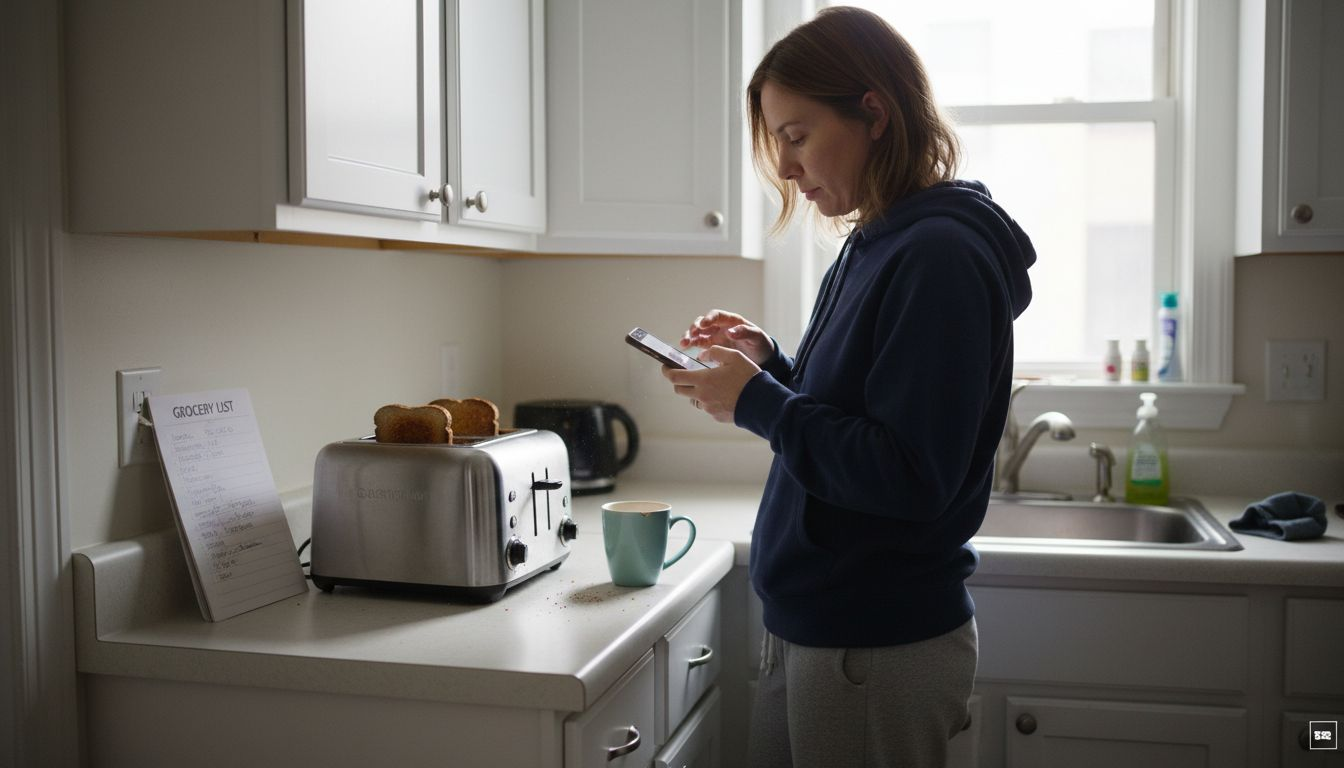
The damage starts in your brain structure. Excessive smartphone use impacts brain function, affecting areas responsible for attention, decision-making, and emotional regulation. Your brain adapts to constant interruption by becoming less capable of sustained focus. Neurologically, you're training your brain to be worse at the very skills you need for meaningful work.
Here's what happens when autopilot phone use takes over:
- Fragmented attention – Your focus splits between tasks, reducing efficiency and quality
- Cognitive resource depletion – Decision-making energy gets exhausted by constant task switching
- Working memory damage – Complex thinking requires holding multiple ideas simultaneously, which phone interruptions destroy
- Reduced learning retention – Information doesn't stick when your attention keeps fragmenting
- Emotional dysregulation – Constant novelty-seeking from your phone weakens emotional stability
Professionals often don't realize how much phone autopilot costs them. Multitasking with phones significantly reduces academic performance through constant task switching, which breaks concentration and compounds mistakes. A study showed young adults checking phones during focused work experienced measurable declines in test scores and problem-solving accuracy.
The health impact extends beyond focus. Autopilot phone use disrupts sleep quality, increases anxiety through constant notification stress, and weakens your capacity for deep relationships. You're physically present but mentally absent, training your brain to divide attention even during important conversations.
Where the damage really compounds is in your ability to do deep work. Writing, strategic thinking, and creative problem-solving all require sustained mental effort for 45-90 minutes without interruption. Autopilot phone checking destroys this capability, making it nearly impossible to produce your best work.
" Autopilot phone use trains your brain to be distracted - rewiring your neural pathways away from focus and toward constant fragmentation. "
The good news is this damage is reversible. When you interrupt autopilot patterns consistently, your brain begins rebuilding its focus capacity. Within 2-3 weeks of eliminating phone autopilot triggers, professionals report noticeably sharper concentration and better work quality.
Practicing mindful tech habits helps your brain recover from autopilot damage by establishing periods of genuine focus. Your attention span strengthens like a muscle when given uninterrupted time.
Pro tip: Track one specific task (like writing or analysis) before and after breaking your autopilot phone habit - measuring your actual performance improvement will motivate you far more than willpower ever could.
Breaking the Cycle: Proven Disruption Methods
Breaking autopilot phone use requires more than willpower - you need proven disruption strategies that interrupt the automatic patterns before they start. The key is changing your environment and decision-making, not just your intentions.
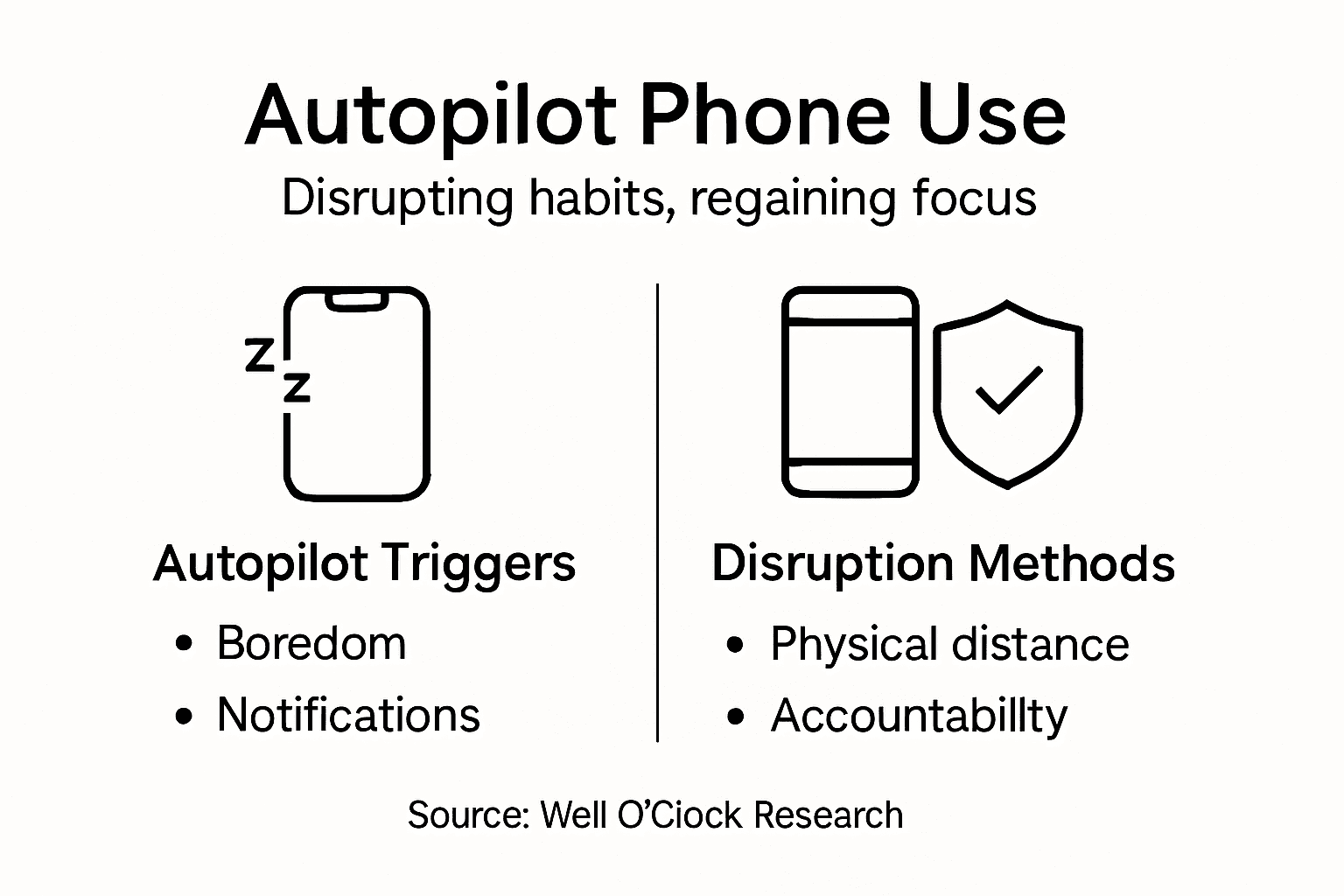
The foundation of breaking autopilot starts with increasing self-awareness through intentional practice. Most people don't realize when they reach for their phone because the behavior happens without conscious thought. Pause and notice: When do you check your phone? What triggers the urge? What feeling precedes each reach? This awareness alone begins breaking the automatic cycle.
Once you see the pattern, introduce physical friction between you and the device:
- Distance interrupts habit – Place your phone in another room during focused work
- Removal from sight – Keep it in a drawer or bag, not on your desk
- App locks – Use physical barriers or app blocking during work hours
- Notification silence – Disable all alerts that trigger checking
- Scheduled checking – Designate specific times when you check your phone intentionally
The most effective disruption method is novelty and environmental change. When you break routine, your brain stops running on autopilot and engages conscious attention. Move to a different workspace. Change your work-start ritual. Take a different route to your desk. These small changes force your brain to think, interrupting the automatic phone-reaching pattern.
Another powerful approach: analyze and redirect your thoughts toward deliberate intention instead of habit. When you feel the urge to check your phone, pause and ask "Why am I reaching for this right now?" If there's no genuine reason, you've just interrupted the autopilot loop. Replace the phone-checking impulse with something intentional - take three deep breaths, write one sentence toward your goal, or stretch.
Accountability structures accelerate progress. Tell a colleague about your goal to break phone autopilot. Share your daily wins. When someone else is tracking your progress, your brain activates stronger resistance to automatic behavior.
The reality: disruption works fastest when combined. Physical friction stops the habit loop. Awareness prevents unconscious reaching. Novelty engages your brain. Accountability provides motivation.
" The first week is uncomfortable - your hand will reach for your phone dozens of times. By week three, the urge fades dramatically, and by week six, the autopilot cycle is broken. "
Most professionals see measurable focus improvement within 2-3 weeks of consistent disruption. Your ability to sustain attention on one task grows noticeably.
Pro tip: Start with just one disruption method (physical distance works best) - pick one location where you do focused work, and commit to keeping your phone out of that space for two weeks before adding additional strategies.
Take Control of Your Focus by Breaking Autopilot Phone Use Today
Struggling with habitual phone checking that fragments your attention and drains your productivity is more common than you realize. The article highlights how autopilot phone use hijacks your mental engagement and erodes your ability to focus on meaningful work or fully enjoy personal moments. Key challenges include mindless scrolling, impulsive notification responses, and unconscious app switching that steal precious time and well-being.
Well O’Clock offers a powerful, outside-the-phone solution combining physical NFC tags with an intuitive mobile app to help you interrupt autopilot behaviors before they start. This unique system creates tangible barriers that empower you to regain control over your phone use and boost mental clarity. If you want to stop autopilot habits like habitual reaching or ambient checking and strengthen sustained focus, explore how our approach supports healthier digital habits at Well O’Clock.
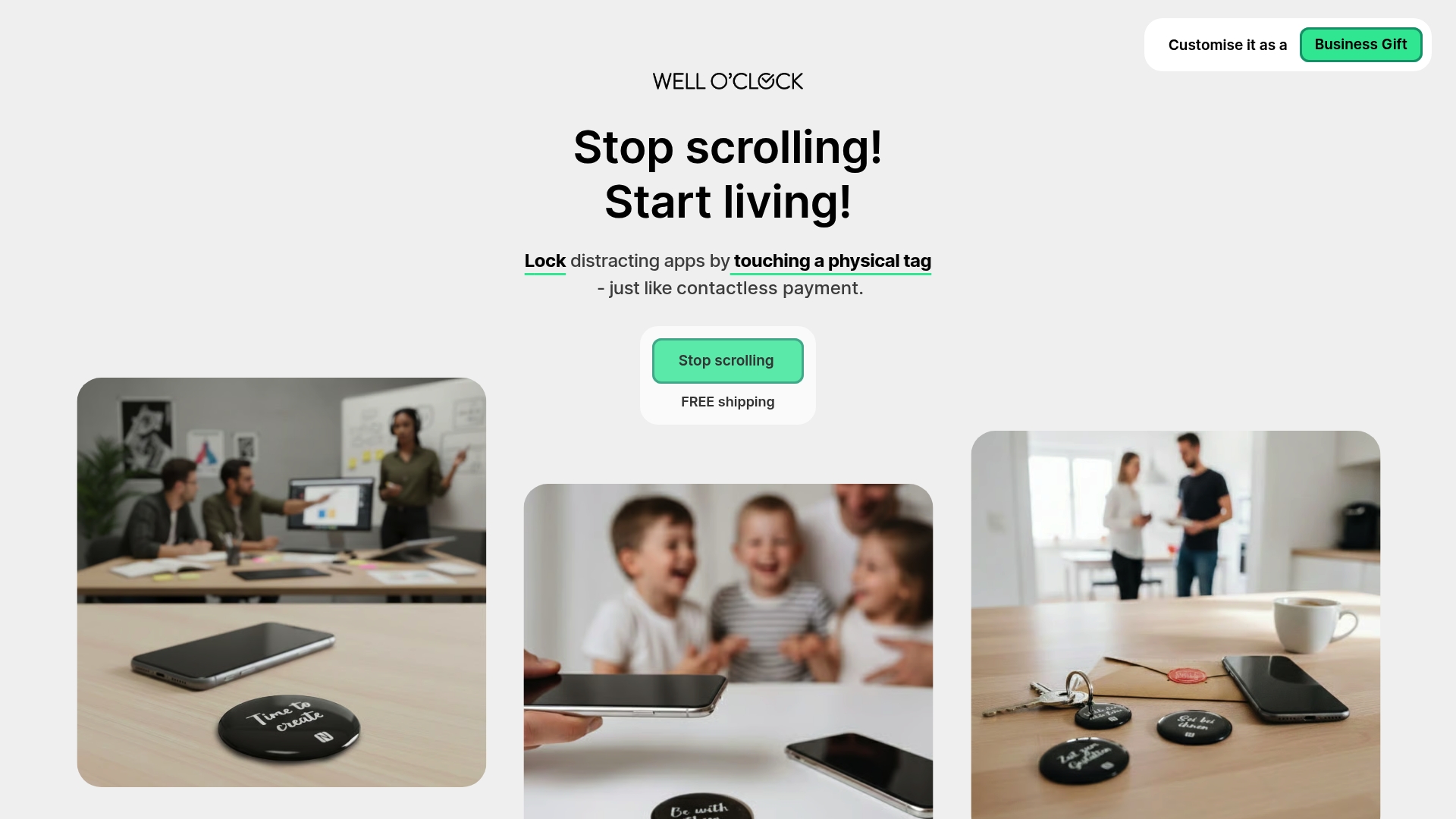
Ready to transform your phone use and reclaim your attention? Visit Well O’Clock to discover a user-friendly, customizable solution designed to reduce distractions, improve well-being, and enhance productivity. Start breaking the cycle of autopilot phone behavior now and experience noticeable improvements in focus within weeks.
Frequently Asked Questions
What is autopilot phone use?
Autopilot phone use refers to the unconscious behavior of interacting with your smartphone without intentionality, such as mindlessly scrolling through apps or reacting to notifications without a specific purpose.
How does autopilot phone use affect focus?
Autopilot phone use can fragment attention, reducing concentration and efficiency in completing tasks. It trains your brain to be less capable of sustained focus, which can hinder deep work and cognitive performance.
What are some common behaviors associated with autopilot phone use?
Common behaviors include habitual reaching for your phone, app switching without completing tasks, reacting to notifications immediately, mindless scrolling, and checking your phone during conversations or work.
How can I break the cycle of autopilot phone use?
To break the cycle, you can implement strategies such as creating physical distance from your phone during work, turning off notifications, scheduling specific times to check your phone, and altering your environment to disrupt habitual behaviors.

Mak Kordić
Co founder
Mak Kordić is the founder and CEO of CNJ Digital, an agency based in Ljubljana, where he and his team develop UX/UI and digital products for demanding B2B projects. Over his career, he has led and co-created hundreds of digital solutions and worked with international clients.








Autopilot Phone Use – How It Impacts Focus and Well-Being
Mak Kordić
,
February 27, 2026
You put your phone down after a quick message, but within minutes your hand reaches for it again, almost without thinking. This familiar impulse is more than just habit - it signals that your device is now driving your actions, not you. Understanding the triggers and core features of autopilot phone use can help you reclaim mental clarity and focus for your most important work. In this guide, you'll discover practical strategies to interrupt the automatic cycle and create healthier digital routines.
Table of Contents
- Defining Autopilot Phone Use And Core Features
- Types Of Autopilot Behaviors In Daily Life
- How Autopilot Use Harms Focus And Health
- Breaking The Cycle: Proven Disruption Methods]
Defining Autopilot Phone Use and Core Features
Autopilot phone use describes the behavior of interacting with your device on autopilot - picking it up, unlocking it, and scrolling through apps without conscious intention or awareness. You're not deciding to check email or social media; your hand simply reaches for the phone while your mind stays elsewhere. This happens so automatically that you often can't remember what you were looking for when you started.
Unlike deliberate phone use for a specific task, autopilot behavior operates with minimal mental engagement. Semi-automated systems that reduce active control create patterns of relaxed monitoring and decreased focus over time. Your brain enters a passive state, similar to highway driving where you arrive at your destination without remembering the drive itself.
Core features of autopilot phone use include:
- Habitual reaching – Touching your phone within minutes of setting it down, without purpose
- App switching – Jumping between apps aimlessly instead of completing one task
- Notification response – Reacting instantly to every ping, buzz, or alert
- Mindless scrolling – Feeding endless content streams without retention or satisfaction
- Ambient checking – Glancing at your screen during conversations or work
The behavior develops through repetition. Your brain learns that checking your phone delivers small hits of novelty and stimulation, so it keeps pulling you back. After weeks of this pattern, the urge becomes automatic - stronger than your conscious decision to put the phone away.
Autopilot phone use differs from intentional phone use in one critical way: conscious choice is absent. When you decide to respond to an email or check a specific app for information, you're in control. With autopilot, your habits control you, stealing focus from work, conversations, and rest.
" The longer you practice autopilot phone habits, the harder they become to break - and the more they erode your ability to concentrate on meaningful tasks. "
Healthy professionals often recognize this pattern after noticing they've lost 45 minutes to their phone without achieving anything. They feel the mental friction of constantly divided attention. They notice conversations interrupted by the urge to check messages. These are signals that autopilot phone use has taken hold.
The distinction matters because autopilot phone use creates a specific problem: your phone becomes a default reflex rather than a tool. Breaking this cycle requires interrupting the automatic behavior itself, not just limiting total screen time.
Pro tip: Notice when your hand reaches for your phone without intention - these moments reveal your autopilot triggers, so you can address them before they hijack your focus.
Types of Autopilot Behaviors in Daily Life
Autopilot behaviors aren't limited to phones. They show up everywhere - at work, home, during meals, and in how you move through your day. The behavior feels normal because you've done it hundreds of times before, so your brain stops paying attention.
Research reveals that two-thirds of daily behaviors happen automatically, triggered by environmental cues rather than conscious decisions. You walk the same route to your desk and realize you're there without remembering the walk. You open your laptop and immediately click to email without planning to. You reach for snacks during work calls out of habit, not hunger.
Common autopilot behaviors professionals experience include:
- Work rituals – Opening the same tabs, checking email before starting focused work, attending meetings on autopilot
- Commute patterns – Taking the same route, listening to the same podcast, arriving without conscious awareness
- Meal habits – Eating at the same time daily, snacking during specific tasks, finishing plates without tasting
- Social defaults – Scrolling phone during conversations, checking messages during breaks, defaulting to email for quick questions
- Evening routines – Settling into the couch with your phone, streaming shows while working, checking work messages before bed
The distinction between habitual triggering and habitual execution matters here. Many daily actions are automatically triggered and executed, meaning the behavior starts without your decision and runs without your attention. You don't choose to check Slack at 3 p.m. - the time arrives, and your hand moves automatically.
Phone autopilot is especially dangerous because it interrupts every other autopilot behavior. You're mid-work ritual and reach for your phone. You're on your commute and pull out your device. You're eating lunch and scroll instead of tasting. The phone becomes the default response to any moment of transition or boredom.
Where autopilot really hurts professionals is in focus-dependent work. Writing reports, strategic thinking, and creative problem-solving all demand sustained attention. Autopilot phone checking fragments this attention, making deep work nearly impossible.
" Your brain defaults to autopilot for 65-88% of daily actions, but phone autopilot specifically disrupts the intentional behaviors that drive your best work. "
The good news: autopilot behaviors respond to environmental interruption. When you change the trigger or add friction to the automatic response, the behavior loses its power. This is where breaking phone autopilot creates a ripple effect - successful phone interruption strengthens your ability to interrupt other autopilot patterns.
Pro tip: Identify one phone autopilot trigger (like checking your phone when you sit down), then create a physical barrier between you and the phone at that moment - this single interruption breaks the habit chain faster than willpower alone.
How Autopilot Use Harms Focus and Health
Autopilot phone use isn't just annoying - it actively damages your brain's ability to concentrate and harms your overall well-being. Every time you reach for your phone without intention, you're fragmenting your attention and degrading your mental performance.
The damage starts in your brain structure. Excessive smartphone use impacts brain function, affecting areas responsible for attention, decision-making, and emotional regulation. Your brain adapts to constant interruption by becoming less capable of sustained focus. Neurologically, you're training your brain to be worse at the very skills you need for meaningful work.
Here's what happens when autopilot phone use takes over:
- Fragmented attention – Your focus splits between tasks, reducing efficiency and quality
- Cognitive resource depletion – Decision-making energy gets exhausted by constant task switching
- Working memory damage – Complex thinking requires holding multiple ideas simultaneously, which phone interruptions destroy
- Reduced learning retention – Information doesn't stick when your attention keeps fragmenting
- Emotional dysregulation – Constant novelty-seeking from your phone weakens emotional stability
Professionals often don't realize how much phone autopilot costs them. Multitasking with phones significantly reduces academic performance through constant task switching, which breaks concentration and compounds mistakes. A study showed young adults checking phones during focused work experienced measurable declines in test scores and problem-solving accuracy.
The health impact extends beyond focus. Autopilot phone use disrupts sleep quality, increases anxiety through constant notification stress, and weakens your capacity for deep relationships. You're physically present but mentally absent, training your brain to divide attention even during important conversations.
Where the damage really compounds is in your ability to do deep work. Writing, strategic thinking, and creative problem-solving all require sustained mental effort for 45-90 minutes without interruption. Autopilot phone checking destroys this capability, making it nearly impossible to produce your best work.
" Autopilot phone use trains your brain to be distracted - rewiring your neural pathways away from focus and toward constant fragmentation. "
The good news is this damage is reversible. When you interrupt autopilot patterns consistently, your brain begins rebuilding its focus capacity. Within 2-3 weeks of eliminating phone autopilot triggers, professionals report noticeably sharper concentration and better work quality.
Practicing mindful tech habits helps your brain recover from autopilot damage by establishing periods of genuine focus. Your attention span strengthens like a muscle when given uninterrupted time.
Pro tip: Track one specific task (like writing or analysis) before and after breaking your autopilot phone habit - measuring your actual performance improvement will motivate you far more than willpower ever could.
Breaking the Cycle: Proven Disruption Methods
Breaking autopilot phone use requires more than willpower - you need proven disruption strategies that interrupt the automatic patterns before they start. The key is changing your environment and decision-making, not just your intentions.
The foundation of breaking autopilot starts with increasing self-awareness through intentional practice. Most people don't realize when they reach for their phone because the behavior happens without conscious thought. Pause and notice: When do you check your phone? What triggers the urge? What feeling precedes each reach? This awareness alone begins breaking the automatic cycle.
Once you see the pattern, introduce physical friction between you and the device:
- Distance interrupts habit – Place your phone in another room during focused work
- Removal from sight – Keep it in a drawer or bag, not on your desk
- App locks – Use physical barriers or app blocking during work hours
- Notification silence – Disable all alerts that trigger checking
- Scheduled checking – Designate specific times when you check your phone intentionally
The most effective disruption method is novelty and environmental change. When you break routine, your brain stops running on autopilot and engages conscious attention. Move to a different workspace. Change your work-start ritual. Take a different route to your desk. These small changes force your brain to think, interrupting the automatic phone-reaching pattern.
Another powerful approach: analyze and redirect your thoughts toward deliberate intention instead of habit. When you feel the urge to check your phone, pause and ask "Why am I reaching for this right now?" If there's no genuine reason, you've just interrupted the autopilot loop. Replace the phone-checking impulse with something intentional - take three deep breaths, write one sentence toward your goal, or stretch.
Accountability structures accelerate progress. Tell a colleague about your goal to break phone autopilot. Share your daily wins. When someone else is tracking your progress, your brain activates stronger resistance to automatic behavior.
The reality: disruption works fastest when combined. Physical friction stops the habit loop. Awareness prevents unconscious reaching. Novelty engages your brain. Accountability provides motivation.
" The first week is uncomfortable - your hand will reach for your phone dozens of times. By week three, the urge fades dramatically, and by week six, the autopilot cycle is broken. "
Most professionals see measurable focus improvement within 2-3 weeks of consistent disruption. Your ability to sustain attention on one task grows noticeably.
Pro tip: Start with just one disruption method (physical distance works best) - pick one location where you do focused work, and commit to keeping your phone out of that space for two weeks before adding additional strategies.
Take Control of Your Focus by Breaking Autopilot Phone Use Today
Struggling with habitual phone checking that fragments your attention and drains your productivity is more common than you realize. The article highlights how autopilot phone use hijacks your mental engagement and erodes your ability to focus on meaningful work or fully enjoy personal moments. Key challenges include mindless scrolling, impulsive notification responses, and unconscious app switching that steal precious time and well-being.
Well O’Clock offers a powerful, outside-the-phone solution combining physical NFC tags with an intuitive mobile app to help you interrupt autopilot behaviors before they start. This unique system creates tangible barriers that empower you to regain control over your phone use and boost mental clarity. If you want to stop autopilot habits like habitual reaching or ambient checking and strengthen sustained focus, explore how our approach supports healthier digital habits at Well O’Clock.
Ready to transform your phone use and reclaim your attention? Visit Well O’Clock to discover a user-friendly, customizable solution designed to reduce distractions, improve well-being, and enhance productivity. Start breaking the cycle of autopilot phone behavior now and experience noticeable improvements in focus within weeks.
Frequently Asked Questions
What is autopilot phone use?
Autopilot phone use refers to the unconscious behavior of interacting with your smartphone without intentionality, such as mindlessly scrolling through apps or reacting to notifications without a specific purpose.
How does autopilot phone use affect focus?
Autopilot phone use can fragment attention, reducing concentration and efficiency in completing tasks. It trains your brain to be less capable of sustained focus, which can hinder deep work and cognitive performance.
What are some common behaviors associated with autopilot phone use?
Common behaviors include habitual reaching for your phone, app switching without completing tasks, reacting to notifications immediately, mindless scrolling, and checking your phone during conversations or work.
How can I break the cycle of autopilot phone use?
To break the cycle, you can implement strategies such as creating physical distance from your phone during work, turning off notifications, scheduling specific times to check your phone, and altering your environment to disrupt habitual behaviors.
Mak Kordić
Co founder
Mak Kordić is the founder and CEO of CNJ Digital, an agency based in Ljubljana, where he and his team develop UX/UI and digital products for demanding B2B projects. Over his career, he has led and co-created hundreds of digital solutions and worked with international clients.
Autopilot Phone Use – How It Impacts Focus and Well-Being
Mak Kordić
,
February 27, 2026
You put your phone down after a quick message, but within minutes your hand reaches for it again, almost without thinking. This familiar impulse is more than just habit - it signals that your device is now driving your actions, not you. Understanding the triggers and core features of autopilot phone use can help you reclaim mental clarity and focus for your most important work. In this guide, you'll discover practical strategies to interrupt the automatic cycle and create healthier digital routines.
Table of Contents
- Defining Autopilot Phone Use And Core Features
- Types Of Autopilot Behaviors In Daily Life
- How Autopilot Use Harms Focus And Health
- Breaking The Cycle: Proven Disruption Methods]
Defining Autopilot Phone Use and Core Features
Autopilot phone use describes the behavior of interacting with your device on autopilot - picking it up, unlocking it, and scrolling through apps without conscious intention or awareness. You're not deciding to check email or social media; your hand simply reaches for the phone while your mind stays elsewhere. This happens so automatically that you often can't remember what you were looking for when you started.
Unlike deliberate phone use for a specific task, autopilot behavior operates with minimal mental engagement. Semi-automated systems that reduce active control create patterns of relaxed monitoring and decreased focus over time. Your brain enters a passive state, similar to highway driving where you arrive at your destination without remembering the drive itself.
Core features of autopilot phone use include:
- Habitual reaching – Touching your phone within minutes of setting it down, without purpose
- App switching – Jumping between apps aimlessly instead of completing one task
- Notification response – Reacting instantly to every ping, buzz, or alert
- Mindless scrolling – Feeding endless content streams without retention or satisfaction
- Ambient checking – Glancing at your screen during conversations or work
The behavior develops through repetition. Your brain learns that checking your phone delivers small hits of novelty and stimulation, so it keeps pulling you back. After weeks of this pattern, the urge becomes automatic - stronger than your conscious decision to put the phone away.
Autopilot phone use differs from intentional phone use in one critical way: conscious choice is absent. When you decide to respond to an email or check a specific app for information, you're in control. With autopilot, your habits control you, stealing focus from work, conversations, and rest.
" The longer you practice autopilot phone habits, the harder they become to break - and the more they erode your ability to concentrate on meaningful tasks. "
Healthy professionals often recognize this pattern after noticing they've lost 45 minutes to their phone without achieving anything. They feel the mental friction of constantly divided attention. They notice conversations interrupted by the urge to check messages. These are signals that autopilot phone use has taken hold.
The distinction matters because autopilot phone use creates a specific problem: your phone becomes a default reflex rather than a tool. Breaking this cycle requires interrupting the automatic behavior itself, not just limiting total screen time.
Pro tip: Notice when your hand reaches for your phone without intention - these moments reveal your autopilot triggers, so you can address them before they hijack your focus.
Types of Autopilot Behaviors in Daily Life
Autopilot behaviors aren't limited to phones. They show up everywhere - at work, home, during meals, and in how you move through your day. The behavior feels normal because you've done it hundreds of times before, so your brain stops paying attention.
Research reveals that two-thirds of daily behaviors happen automatically, triggered by environmental cues rather than conscious decisions. You walk the same route to your desk and realize you're there without remembering the walk. You open your laptop and immediately click to email without planning to. You reach for snacks during work calls out of habit, not hunger.
Common autopilot behaviors professionals experience include:
- Work rituals – Opening the same tabs, checking email before starting focused work, attending meetings on autopilot
- Commute patterns – Taking the same route, listening to the same podcast, arriving without conscious awareness
- Meal habits – Eating at the same time daily, snacking during specific tasks, finishing plates without tasting
- Social defaults – Scrolling phone during conversations, checking messages during breaks, defaulting to email for quick questions
- Evening routines – Settling into the couch with your phone, streaming shows while working, checking work messages before bed
The distinction between habitual triggering and habitual execution matters here. Many daily actions are automatically triggered and executed, meaning the behavior starts without your decision and runs without your attention. You don't choose to check Slack at 3 p.m. - the time arrives, and your hand moves automatically.
Phone autopilot is especially dangerous because it interrupts every other autopilot behavior. You're mid-work ritual and reach for your phone. You're on your commute and pull out your device. You're eating lunch and scroll instead of tasting. The phone becomes the default response to any moment of transition or boredom.
Where autopilot really hurts professionals is in focus-dependent work. Writing reports, strategic thinking, and creative problem-solving all demand sustained attention. Autopilot phone checking fragments this attention, making deep work nearly impossible.
" Your brain defaults to autopilot for 65-88% of daily actions, but phone autopilot specifically disrupts the intentional behaviors that drive your best work. "
The good news: autopilot behaviors respond to environmental interruption. When you change the trigger or add friction to the automatic response, the behavior loses its power. This is where breaking phone autopilot creates a ripple effect - successful phone interruption strengthens your ability to interrupt other autopilot patterns.
Pro tip: Identify one phone autopilot trigger (like checking your phone when you sit down), then create a physical barrier between you and the phone at that moment - this single interruption breaks the habit chain faster than willpower alone.
How Autopilot Use Harms Focus and Health
Autopilot phone use isn't just annoying - it actively damages your brain's ability to concentrate and harms your overall well-being. Every time you reach for your phone without intention, you're fragmenting your attention and degrading your mental performance.
The damage starts in your brain structure. Excessive smartphone use impacts brain function, affecting areas responsible for attention, decision-making, and emotional regulation. Your brain adapts to constant interruption by becoming less capable of sustained focus. Neurologically, you're training your brain to be worse at the very skills you need for meaningful work.
Here's what happens when autopilot phone use takes over:
- Fragmented attention – Your focus splits between tasks, reducing efficiency and quality
- Cognitive resource depletion – Decision-making energy gets exhausted by constant task switching
- Working memory damage – Complex thinking requires holding multiple ideas simultaneously, which phone interruptions destroy
- Reduced learning retention – Information doesn't stick when your attention keeps fragmenting
- Emotional dysregulation – Constant novelty-seeking from your phone weakens emotional stability
Professionals often don't realize how much phone autopilot costs them. Multitasking with phones significantly reduces academic performance through constant task switching, which breaks concentration and compounds mistakes. A study showed young adults checking phones during focused work experienced measurable declines in test scores and problem-solving accuracy.
The health impact extends beyond focus. Autopilot phone use disrupts sleep quality, increases anxiety through constant notification stress, and weakens your capacity for deep relationships. You're physically present but mentally absent, training your brain to divide attention even during important conversations.
Where the damage really compounds is in your ability to do deep work. Writing, strategic thinking, and creative problem-solving all require sustained mental effort for 45-90 minutes without interruption. Autopilot phone checking destroys this capability, making it nearly impossible to produce your best work.
" Autopilot phone use trains your brain to be distracted - rewiring your neural pathways away from focus and toward constant fragmentation. "
The good news is this damage is reversible. When you interrupt autopilot patterns consistently, your brain begins rebuilding its focus capacity. Within 2-3 weeks of eliminating phone autopilot triggers, professionals report noticeably sharper concentration and better work quality.
Practicing mindful tech habits helps your brain recover from autopilot damage by establishing periods of genuine focus. Your attention span strengthens like a muscle when given uninterrupted time.
Pro tip: Track one specific task (like writing or analysis) before and after breaking your autopilot phone habit - measuring your actual performance improvement will motivate you far more than willpower ever could.
Breaking the Cycle: Proven Disruption Methods
Breaking autopilot phone use requires more than willpower - you need proven disruption strategies that interrupt the automatic patterns before they start. The key is changing your environment and decision-making, not just your intentions.
The foundation of breaking autopilot starts with increasing self-awareness through intentional practice. Most people don't realize when they reach for their phone because the behavior happens without conscious thought. Pause and notice: When do you check your phone? What triggers the urge? What feeling precedes each reach? This awareness alone begins breaking the automatic cycle.
Once you see the pattern, introduce physical friction between you and the device:
- Distance interrupts habit – Place your phone in another room during focused work
- Removal from sight – Keep it in a drawer or bag, not on your desk
- App locks – Use physical barriers or app blocking during work hours
- Notification silence – Disable all alerts that trigger checking
- Scheduled checking – Designate specific times when you check your phone intentionally
The most effective disruption method is novelty and environmental change. When you break routine, your brain stops running on autopilot and engages conscious attention. Move to a different workspace. Change your work-start ritual. Take a different route to your desk. These small changes force your brain to think, interrupting the automatic phone-reaching pattern.
Another powerful approach: analyze and redirect your thoughts toward deliberate intention instead of habit. When you feel the urge to check your phone, pause and ask "Why am I reaching for this right now?" If there's no genuine reason, you've just interrupted the autopilot loop. Replace the phone-checking impulse with something intentional - take three deep breaths, write one sentence toward your goal, or stretch.
Accountability structures accelerate progress. Tell a colleague about your goal to break phone autopilot. Share your daily wins. When someone else is tracking your progress, your brain activates stronger resistance to automatic behavior.
The reality: disruption works fastest when combined. Physical friction stops the habit loop. Awareness prevents unconscious reaching. Novelty engages your brain. Accountability provides motivation.
" The first week is uncomfortable - your hand will reach for your phone dozens of times. By week three, the urge fades dramatically, and by week six, the autopilot cycle is broken. "
Most professionals see measurable focus improvement within 2-3 weeks of consistent disruption. Your ability to sustain attention on one task grows noticeably.
Pro tip: Start with just one disruption method (physical distance works best) - pick one location where you do focused work, and commit to keeping your phone out of that space for two weeks before adding additional strategies.
Take Control of Your Focus by Breaking Autopilot Phone Use Today
Struggling with habitual phone checking that fragments your attention and drains your productivity is more common than you realize. The article highlights how autopilot phone use hijacks your mental engagement and erodes your ability to focus on meaningful work or fully enjoy personal moments. Key challenges include mindless scrolling, impulsive notification responses, and unconscious app switching that steal precious time and well-being.
Well O’Clock offers a powerful, outside-the-phone solution combining physical NFC tags with an intuitive mobile app to help you interrupt autopilot behaviors before they start. This unique system creates tangible barriers that empower you to regain control over your phone use and boost mental clarity. If you want to stop autopilot habits like habitual reaching or ambient checking and strengthen sustained focus, explore how our approach supports healthier digital habits at Well O’Clock.
Ready to transform your phone use and reclaim your attention? Visit Well O’Clock to discover a user-friendly, customizable solution designed to reduce distractions, improve well-being, and enhance productivity. Start breaking the cycle of autopilot phone behavior now and experience noticeable improvements in focus within weeks.
Frequently Asked Questions
What is autopilot phone use?
Autopilot phone use refers to the unconscious behavior of interacting with your smartphone without intentionality, such as mindlessly scrolling through apps or reacting to notifications without a specific purpose.
How does autopilot phone use affect focus?
Autopilot phone use can fragment attention, reducing concentration and efficiency in completing tasks. It trains your brain to be less capable of sustained focus, which can hinder deep work and cognitive performance.
What are some common behaviors associated with autopilot phone use?
Common behaviors include habitual reaching for your phone, app switching without completing tasks, reacting to notifications immediately, mindless scrolling, and checking your phone during conversations or work.
How can I break the cycle of autopilot phone use?
To break the cycle, you can implement strategies such as creating physical distance from your phone during work, turning off notifications, scheduling specific times to check your phone, and altering your environment to disrupt habitual behaviors.
Mak Kordić
Co founder
Mak Kordić is the founder and CEO of CNJ Digital, an agency based in Ljubljana, where he and his team develop UX/UI and digital products for demanding B2B projects. Over his career, he has led and co-created hundreds of digital solutions and worked with international clients.