
Screen Time: How It Impacts Wellness & Focus
Mak Kordić
,
March 2, 2026

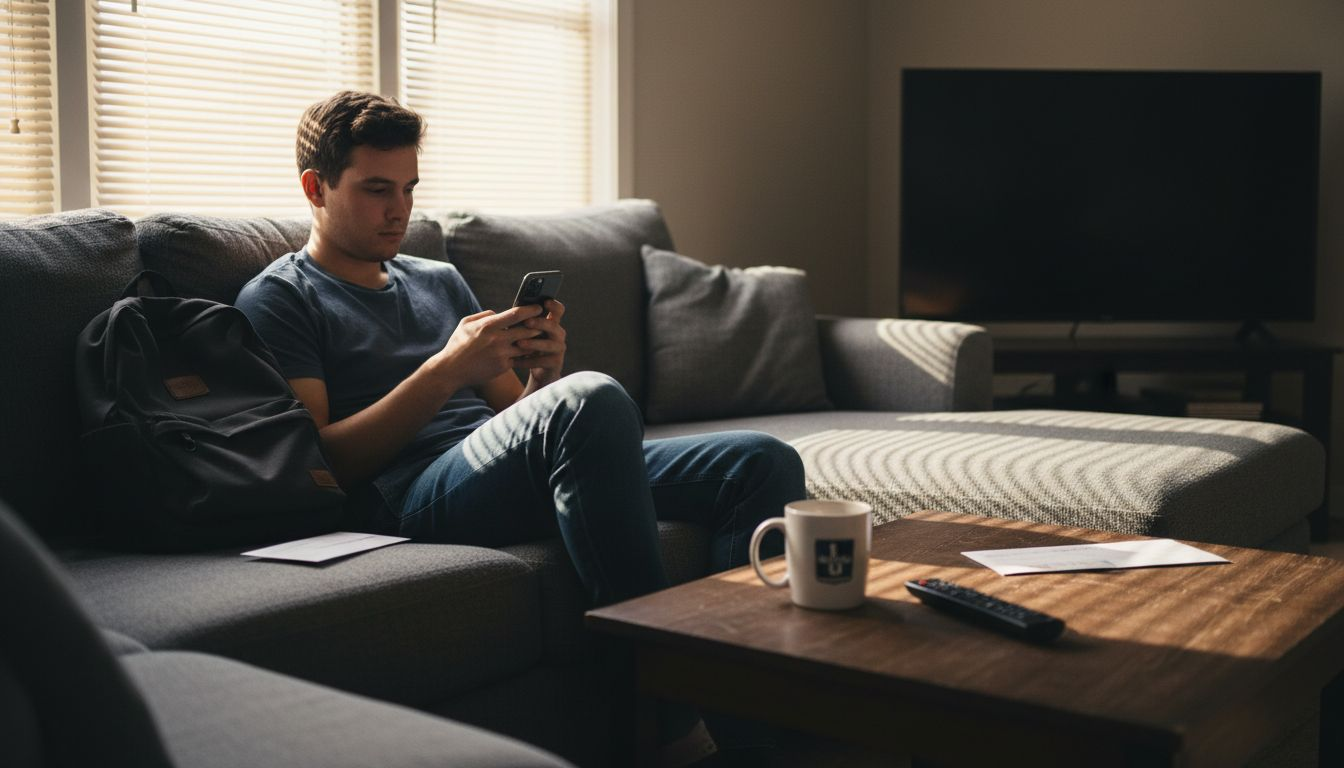
Every household in the United States, United Kingdom, and Canada grapples with how screens shape daily life. The surge of smartphones, tablets, and computers means work, learning, and relaxation often happen on digital devices. Modern devices serve multiple purposes and blur the lines between productive and distracting habits. This article reveals clear distinctions and practical strategies to help you reclaim focus, boost mental clarity, and build healthier tech routines for yourself and your family.
Table of Contents
- Screen Time Defined And Common Misconceptions
- Types Of Screen Time And Key Distinctions
- How Screen Time Affects Health And Well-Being
- Benefits And Risks Of Screen Usage
- Strategies To Reduce And Manage Screen Time
Screen Time Defined and Common Misconceptions
Screen time refers to the amount of time you spend interacting with screen-based devices - smartphones, tablets, computers, and televisions. This isn't just about passive scrolling; it encompasses everything from checking emails to video calls to streaming content.
The definition sounds simple, but reality is more nuanced. Time spent on digital devices actually breaks down into two distinct categories. Active usage involves deliberate interaction like posting on social media, responding to messages, or creating content. Passive usage means consuming content without engaging - scrolling feeds, watching videos, or simply having a screen nearby.
Today's context makes this distinction critical. Modern devices serve multiple purposes simultaneously:
- Work and professional communication
- Educational content and learning
- Social connection and relationship maintenance
- Entertainment and recreation
- Information gathering and news
This multipurpose nature creates confusion about what "healthy" screen time looks like. Many people overestimate their actual usage or misunderstand which activities count most.
Common misconceptions cloud the conversation:
1. All screen time is identical - A 30-minute work call differs fundamentally from 30 minutes of mindless scrolling
2. More screen time always means worse outcomes - Educational screen use may have different effects than gaming or social media
3. Children today are uniquely addicted - Digital connectivity shapes modern childhood differently, but screens serve legitimate functions in education and communication
4. Screen time is purely negative - Screens enable learning, connection, and access to opportunity
Yet another misconception persists: that you can simply eliminate screen time entirely. The reality is different. Screens are embedded in modern life-work, education, and relationships often depend on them.
" Understanding what screen time actually means helps you identify which activities genuinely impact your focus and wellness. "
The real issue isn't screens themselves. It's how we use them. Understanding the distinction between active and passive usage, recognizing your devices' multiple roles, and addressing screen addiction's impact on mental clarity helps shift the conversation from "screen time is bad" to "intentional screen use is better."
This distinction matters because it changes how you approach solutions. You're not trying to eliminate screens - you're trying to control which activities consume your attention.
Pro tip: Track what you actually do on screens for three days. Note whether each activity was active (deliberate) or passive (habitual). This reveals which habits genuinely drain your focus.
Types of Screen Time and Key Distinctions
Not all screen time affects you the same way. The duration you spend on screens matters far less than what you're doing during that time. This distinction fundamentally changes how you should think about your digital habits.
Passive screen time differs from active engagement in measurable ways. Passive consumption includes watching television, scrolling social media feeds, or streaming videos without interaction. Your brain receives information but doesn't require deliberate choice or creation.
Active screen time demands engagement. You're posting content, responding to messages, participating in video calls, or working on documents. Your hands and mind are directly involved in creating or responding.
Why does this matter for your wellness and focus?
- Passive consumption is addictive - scrolling triggers dopamine loops that keep you engaged
- Active work builds engagement - intentional tasks create flow states and productivity
- Passive time drains focus - hours disappear without accomplishment
- Active time often feels purposeful - even if it's work communication
Different device types enable different activities. Smartphones make passive consumption effortless. Computers support deeper work. Television creates background consumption. Tablets offer flexibility between active and passive use.
A crucial distinction exists between productive screen time and distracting screen time. Productive includes work, learning, meaningful communication, and creating content. Distracting includes endless scrolling, compulsive checking, and content consumption without purpose.
" Your screen time impact depends less on duration and more on the type of activity and your intentionality during it. "
Yet another layer matters: device proximity and availability. Having your phone within arm's reach triggers different behavior than keeping it in another room. Notifications constantly interrupt, shifting you from active to passive engagement involuntarily.
The distinction between these types helps explain why two people with identical screen time experience completely different effects on focus and wellness. One person checks their phone frequently for work - active, purposeful engagement. Another person scrolls feeds passively for the same duration - distracted, unfocused.
Understanding your personal patterns means tracking not just how long you use screens, but what type of activity dominates your usage.
Pro tip: For the next week, label each screen session as either "active" (purposeful work or communication) or "passive" (scrolling or watching). You'll quickly see which type consumes most of your time and impacts your focus most negatively.
How Screen Time Affects Health and Well-Being
Excessive screen time doesn't just waste hours. It actively harms your physical health, mental clarity, and emotional stability. The evidence is clear and growing.

Your body suffers first. Higher non-schoolwork daily screen time correlates directly with reduced physical activity, irregular sleep patterns, and weight concerns. When you're stationary and focused on a glowing rectangle, your body enters a sedentary state that accumulates damage over weeks and months.
Sleep becomes fragmented. Blue light from screens suppresses melatonin production, making it harder to fall asleep. Notifications ping throughout the evening, keeping your nervous system activated when it should be winding down. Poor sleep then cascades into everything else—weakened immunity, slower metabolism, and impaired decision-making.
Mental health takes a sharper hit. The same research shows strong associations between excessive screen time and depression, anxiety, and insufficient social support. Your brain wasn't designed for constant stimulation and comparison with others' curated lives.
Cognitive function deteriorates measurably. Excessive screen time leads to decreased focus and memory retention, impacting your ability to concentrate on meaningful work. Hours disappear, but you struggle to recall what you actually accomplished.
The impact compounds across multiple dimensions:
- Sleep quality - disrupted circadian rhythms and late-night stimulation
- Physical health -reduced movement, postural strain, and metabolic slowdown
- Mental clarity - divided attention and reduced working memory
- Emotional stability - anxiety from notifications and social comparison
- Real-world relationships - less face-to-face interaction and deeper connection
What makes this particularly damaging is the compounding effect. Poor sleep worsens anxiety. Anxiety drives more scrolling for distraction. More scrolling destroys focus. Loss of focus leads to incomplete work and increased stress.
" Screen time's health impact extends far beyond the hours spent - it disrupts sleep, movement, focus, and emotional regulation simultaneously. "
Professionals face unique challenges. Work often requires screens, but then personal use adds hours on top. The total exposure becomes overwhelming without intentional boundaries.
Parents see the effects firsthand in their children. Reduced outdoor play, weakened attention spans, and sleep problems have all increased alongside rising screen time. Yet work and school increasingly depend on devices, creating pressure to accept the damage.
The good news: these effects reverse when you reduce screen time intentionally. Sleep normalizes within days. Anxiety decreases within weeks. Focus sharpens noticeably within a month. Your body and mind want to recover.
Pro tip: Track one specific health metric - sleep quality, energy level, or anxiety - for one week while monitoring your screen habits. You'll likely spot a direct correlation that motivates real change.
Benefits and Risks of Screen Usage
Screens aren't inherently evil. The problem isn't technology itself - it's how we use it. Understanding both benefits and risks helps you make intentional choices rather than defaulting to habit.
Educational screens create real value. When used purposefully, digital tools support learning and skill development. Video tutorials teach coding faster than textbooks. Collaborative platforms enable teamwork across distances. Research databases provide instant access to information. For older children and professionals, genuinely educational screen use offers learning benefits alongside skill development.
Work and communication depend on screens. Remote teams collaborate through video calls. Professionals research, write, and create entirely through digital tools. Students access course materials and submit assignments online. These aren't frivolous uses - they're necessary and productive.
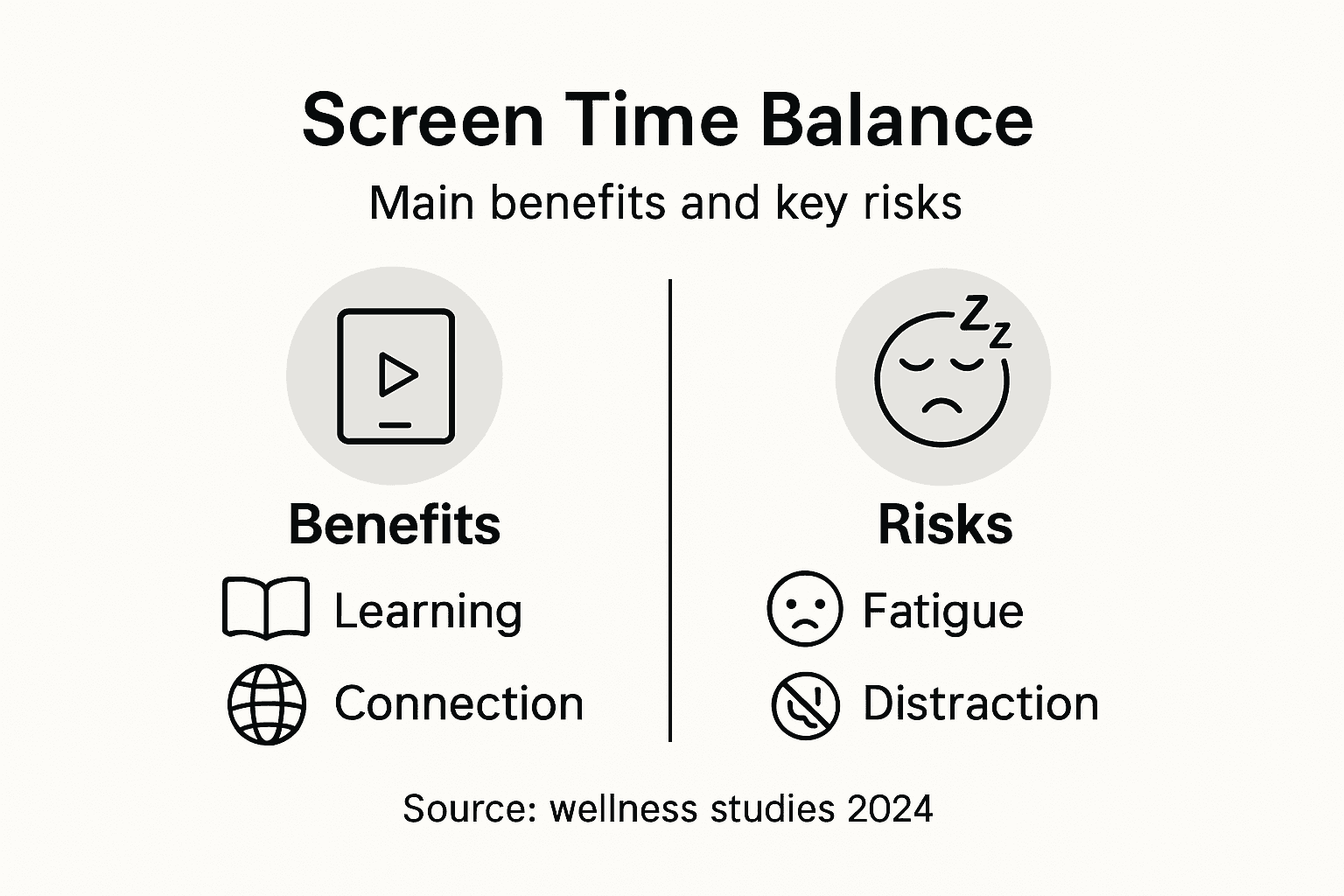
Yet the risks accumulate quietly. Digital tools can support learning when well-managed, but risks include addiction, fatigue, and mental health issues if usage becomes excessive or unregulated. The same devices enabling productivity also enable endless distraction.
Here's the crucial distinction:
Benefits of intentional screen use:
- Educational content and skill development
- Meaningful work and professional communication
- Access to information and research
- Connection with distant friends and family
- Creative expression and content creation
Risks of uncontrolled screen use:
- Addiction to notifications and social feeds
- Reduced physical activity and postural strain
- Sleep disruption from blue light exposure
- Mental health challenges from comparison and isolation
- Weakened focus and attention capacity
The balance matters enormously. A professional spending eight hours on work screens faces different consequences than someone passively scrolling for eight hours. Context changes everything.
" The quality and purpose of screen time matter far more than the quantity spent. "
Your device proximity determines much of the outcome. A phone within arm's reach triggers constant checking. The same phone in another room becomes a tool you use intentionally. Your environment shapes behavior more than willpower does.
Notifications deserve special attention. Push alerts interrupt deep work, fragment attention, and create constant low-level stress. Disabling notifications removes the compulsive checking loop while preserving the screen's benefits.
Children face particular vulnerability. Educational screens offer learning benefits, but young brains still develop. The balance skews more heavily toward risk for younger children. By adolescence, developmental benefits of intentional screen use increase while risks of addiction remain constant.
Pro tip: Separate your devices by purpose. Use one device primarily for work, another for communication, and keep entertainment devices in different rooms. This physical separation naturally reduces unintentional usage while preserving each device's legitimate benefits.
Strategies to Reduce and Manage Screen Time
Reducing screen time isn't about willpower. It's about changing your environment and habits so the easier choice becomes the better choice. Small shifts compound into significant results.
Start with notification management. Every ping interrupts focus and triggers checking. Disable notifications for everything except truly urgent contacts. Your phone becomes a tool you use intentionally rather than a device that uses you.
Create physical barriers to distraction. Keep your phone in another room during focused work. Place tablets and laptops out of arm's reach when not actively using them. Distance transforms behavior more reliably than discipline does.
Managing distractions through establishing policies and promoting responsible device use requires creating an environment where distraction requires extra effort. When your phone is two rooms away, you check it far less frequently.
Next, use app blockers strategically. Set specific times when entertainment apps become inaccessible. You can still access them during designated periods, but the friction of unlocking them prevents mindless scrolling. Physical solutions work even better - physical NFC tags provide tangible interrupts that break autopilot phone usage.
Establish screen-free zones and times:
1. No phones during meals with family
2. No screens one hour before bed
3. No devices in bedrooms overnight
4. No screens during first and last hour of your day
5. No phones during focused work blocks
These boundaries seem strict initially but feel liberating quickly. Your sleep improves. Conversations deepen. Work accelerates when uninterrupted.
Prioritize intentional screen use over passive consumption. When you open your device, know specifically what you're doing. If you can't articulate the purpose, it's likely distraction disguised as productivity.
Evidence-based approaches for managing screen time involve self-regulation tools and public awareness of impacts. Understanding how your specific screen habits affect sleep, focus, and mood motivates genuine change. Track what you actually do on screens for a week. The data becomes your motivator.
" The most effective screen time reduction strategy matches your specific barriers to change, not someone else's ideal approach. "
For professionals, separating work and personal devices helps tremendously. Use your computer for work. Use a tablet for learning. Keep your phone for genuine communication only. This device separation creates natural context shifts that reduce total consumption.
Family accountability accelerates progress. Share your screen time goals with others. Weekly check-ins maintain momentum. When someone asks if you've stuck to your boundaries, follow-through strengthens.
Pro tip: Start with one single boundary - either notifications off, phone in another room, or no screens after 9 p.m. Establish this one habit firmly before adding others. Small wins compound faster than ambitious overhauls that fail.
Take Control of Your Screen Time and Reclaim Your Focus
The article highlights the hidden challenges behind excessive screen time such as reduced focus, disrupted sleep, and increased anxiety caused by passive scrolling and constant notification distractions. If you find yourself struggling with unintentional phone use or feeling overwhelmed by addictive digital habits, you are not alone. These issues go beyond mere time spent on devices and come down to how and when you engage with screens.
Well O’Clock offers a powerful, easy-to-use solution that combines physical NFC tags with a mobile app to help you physically interrupt autopilot behaviors and lock distracting apps. This innovative system empowers you to build intentional digital habits by creating natural barriers that support mental clarity and healthier routines. Designed with personalization and behavioral science in mind, it helps reduce passive consumption and protect your wellbeing.
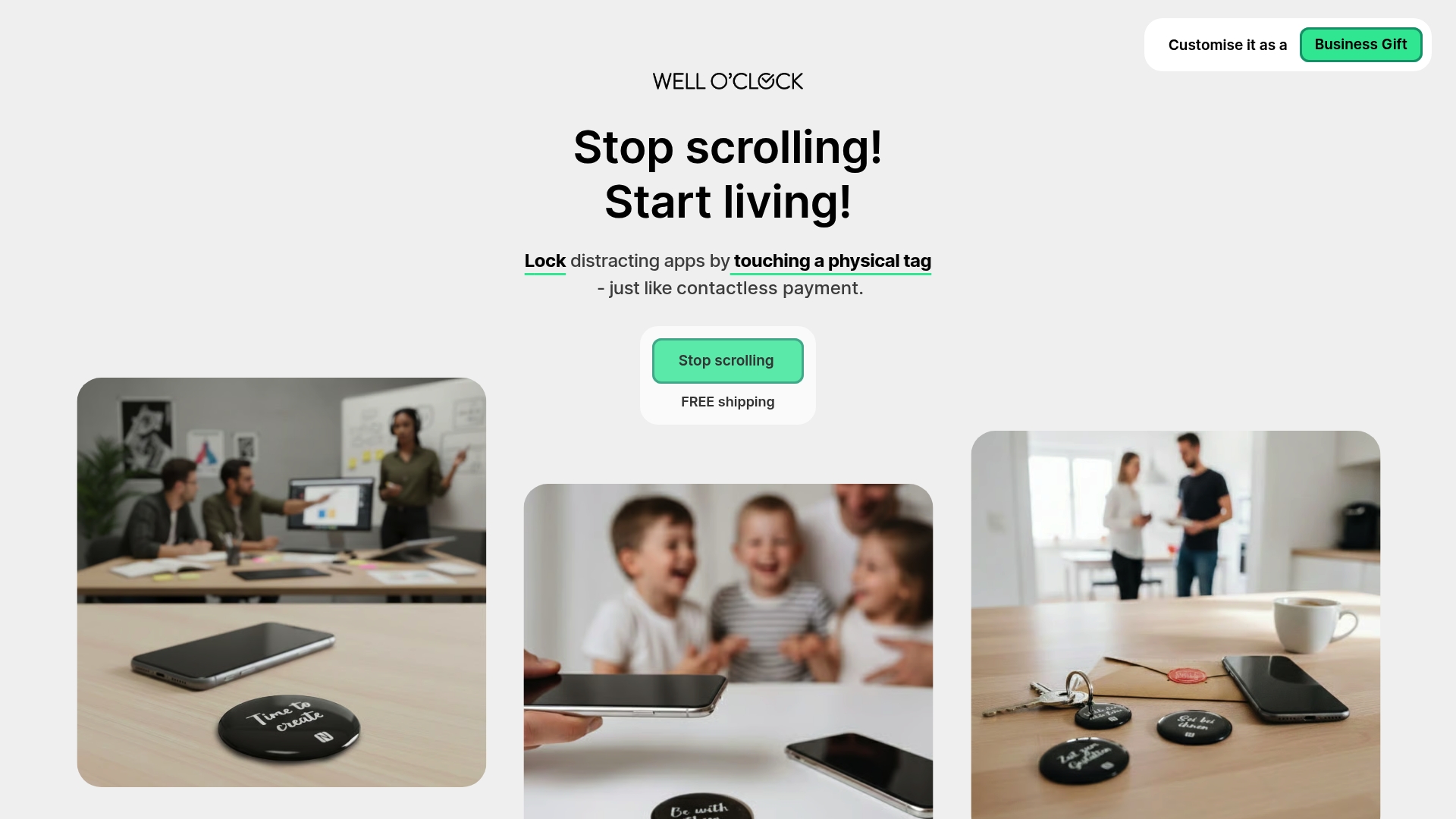
Ready to protect your focus and improve your wellness? Visit Well O’Clock now to discover how our unique approach can help you break free from endless scrolling and establish meaningful boundaries with your devices today. Your path to better sleep, less anxiety, and increased productivity starts with one simple tap. Learn more and take the first step toward intentional screen use.
Frequently Asked Questions
What is screen time and how is it measured?
Screen time refers to the amount of time spent interacting with screen-based devices such as smartphones, tablets, computers, and televisions. It includes both active usage, like video calls and content creation, and passive usage, like browsing social media or watching videos.
How does screen time affect mental health?
Excessive screen time is associated with mental health challenges such as anxiety, depression, and reduced social support. Continuous stimulation and comparison on digital platforms can exacerbate these issues.
What are the differences between active and passive screen time?
Active screen time involves intentional engagement, such as video calls or working on projects, while passive screen time includes activities like scrolling through feeds or binge-watching shows without direct interaction. Active use tends to support focus and productivity, whereas passive use can diminish attention span.
What strategies can help reduce screen time effectively?
Effective strategies include disabling non-essential notifications, creating screen-free zones, setting app blockers for distracting applications, and physically separating devices used for work from those used for entertainment. These changes encourage intentional screen use over mindless consumption.

Mak Kordić
Co founder
Mak Kordić is the founder and CEO of CNJ Digital, an agency based in Ljubljana, where he and his team develop UX/UI and digital products for demanding B2B projects. Over his career, he has led and co-created hundreds of digital solutions and worked with international clients.








Screen Time: How It Impacts Wellness & Focus
Mak Kordić
,
March 2, 2026
Every household in the United States, United Kingdom, and Canada grapples with how screens shape daily life. The surge of smartphones, tablets, and computers means work, learning, and relaxation often happen on digital devices. Modern devices serve multiple purposes and blur the lines between productive and distracting habits. This article reveals clear distinctions and practical strategies to help you reclaim focus, boost mental clarity, and build healthier tech routines for yourself and your family.
Table of Contents
- Screen Time Defined And Common Misconceptions
- Types Of Screen Time And Key Distinctions
- How Screen Time Affects Health And Well-Being
- Benefits And Risks Of Screen Usage
- Strategies To Reduce And Manage Screen Time
Screen Time Defined and Common Misconceptions
Screen time refers to the amount of time you spend interacting with screen-based devices - smartphones, tablets, computers, and televisions. This isn't just about passive scrolling; it encompasses everything from checking emails to video calls to streaming content.
The definition sounds simple, but reality is more nuanced. Time spent on digital devices actually breaks down into two distinct categories. Active usage involves deliberate interaction like posting on social media, responding to messages, or creating content. Passive usage means consuming content without engaging - scrolling feeds, watching videos, or simply having a screen nearby.
Today's context makes this distinction critical. Modern devices serve multiple purposes simultaneously:
- Work and professional communication
- Educational content and learning
- Social connection and relationship maintenance
- Entertainment and recreation
- Information gathering and news
This multipurpose nature creates confusion about what "healthy" screen time looks like. Many people overestimate their actual usage or misunderstand which activities count most.
Common misconceptions cloud the conversation:
1. All screen time is identical - A 30-minute work call differs fundamentally from 30 minutes of mindless scrolling
2. More screen time always means worse outcomes - Educational screen use may have different effects than gaming or social media
3. Children today are uniquely addicted - Digital connectivity shapes modern childhood differently, but screens serve legitimate functions in education and communication
4. Screen time is purely negative - Screens enable learning, connection, and access to opportunity
Yet another misconception persists: that you can simply eliminate screen time entirely. The reality is different. Screens are embedded in modern life-work, education, and relationships often depend on them.
" Understanding what screen time actually means helps you identify which activities genuinely impact your focus and wellness. "
The real issue isn't screens themselves. It's how we use them. Understanding the distinction between active and passive usage, recognizing your devices' multiple roles, and addressing screen addiction's impact on mental clarity helps shift the conversation from "screen time is bad" to "intentional screen use is better."
This distinction matters because it changes how you approach solutions. You're not trying to eliminate screens - you're trying to control which activities consume your attention.
Pro tip: Track what you actually do on screens for three days. Note whether each activity was active (deliberate) or passive (habitual). This reveals which habits genuinely drain your focus.
Types of Screen Time and Key Distinctions
Not all screen time affects you the same way. The duration you spend on screens matters far less than what you're doing during that time. This distinction fundamentally changes how you should think about your digital habits.
Passive screen time differs from active engagement in measurable ways. Passive consumption includes watching television, scrolling social media feeds, or streaming videos without interaction. Your brain receives information but doesn't require deliberate choice or creation.
Active screen time demands engagement. You're posting content, responding to messages, participating in video calls, or working on documents. Your hands and mind are directly involved in creating or responding.
Why does this matter for your wellness and focus?
- Passive consumption is addictive - scrolling triggers dopamine loops that keep you engaged
- Active work builds engagement - intentional tasks create flow states and productivity
- Passive time drains focus - hours disappear without accomplishment
- Active time often feels purposeful - even if it's work communication
Different device types enable different activities. Smartphones make passive consumption effortless. Computers support deeper work. Television creates background consumption. Tablets offer flexibility between active and passive use.
A crucial distinction exists between productive screen time and distracting screen time. Productive includes work, learning, meaningful communication, and creating content. Distracting includes endless scrolling, compulsive checking, and content consumption without purpose.
" Your screen time impact depends less on duration and more on the type of activity and your intentionality during it. "
Yet another layer matters: device proximity and availability. Having your phone within arm's reach triggers different behavior than keeping it in another room. Notifications constantly interrupt, shifting you from active to passive engagement involuntarily.
The distinction between these types helps explain why two people with identical screen time experience completely different effects on focus and wellness. One person checks their phone frequently for work - active, purposeful engagement. Another person scrolls feeds passively for the same duration - distracted, unfocused.
Understanding your personal patterns means tracking not just how long you use screens, but what type of activity dominates your usage.
Pro tip: For the next week, label each screen session as either "active" (purposeful work or communication) or "passive" (scrolling or watching). You'll quickly see which type consumes most of your time and impacts your focus most negatively.
How Screen Time Affects Health and Well-Being
Excessive screen time doesn't just waste hours. It actively harms your physical health, mental clarity, and emotional stability. The evidence is clear and growing.
Your body suffers first. Higher non-schoolwork daily screen time correlates directly with reduced physical activity, irregular sleep patterns, and weight concerns. When you're stationary and focused on a glowing rectangle, your body enters a sedentary state that accumulates damage over weeks and months.
Sleep becomes fragmented. Blue light from screens suppresses melatonin production, making it harder to fall asleep. Notifications ping throughout the evening, keeping your nervous system activated when it should be winding down. Poor sleep then cascades into everything else—weakened immunity, slower metabolism, and impaired decision-making.
Mental health takes a sharper hit. The same research shows strong associations between excessive screen time and depression, anxiety, and insufficient social support. Your brain wasn't designed for constant stimulation and comparison with others' curated lives.
Cognitive function deteriorates measurably. Excessive screen time leads to decreased focus and memory retention, impacting your ability to concentrate on meaningful work. Hours disappear, but you struggle to recall what you actually accomplished.
The impact compounds across multiple dimensions:
- Sleep quality - disrupted circadian rhythms and late-night stimulation
- Physical health -reduced movement, postural strain, and metabolic slowdown
- Mental clarity - divided attention and reduced working memory
- Emotional stability - anxiety from notifications and social comparison
- Real-world relationships - less face-to-face interaction and deeper connection
What makes this particularly damaging is the compounding effect. Poor sleep worsens anxiety. Anxiety drives more scrolling for distraction. More scrolling destroys focus. Loss of focus leads to incomplete work and increased stress.
" Screen time's health impact extends far beyond the hours spent - it disrupts sleep, movement, focus, and emotional regulation simultaneously. "
Professionals face unique challenges. Work often requires screens, but then personal use adds hours on top. The total exposure becomes overwhelming without intentional boundaries.
Parents see the effects firsthand in their children. Reduced outdoor play, weakened attention spans, and sleep problems have all increased alongside rising screen time. Yet work and school increasingly depend on devices, creating pressure to accept the damage.
The good news: these effects reverse when you reduce screen time intentionally. Sleep normalizes within days. Anxiety decreases within weeks. Focus sharpens noticeably within a month. Your body and mind want to recover.
Pro tip: Track one specific health metric - sleep quality, energy level, or anxiety - for one week while monitoring your screen habits. You'll likely spot a direct correlation that motivates real change.
Benefits and Risks of Screen Usage
Screens aren't inherently evil. The problem isn't technology itself - it's how we use it. Understanding both benefits and risks helps you make intentional choices rather than defaulting to habit.
Educational screens create real value. When used purposefully, digital tools support learning and skill development. Video tutorials teach coding faster than textbooks. Collaborative platforms enable teamwork across distances. Research databases provide instant access to information. For older children and professionals, genuinely educational screen use offers learning benefits alongside skill development.
Work and communication depend on screens. Remote teams collaborate through video calls. Professionals research, write, and create entirely through digital tools. Students access course materials and submit assignments online. These aren't frivolous uses - they're necessary and productive.
Yet the risks accumulate quietly. Digital tools can support learning when well-managed, but risks include addiction, fatigue, and mental health issues if usage becomes excessive or unregulated. The same devices enabling productivity also enable endless distraction.
Here's the crucial distinction:
Benefits of intentional screen use:
- Educational content and skill development
- Meaningful work and professional communication
- Access to information and research
- Connection with distant friends and family
- Creative expression and content creation
Risks of uncontrolled screen use:
- Addiction to notifications and social feeds
- Reduced physical activity and postural strain
- Sleep disruption from blue light exposure
- Mental health challenges from comparison and isolation
- Weakened focus and attention capacity
The balance matters enormously. A professional spending eight hours on work screens faces different consequences than someone passively scrolling for eight hours. Context changes everything.
" The quality and purpose of screen time matter far more than the quantity spent. "
Your device proximity determines much of the outcome. A phone within arm's reach triggers constant checking. The same phone in another room becomes a tool you use intentionally. Your environment shapes behavior more than willpower does.
Notifications deserve special attention. Push alerts interrupt deep work, fragment attention, and create constant low-level stress. Disabling notifications removes the compulsive checking loop while preserving the screen's benefits.
Children face particular vulnerability. Educational screens offer learning benefits, but young brains still develop. The balance skews more heavily toward risk for younger children. By adolescence, developmental benefits of intentional screen use increase while risks of addiction remain constant.
Pro tip: Separate your devices by purpose. Use one device primarily for work, another for communication, and keep entertainment devices in different rooms. This physical separation naturally reduces unintentional usage while preserving each device's legitimate benefits.
Strategies to Reduce and Manage Screen Time
Reducing screen time isn't about willpower. It's about changing your environment and habits so the easier choice becomes the better choice. Small shifts compound into significant results.
Start with notification management. Every ping interrupts focus and triggers checking. Disable notifications for everything except truly urgent contacts. Your phone becomes a tool you use intentionally rather than a device that uses you.
Create physical barriers to distraction. Keep your phone in another room during focused work. Place tablets and laptops out of arm's reach when not actively using them. Distance transforms behavior more reliably than discipline does.
Managing distractions through establishing policies and promoting responsible device use requires creating an environment where distraction requires extra effort. When your phone is two rooms away, you check it far less frequently.
Next, use app blockers strategically. Set specific times when entertainment apps become inaccessible. You can still access them during designated periods, but the friction of unlocking them prevents mindless scrolling. Physical solutions work even better - physical NFC tags provide tangible interrupts that break autopilot phone usage.
Establish screen-free zones and times:
1. No phones during meals with family
2. No screens one hour before bed
3. No devices in bedrooms overnight
4. No screens during first and last hour of your day
5. No phones during focused work blocks
These boundaries seem strict initially but feel liberating quickly. Your sleep improves. Conversations deepen. Work accelerates when uninterrupted.
Prioritize intentional screen use over passive consumption. When you open your device, know specifically what you're doing. If you can't articulate the purpose, it's likely distraction disguised as productivity.
Evidence-based approaches for managing screen time involve self-regulation tools and public awareness of impacts. Understanding how your specific screen habits affect sleep, focus, and mood motivates genuine change. Track what you actually do on screens for a week. The data becomes your motivator.
" The most effective screen time reduction strategy matches your specific barriers to change, not someone else's ideal approach. "
For professionals, separating work and personal devices helps tremendously. Use your computer for work. Use a tablet for learning. Keep your phone for genuine communication only. This device separation creates natural context shifts that reduce total consumption.
Family accountability accelerates progress. Share your screen time goals with others. Weekly check-ins maintain momentum. When someone asks if you've stuck to your boundaries, follow-through strengthens.
Pro tip: Start with one single boundary - either notifications off, phone in another room, or no screens after 9 p.m. Establish this one habit firmly before adding others. Small wins compound faster than ambitious overhauls that fail.
Take Control of Your Screen Time and Reclaim Your Focus
The article highlights the hidden challenges behind excessive screen time such as reduced focus, disrupted sleep, and increased anxiety caused by passive scrolling and constant notification distractions. If you find yourself struggling with unintentional phone use or feeling overwhelmed by addictive digital habits, you are not alone. These issues go beyond mere time spent on devices and come down to how and when you engage with screens.
Well O’Clock offers a powerful, easy-to-use solution that combines physical NFC tags with a mobile app to help you physically interrupt autopilot behaviors and lock distracting apps. This innovative system empowers you to build intentional digital habits by creating natural barriers that support mental clarity and healthier routines. Designed with personalization and behavioral science in mind, it helps reduce passive consumption and protect your wellbeing.
Ready to protect your focus and improve your wellness? Visit Well O’Clock now to discover how our unique approach can help you break free from endless scrolling and establish meaningful boundaries with your devices today. Your path to better sleep, less anxiety, and increased productivity starts with one simple tap. Learn more and take the first step toward intentional screen use.
Frequently Asked Questions
What is screen time and how is it measured?
Screen time refers to the amount of time spent interacting with screen-based devices such as smartphones, tablets, computers, and televisions. It includes both active usage, like video calls and content creation, and passive usage, like browsing social media or watching videos.
How does screen time affect mental health?
Excessive screen time is associated with mental health challenges such as anxiety, depression, and reduced social support. Continuous stimulation and comparison on digital platforms can exacerbate these issues.
What are the differences between active and passive screen time?
Active screen time involves intentional engagement, such as video calls or working on projects, while passive screen time includes activities like scrolling through feeds or binge-watching shows without direct interaction. Active use tends to support focus and productivity, whereas passive use can diminish attention span.
What strategies can help reduce screen time effectively?
Effective strategies include disabling non-essential notifications, creating screen-free zones, setting app blockers for distracting applications, and physically separating devices used for work from those used for entertainment. These changes encourage intentional screen use over mindless consumption.
Mak Kordić
Co founder
Mak Kordić is the founder and CEO of CNJ Digital, an agency based in Ljubljana, where he and his team develop UX/UI and digital products for demanding B2B projects. Over his career, he has led and co-created hundreds of digital solutions and worked with international clients.
Screen Time: How It Impacts Wellness & Focus
Mak Kordić
,
March 2, 2026
Every household in the United States, United Kingdom, and Canada grapples with how screens shape daily life. The surge of smartphones, tablets, and computers means work, learning, and relaxation often happen on digital devices. Modern devices serve multiple purposes and blur the lines between productive and distracting habits. This article reveals clear distinctions and practical strategies to help you reclaim focus, boost mental clarity, and build healthier tech routines for yourself and your family.
Table of Contents
- Screen Time Defined And Common Misconceptions
- Types Of Screen Time And Key Distinctions
- How Screen Time Affects Health And Well-Being
- Benefits And Risks Of Screen Usage
- Strategies To Reduce And Manage Screen Time
Screen Time Defined and Common Misconceptions
Screen time refers to the amount of time you spend interacting with screen-based devices - smartphones, tablets, computers, and televisions. This isn't just about passive scrolling; it encompasses everything from checking emails to video calls to streaming content.
The definition sounds simple, but reality is more nuanced. Time spent on digital devices actually breaks down into two distinct categories. Active usage involves deliberate interaction like posting on social media, responding to messages, or creating content. Passive usage means consuming content without engaging - scrolling feeds, watching videos, or simply having a screen nearby.
Today's context makes this distinction critical. Modern devices serve multiple purposes simultaneously:
- Work and professional communication
- Educational content and learning
- Social connection and relationship maintenance
- Entertainment and recreation
- Information gathering and news
This multipurpose nature creates confusion about what "healthy" screen time looks like. Many people overestimate their actual usage or misunderstand which activities count most.
Common misconceptions cloud the conversation:
1. All screen time is identical - A 30-minute work call differs fundamentally from 30 minutes of mindless scrolling
2. More screen time always means worse outcomes - Educational screen use may have different effects than gaming or social media
3. Children today are uniquely addicted - Digital connectivity shapes modern childhood differently, but screens serve legitimate functions in education and communication
4. Screen time is purely negative - Screens enable learning, connection, and access to opportunity
Yet another misconception persists: that you can simply eliminate screen time entirely. The reality is different. Screens are embedded in modern life-work, education, and relationships often depend on them.
" Understanding what screen time actually means helps you identify which activities genuinely impact your focus and wellness. "
The real issue isn't screens themselves. It's how we use them. Understanding the distinction between active and passive usage, recognizing your devices' multiple roles, and addressing screen addiction's impact on mental clarity helps shift the conversation from "screen time is bad" to "intentional screen use is better."
This distinction matters because it changes how you approach solutions. You're not trying to eliminate screens - you're trying to control which activities consume your attention.
Pro tip: Track what you actually do on screens for three days. Note whether each activity was active (deliberate) or passive (habitual). This reveals which habits genuinely drain your focus.
Types of Screen Time and Key Distinctions
Not all screen time affects you the same way. The duration you spend on screens matters far less than what you're doing during that time. This distinction fundamentally changes how you should think about your digital habits.
Passive screen time differs from active engagement in measurable ways. Passive consumption includes watching television, scrolling social media feeds, or streaming videos without interaction. Your brain receives information but doesn't require deliberate choice or creation.
Active screen time demands engagement. You're posting content, responding to messages, participating in video calls, or working on documents. Your hands and mind are directly involved in creating or responding.
Why does this matter for your wellness and focus?
- Passive consumption is addictive - scrolling triggers dopamine loops that keep you engaged
- Active work builds engagement - intentional tasks create flow states and productivity
- Passive time drains focus - hours disappear without accomplishment
- Active time often feels purposeful - even if it's work communication
Different device types enable different activities. Smartphones make passive consumption effortless. Computers support deeper work. Television creates background consumption. Tablets offer flexibility between active and passive use.
A crucial distinction exists between productive screen time and distracting screen time. Productive includes work, learning, meaningful communication, and creating content. Distracting includes endless scrolling, compulsive checking, and content consumption without purpose.
" Your screen time impact depends less on duration and more on the type of activity and your intentionality during it. "
Yet another layer matters: device proximity and availability. Having your phone within arm's reach triggers different behavior than keeping it in another room. Notifications constantly interrupt, shifting you from active to passive engagement involuntarily.
The distinction between these types helps explain why two people with identical screen time experience completely different effects on focus and wellness. One person checks their phone frequently for work - active, purposeful engagement. Another person scrolls feeds passively for the same duration - distracted, unfocused.
Understanding your personal patterns means tracking not just how long you use screens, but what type of activity dominates your usage.
Pro tip: For the next week, label each screen session as either "active" (purposeful work or communication) or "passive" (scrolling or watching). You'll quickly see which type consumes most of your time and impacts your focus most negatively.
How Screen Time Affects Health and Well-Being
Excessive screen time doesn't just waste hours. It actively harms your physical health, mental clarity, and emotional stability. The evidence is clear and growing.
Your body suffers first. Higher non-schoolwork daily screen time correlates directly with reduced physical activity, irregular sleep patterns, and weight concerns. When you're stationary and focused on a glowing rectangle, your body enters a sedentary state that accumulates damage over weeks and months.
Sleep becomes fragmented. Blue light from screens suppresses melatonin production, making it harder to fall asleep. Notifications ping throughout the evening, keeping your nervous system activated when it should be winding down. Poor sleep then cascades into everything else—weakened immunity, slower metabolism, and impaired decision-making.
Mental health takes a sharper hit. The same research shows strong associations between excessive screen time and depression, anxiety, and insufficient social support. Your brain wasn't designed for constant stimulation and comparison with others' curated lives.
Cognitive function deteriorates measurably. Excessive screen time leads to decreased focus and memory retention, impacting your ability to concentrate on meaningful work. Hours disappear, but you struggle to recall what you actually accomplished.
The impact compounds across multiple dimensions:
- Sleep quality - disrupted circadian rhythms and late-night stimulation
- Physical health -reduced movement, postural strain, and metabolic slowdown
- Mental clarity - divided attention and reduced working memory
- Emotional stability - anxiety from notifications and social comparison
- Real-world relationships - less face-to-face interaction and deeper connection
What makes this particularly damaging is the compounding effect. Poor sleep worsens anxiety. Anxiety drives more scrolling for distraction. More scrolling destroys focus. Loss of focus leads to incomplete work and increased stress.
" Screen time's health impact extends far beyond the hours spent - it disrupts sleep, movement, focus, and emotional regulation simultaneously. "
Professionals face unique challenges. Work often requires screens, but then personal use adds hours on top. The total exposure becomes overwhelming without intentional boundaries.
Parents see the effects firsthand in their children. Reduced outdoor play, weakened attention spans, and sleep problems have all increased alongside rising screen time. Yet work and school increasingly depend on devices, creating pressure to accept the damage.
The good news: these effects reverse when you reduce screen time intentionally. Sleep normalizes within days. Anxiety decreases within weeks. Focus sharpens noticeably within a month. Your body and mind want to recover.
Pro tip: Track one specific health metric - sleep quality, energy level, or anxiety - for one week while monitoring your screen habits. You'll likely spot a direct correlation that motivates real change.
Benefits and Risks of Screen Usage
Screens aren't inherently evil. The problem isn't technology itself - it's how we use it. Understanding both benefits and risks helps you make intentional choices rather than defaulting to habit.
Educational screens create real value. When used purposefully, digital tools support learning and skill development. Video tutorials teach coding faster than textbooks. Collaborative platforms enable teamwork across distances. Research databases provide instant access to information. For older children and professionals, genuinely educational screen use offers learning benefits alongside skill development.
Work and communication depend on screens. Remote teams collaborate through video calls. Professionals research, write, and create entirely through digital tools. Students access course materials and submit assignments online. These aren't frivolous uses - they're necessary and productive.
Yet the risks accumulate quietly. Digital tools can support learning when well-managed, but risks include addiction, fatigue, and mental health issues if usage becomes excessive or unregulated. The same devices enabling productivity also enable endless distraction.
Here's the crucial distinction:
Benefits of intentional screen use:
- Educational content and skill development
- Meaningful work and professional communication
- Access to information and research
- Connection with distant friends and family
- Creative expression and content creation
Risks of uncontrolled screen use:
- Addiction to notifications and social feeds
- Reduced physical activity and postural strain
- Sleep disruption from blue light exposure
- Mental health challenges from comparison and isolation
- Weakened focus and attention capacity
The balance matters enormously. A professional spending eight hours on work screens faces different consequences than someone passively scrolling for eight hours. Context changes everything.
" The quality and purpose of screen time matter far more than the quantity spent. "
Your device proximity determines much of the outcome. A phone within arm's reach triggers constant checking. The same phone in another room becomes a tool you use intentionally. Your environment shapes behavior more than willpower does.
Notifications deserve special attention. Push alerts interrupt deep work, fragment attention, and create constant low-level stress. Disabling notifications removes the compulsive checking loop while preserving the screen's benefits.
Children face particular vulnerability. Educational screens offer learning benefits, but young brains still develop. The balance skews more heavily toward risk for younger children. By adolescence, developmental benefits of intentional screen use increase while risks of addiction remain constant.
Pro tip: Separate your devices by purpose. Use one device primarily for work, another for communication, and keep entertainment devices in different rooms. This physical separation naturally reduces unintentional usage while preserving each device's legitimate benefits.
Strategies to Reduce and Manage Screen Time
Reducing screen time isn't about willpower. It's about changing your environment and habits so the easier choice becomes the better choice. Small shifts compound into significant results.
Start with notification management. Every ping interrupts focus and triggers checking. Disable notifications for everything except truly urgent contacts. Your phone becomes a tool you use intentionally rather than a device that uses you.
Create physical barriers to distraction. Keep your phone in another room during focused work. Place tablets and laptops out of arm's reach when not actively using them. Distance transforms behavior more reliably than discipline does.
Managing distractions through establishing policies and promoting responsible device use requires creating an environment where distraction requires extra effort. When your phone is two rooms away, you check it far less frequently.
Next, use app blockers strategically. Set specific times when entertainment apps become inaccessible. You can still access them during designated periods, but the friction of unlocking them prevents mindless scrolling. Physical solutions work even better - physical NFC tags provide tangible interrupts that break autopilot phone usage.
Establish screen-free zones and times:
1. No phones during meals with family
2. No screens one hour before bed
3. No devices in bedrooms overnight
4. No screens during first and last hour of your day
5. No phones during focused work blocks
These boundaries seem strict initially but feel liberating quickly. Your sleep improves. Conversations deepen. Work accelerates when uninterrupted.
Prioritize intentional screen use over passive consumption. When you open your device, know specifically what you're doing. If you can't articulate the purpose, it's likely distraction disguised as productivity.
Evidence-based approaches for managing screen time involve self-regulation tools and public awareness of impacts. Understanding how your specific screen habits affect sleep, focus, and mood motivates genuine change. Track what you actually do on screens for a week. The data becomes your motivator.
" The most effective screen time reduction strategy matches your specific barriers to change, not someone else's ideal approach. "
For professionals, separating work and personal devices helps tremendously. Use your computer for work. Use a tablet for learning. Keep your phone for genuine communication only. This device separation creates natural context shifts that reduce total consumption.
Family accountability accelerates progress. Share your screen time goals with others. Weekly check-ins maintain momentum. When someone asks if you've stuck to your boundaries, follow-through strengthens.
Pro tip: Start with one single boundary - either notifications off, phone in another room, or no screens after 9 p.m. Establish this one habit firmly before adding others. Small wins compound faster than ambitious overhauls that fail.
Take Control of Your Screen Time and Reclaim Your Focus
The article highlights the hidden challenges behind excessive screen time such as reduced focus, disrupted sleep, and increased anxiety caused by passive scrolling and constant notification distractions. If you find yourself struggling with unintentional phone use or feeling overwhelmed by addictive digital habits, you are not alone. These issues go beyond mere time spent on devices and come down to how and when you engage with screens.
Well O’Clock offers a powerful, easy-to-use solution that combines physical NFC tags with a mobile app to help you physically interrupt autopilot behaviors and lock distracting apps. This innovative system empowers you to build intentional digital habits by creating natural barriers that support mental clarity and healthier routines. Designed with personalization and behavioral science in mind, it helps reduce passive consumption and protect your wellbeing.
Ready to protect your focus and improve your wellness? Visit Well O’Clock now to discover how our unique approach can help you break free from endless scrolling and establish meaningful boundaries with your devices today. Your path to better sleep, less anxiety, and increased productivity starts with one simple tap. Learn more and take the first step toward intentional screen use.
Frequently Asked Questions
What is screen time and how is it measured?
Screen time refers to the amount of time spent interacting with screen-based devices such as smartphones, tablets, computers, and televisions. It includes both active usage, like video calls and content creation, and passive usage, like browsing social media or watching videos.
How does screen time affect mental health?
Excessive screen time is associated with mental health challenges such as anxiety, depression, and reduced social support. Continuous stimulation and comparison on digital platforms can exacerbate these issues.
What are the differences between active and passive screen time?
Active screen time involves intentional engagement, such as video calls or working on projects, while passive screen time includes activities like scrolling through feeds or binge-watching shows without direct interaction. Active use tends to support focus and productivity, whereas passive use can diminish attention span.
What strategies can help reduce screen time effectively?
Effective strategies include disabling non-essential notifications, creating screen-free zones, setting app blockers for distracting applications, and physically separating devices used for work from those used for entertainment. These changes encourage intentional screen use over mindless consumption.
Mak Kordić
Co founder
Mak Kordić is the founder and CEO of CNJ Digital, an agency based in Ljubljana, where he and his team develop UX/UI and digital products for demanding B2B projects. Over his career, he has led and co-created hundreds of digital solutions and worked with international clients.