
How to boost productivity naturally: proven methods 2026
Mak Kordić
,
March 31, 2026


You open your laptop with a clear plan for the day, yet two hours later you've accomplished little more than scrolling feeds and switching between apps. This cycle drains mental energy and leaves you wondering why focus feels impossible. Natural productivity methods offer a research-backed alternative to harsh interventions, helping you reclaim concentration and mental clarity. These strategies reduce digital distractions while enhancing overall well-being, transforming how you approach work and life.
Table of Contents
- Recognizing The Productivity Challenge: The Impact Of Screen Time And Distraction
- Preparing Your Environment For Success: Natural Elements And Workspace Design
- Executing Focused Work: The 2-Hour Deep Work Block And Mindfulness Practices
- Verifying Progress And Optimizing Habits: Planning, Prioritization, And Overcoming Telecommuting Challenges
- Boost Your Productivity Naturally With Well O'Clock
Recognizing the productivity challenge: the impact of screen time and distraction
Digital devices promise efficiency but often deliver the opposite. Excessive screen exposure creates mental fatigue that persists long after you close your laptop. Poor sleep quality follows late-night scrolling, compounding the next day's productivity challenges. While tracked screen time may improve sleep quality, passive monitoring alone rarely triggers significant usage reductions.
Context switching costs accumulate rapidly when notifications fragment your attention. Each ping forces your brain to abandon its current task, reload context, and restart momentum. This constant mental gear-shifting exhausts cognitive resources faster than sustained focus on a single project. The average professional loses 23 minutes of productive time after each interruption, creating a devastating compounding effect throughout the workday.
Understanding these mechanisms reveals why willpower-based approaches fail. Your brain evolved to notice novel stimuli, making digital notifications nearly impossible to ignore through discipline alone. Recognition of this biological reality shifts the solution from personal strength to environmental design. Implementing screen time reduction strategies addresses the root cause rather than fighting natural impulses.
Common digital distractions that sabotage mental clarity include:
- Social media feeds designed to trigger dopamine responses and extend engagement
- Email notifications that create artificial urgency around non-critical communications
- News alerts that exploit anxiety and curiosity to capture attention
- Messaging apps that blur boundaries between work and personal time
- Browser tabs that enable effortless task-switching and research rabbit holes
- Video platforms that autoplay content to maintain viewing sessions
Each distraction type exploits different psychological vulnerabilities. Social platforms leverage social comparison and fear of missing out. Email creates the illusion that immediate responses demonstrate professionalism. News feeds capitalize on negativity bias and the desire to stay informed. Recognizing these patterns empowers you to design countermeasures that work with your psychology rather than against it.
Preparing your environment for success: natural elements and workspace design
Your physical workspace shapes mental performance more than most people realize. Timber, daylight, and greenery boost creativity while reducing stress hormones that impair cognitive function. These natural elements create psychological benefits that extend far beyond aesthetic appeal. Workers in biophilic environments report higher satisfaction, lower anxiety, and improved problem-solving capacity compared to sterile office settings.

Divergent thinking, the cognitive process underlying creative breakthroughs, flourishes in natural settings. Research shows nature boosts creativity more than even well-designed indoor biophilic spaces. This finding suggests that periodic outdoor breaks deliver cognitive benefits that indoor plants alone cannot replicate. The combination of natural light, organic shapes, and living systems creates synergistic effects on brain function.
Cost-effective workspace adaptations bring these benefits within reach:
- Position your desk near windows to maximize natural light exposure throughout the day
- Add low-maintenance plants like pothos or snake plants that thrive in office conditions
- Replace harsh fluorescent bulbs with full-spectrum lighting that mimics daylight
- Incorporate wood elements through desk accessories, shelving, or decorative items
- Use nature photography or artwork depicting outdoor scenes as visual anchors
- Create a small indoor garden with herbs that provide sensory variety
Aesthetic coherence matters because visual chaos consumes cognitive resources. A cluttered desk with mismatched items creates low-level stress that accumulates throughout the workday. Streamlined spaces with intentional natural elements free mental bandwidth for actual work. This principle applies equally to digital environments where browser bookmarks, desktop icons, and notification badges create virtual clutter.
Pro Tip: Start with one high-impact change rather than overwhelming yourself with a complete workspace overhaul. Adding a single thriving plant near your monitor creates an immediate visual anchor while testing your commitment to maintenance before expanding your indoor garden.
The temperature, air quality, and acoustic environment also influence productivity. Natural ventilation when possible, background sounds of nature, and comfortable thermal conditions all contribute to sustained focus. These factors work together to create an environment that supports focus improvement methods rather than fighting against them.
Executing focused work: the 2-hour deep work block and mindfulness practices
The 2-hour deep work block transforms productivity by eliminating the fragmentation that destroys concentration. This structured approach requires deliberate preparation and environmental engineering. Success depends on removing temptation rather than relying on willpower to resist it.
Implementing your first deep work session:
1. Select your most cognitively demanding task that requires uninterrupted thinking
2. Communicate your unavailability to colleagues and family members in advance
3. Silence all notifications and place devices in another room or drawer
4. Set a visible timer for 120 minutes to create psychological commitment
5. Have water and any necessary materials within reach to prevent interruptions
6. Begin work immediately when the timer starts, resisting the urge to check messages
7. Take a substantial break after completion to recharge before the next session
Mindfulness training complements deep work by strengthening the neural circuits that regulate attention. Studies demonstrate mindfulness improves cognitive function while reducing stress markers in measurable ways. These benefits accumulate over time, making each subsequent focus session easier than the last. Regular practice builds trait-level changes that persist beyond formal meditation sessions.
Simple mindfulness exercises to integrate throughout your day:
- Three-minute breathing awareness before starting work to center attention
- Body scan during breaks to release accumulated physical tension
- Mindful walking between tasks to reset mental state
- Single-tasking practice where you notice the urge to multitask without acting on it
- Gratitude reflection at day's end to reinforce positive patterns
" Productivity gains from reduced interruptions compound exponentially because deep work produces higher quality output in less time, creating a virtuous cycle of accomplishment and motivation. "
The synergy between environmental preparation and execution techniques creates results neither approach achieves alone. Your biophilic workspace reduces baseline stress, making it easier to enter flow states. Deep work blocks leverage that calm foundation to produce meaningful progress. Mindfulness practice strengthens your ability to notice when attention drifts and gently redirect it.
Pro Tip: Engineering environments for focus proves more effective than willpower-based strategies because it removes the need for constant decision-making. Automate your focus setup so entering deep work mode requires minimal effort.
Combining these methods with screen time reduction naturally creates sustainable habits rather than temporary improvements. The goal is building systems that make focused work the path of least resistance. Physical barriers like placing your phone in another room work better than app blockers you can easily disable. Mindful tech habits emerge from repeated practice in supportive environments.
Verifying progress and optimizing habits: planning, prioritization, and overcoming telecommuting challenges
Measuring productivity improvements requires more than counting completed tasks. Track subjective metrics like mental clarity at day's end, ease of entering focus states, and satisfaction with work quality. Quantitative measures such as deep work hours per week and screen time reductions provide objective data. Combining both perspectives reveals whether your methods create genuine improvements or just busy work.
Simple reflection questions to assess progress:
- Did I accomplish my most important task before checking email today?
- How many times did I successfully resist the urge to check my phone during deep work?
- What environmental factors helped or hindered my focus today?
- Which mindfulness practices felt most effective at managing stress?
- Am I sleeping better since implementing these changes?
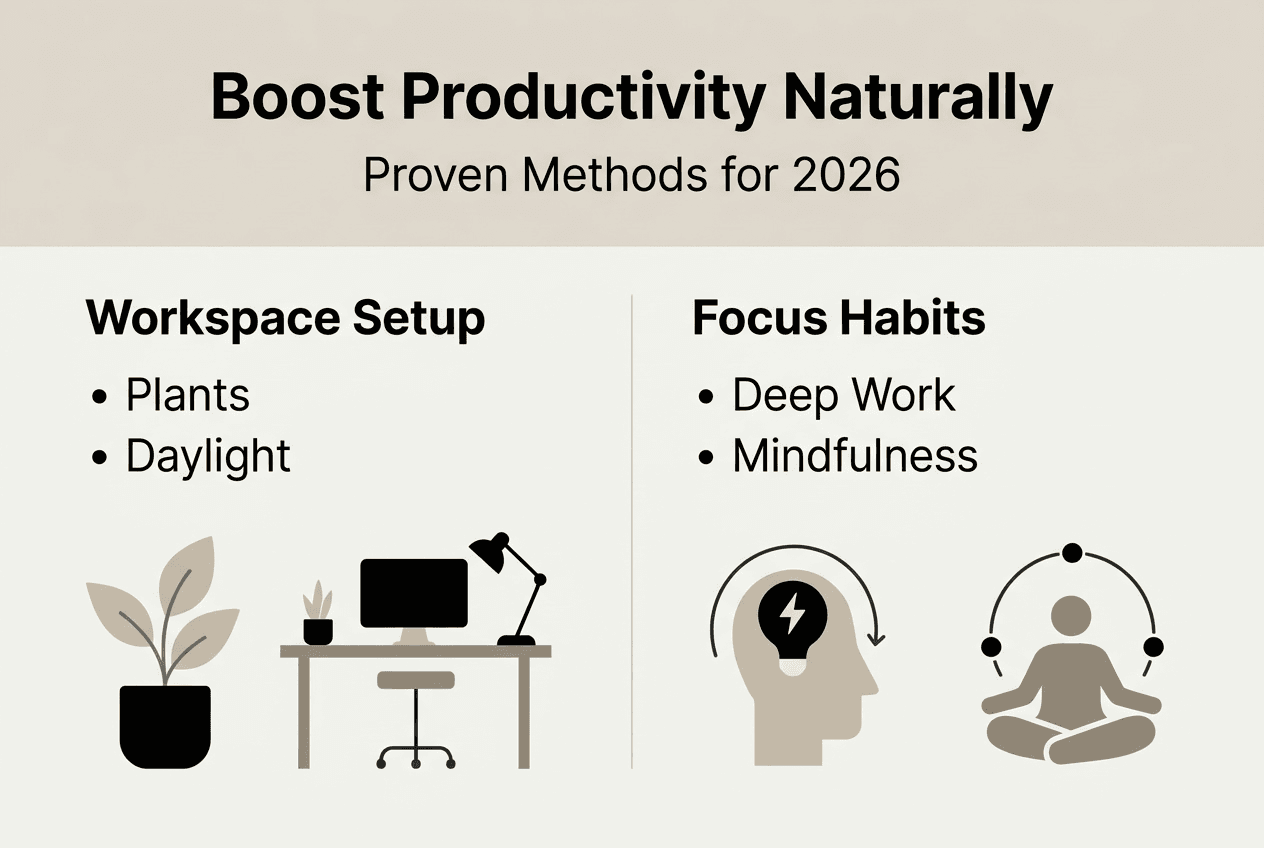
Research confirms planning and prioritization enhance performance across multiple domains. These meta-cognitive skills help you allocate attention to high-impact activities rather than reacting to whatever seems urgent. The following comparison clarifies how each approach contributes uniquely to productivity.
Telecommuting introduces unique mindfulness challenges that office workers rarely face. Home-work interference reduces mindfulness when professional and personal demands blend without clear boundaries. Laundry piles visible during video calls, family members interrupting focused work, and the absence of commute transitions all erode mental separation between roles.
Common telecommuting obstacles and practical solutions:
- Household distractions: Create a dedicated workspace with a door you can close
- Isolation and loneliness: Schedule virtual coffee breaks with colleagues for social connection
- Overworking without clear boundaries: Set firm start and end times with physical rituals
- Difficulty disconnecting: Develop an end-of-day shutdown routine that signals work completion
- Reduced accountability: Use body doubling or virtual coworking sessions for external structure
Pro Tip: Building trait nonreactivity through consistent mindfulness practice helps buffer the stress of home-work interference. This quality allows you to notice distractions without immediately acting on them, creating space for intentional responses rather than automatic reactions.
Sustainable habit formation requires starting smaller than feels necessary. Attempting to implement all these strategies simultaneously often leads to burnout and abandonment. Choose one environmental change, one execution technique, and one measurement practice. Master those before adding complexity. Step-by-step screen time reduction follows this incremental approach for lasting results.
Habit stacking leverages existing routines as triggers for new behaviors. Pair your morning coffee with a brief planning session. Use your lunch break as a cue for a mindfulness walk. Connect your end-of-day shutdown with reviewing tomorrow's priorities. These associations reduce the activation energy required to maintain productive practices.
Boost your productivity naturally with Well O'Clock
Sustaining productivity improvements requires ongoing support and fresh perspectives. Well O'Clock specializes in natural approaches to screen time management and focus enhancement. The platform combines behavioral science with practical tools designed for busy professionals seeking mental clarity without harsh interventions.
Explore tailored strategies for reducing screen time naturally through environmental design and habit formation. Discover additional focus improvement techniques that complement the methods covered here. Join a community of individuals committed to productivity through well-being rather than burnout. Your journey toward sustainable focus and mental clarity continues with resources designed specifically for your challenges.
FAQ
How can mindfulness improve productivity naturally?
Mindfulness enhances cognitive flexibility by training your brain to redirect attention when it wanders. This skill directly improves focus during work sessions by reducing the time lost to mental distractions. Regular practice also lowers stress hormones that impair decision-making and creative thinking. The benefits compound over weeks, making each day's focus work progressively easier.
What is the 2-hour deep work block and why is it effective?
It's a dedicated time period where you eliminate all interruptions to engage in cognitively demanding work. The effectiveness comes from allowing your brain to build momentum without the context-switching costs that fragment typical workdays. Most people accomplish more in one deep work session than in an entire day of interrupted effort. The key is environmental preparation that removes temptation rather than relying on willpower.
How does incorporating natural elements in my workspace boost productivity?
Natural elements like plants, wood, and daylight reduce stress hormones while enhancing mood and creative thinking. These changes create a psychological environment where focus feels easier and more sustainable. Biophilic design also improves air quality and provides visual variety that prevents mental fatigue. The combined effect supports longer periods of concentrated work without the exhaustion typical of sterile environments.
Are digital nudges effective in reducing screen time?
Digital nudges like screen time tracking can improve sleep quality by raising awareness of late-night usage patterns. However, they rarely produce significant reductions in overall screen time because they don't address the environmental factors driving compulsive checking. Lasting change requires engineering your physical space to remove devices from easy reach during focus periods. Combine awareness tools with structural barriers for meaningful results.

Mak Kordić
Co founder
Mak Kordić is the founder and CEO of CNJ Digital, an agency based in Ljubljana, where he and his team develop UX/UI and digital products for demanding B2B projects. Over his career, he has led and co-created hundreds of digital solutions and worked with international clients.








How to boost productivity naturally: proven methods 2026
Mak Kordić
,
March 31, 2026
You open your laptop with a clear plan for the day, yet two hours later you've accomplished little more than scrolling feeds and switching between apps. This cycle drains mental energy and leaves you wondering why focus feels impossible. Natural productivity methods offer a research-backed alternative to harsh interventions, helping you reclaim concentration and mental clarity. These strategies reduce digital distractions while enhancing overall well-being, transforming how you approach work and life.
Table of Contents
- Recognizing The Productivity Challenge: The Impact Of Screen Time And Distraction
- Preparing Your Environment For Success: Natural Elements And Workspace Design
- Executing Focused Work: The 2-Hour Deep Work Block And Mindfulness Practices
- Verifying Progress And Optimizing Habits: Planning, Prioritization, And Overcoming Telecommuting Challenges
- Boost Your Productivity Naturally With Well O'Clock
Recognizing the productivity challenge: the impact of screen time and distraction
Digital devices promise efficiency but often deliver the opposite. Excessive screen exposure creates mental fatigue that persists long after you close your laptop. Poor sleep quality follows late-night scrolling, compounding the next day's productivity challenges. While tracked screen time may improve sleep quality, passive monitoring alone rarely triggers significant usage reductions.
Context switching costs accumulate rapidly when notifications fragment your attention. Each ping forces your brain to abandon its current task, reload context, and restart momentum. This constant mental gear-shifting exhausts cognitive resources faster than sustained focus on a single project. The average professional loses 23 minutes of productive time after each interruption, creating a devastating compounding effect throughout the workday.
Understanding these mechanisms reveals why willpower-based approaches fail. Your brain evolved to notice novel stimuli, making digital notifications nearly impossible to ignore through discipline alone. Recognition of this biological reality shifts the solution from personal strength to environmental design. Implementing screen time reduction strategies addresses the root cause rather than fighting natural impulses.
Common digital distractions that sabotage mental clarity include:
- Social media feeds designed to trigger dopamine responses and extend engagement
- Email notifications that create artificial urgency around non-critical communications
- News alerts that exploit anxiety and curiosity to capture attention
- Messaging apps that blur boundaries between work and personal time
- Browser tabs that enable effortless task-switching and research rabbit holes
- Video platforms that autoplay content to maintain viewing sessions
Each distraction type exploits different psychological vulnerabilities. Social platforms leverage social comparison and fear of missing out. Email creates the illusion that immediate responses demonstrate professionalism. News feeds capitalize on negativity bias and the desire to stay informed. Recognizing these patterns empowers you to design countermeasures that work with your psychology rather than against it.
Preparing your environment for success: natural elements and workspace design
Your physical workspace shapes mental performance more than most people realize. Timber, daylight, and greenery boost creativity while reducing stress hormones that impair cognitive function. These natural elements create psychological benefits that extend far beyond aesthetic appeal. Workers in biophilic environments report higher satisfaction, lower anxiety, and improved problem-solving capacity compared to sterile office settings.
Divergent thinking, the cognitive process underlying creative breakthroughs, flourishes in natural settings. Research shows nature boosts creativity more than even well-designed indoor biophilic spaces. This finding suggests that periodic outdoor breaks deliver cognitive benefits that indoor plants alone cannot replicate. The combination of natural light, organic shapes, and living systems creates synergistic effects on brain function.
Cost-effective workspace adaptations bring these benefits within reach:
- Position your desk near windows to maximize natural light exposure throughout the day
- Add low-maintenance plants like pothos or snake plants that thrive in office conditions
- Replace harsh fluorescent bulbs with full-spectrum lighting that mimics daylight
- Incorporate wood elements through desk accessories, shelving, or decorative items
- Use nature photography or artwork depicting outdoor scenes as visual anchors
- Create a small indoor garden with herbs that provide sensory variety
Aesthetic coherence matters because visual chaos consumes cognitive resources. A cluttered desk with mismatched items creates low-level stress that accumulates throughout the workday. Streamlined spaces with intentional natural elements free mental bandwidth for actual work. This principle applies equally to digital environments where browser bookmarks, desktop icons, and notification badges create virtual clutter.
Pro Tip: Start with one high-impact change rather than overwhelming yourself with a complete workspace overhaul. Adding a single thriving plant near your monitor creates an immediate visual anchor while testing your commitment to maintenance before expanding your indoor garden.
The temperature, air quality, and acoustic environment also influence productivity. Natural ventilation when possible, background sounds of nature, and comfortable thermal conditions all contribute to sustained focus. These factors work together to create an environment that supports focus improvement methods rather than fighting against them.
Executing focused work: the 2-hour deep work block and mindfulness practices
The 2-hour deep work block transforms productivity by eliminating the fragmentation that destroys concentration. This structured approach requires deliberate preparation and environmental engineering. Success depends on removing temptation rather than relying on willpower to resist it.
Implementing your first deep work session:
1. Select your most cognitively demanding task that requires uninterrupted thinking
2. Communicate your unavailability to colleagues and family members in advance
3. Silence all notifications and place devices in another room or drawer
4. Set a visible timer for 120 minutes to create psychological commitment
5. Have water and any necessary materials within reach to prevent interruptions
6. Begin work immediately when the timer starts, resisting the urge to check messages
7. Take a substantial break after completion to recharge before the next session
Mindfulness training complements deep work by strengthening the neural circuits that regulate attention. Studies demonstrate mindfulness improves cognitive function while reducing stress markers in measurable ways. These benefits accumulate over time, making each subsequent focus session easier than the last. Regular practice builds trait-level changes that persist beyond formal meditation sessions.
Simple mindfulness exercises to integrate throughout your day:
- Three-minute breathing awareness before starting work to center attention
- Body scan during breaks to release accumulated physical tension
- Mindful walking between tasks to reset mental state
- Single-tasking practice where you notice the urge to multitask without acting on it
- Gratitude reflection at day's end to reinforce positive patterns
" Productivity gains from reduced interruptions compound exponentially because deep work produces higher quality output in less time, creating a virtuous cycle of accomplishment and motivation. "
The synergy between environmental preparation and execution techniques creates results neither approach achieves alone. Your biophilic workspace reduces baseline stress, making it easier to enter flow states. Deep work blocks leverage that calm foundation to produce meaningful progress. Mindfulness practice strengthens your ability to notice when attention drifts and gently redirect it.
Pro Tip: Engineering environments for focus proves more effective than willpower-based strategies because it removes the need for constant decision-making. Automate your focus setup so entering deep work mode requires minimal effort.
Combining these methods with screen time reduction naturally creates sustainable habits rather than temporary improvements. The goal is building systems that make focused work the path of least resistance. Physical barriers like placing your phone in another room work better than app blockers you can easily disable. Mindful tech habits emerge from repeated practice in supportive environments.
Verifying progress and optimizing habits: planning, prioritization, and overcoming telecommuting challenges
Measuring productivity improvements requires more than counting completed tasks. Track subjective metrics like mental clarity at day's end, ease of entering focus states, and satisfaction with work quality. Quantitative measures such as deep work hours per week and screen time reductions provide objective data. Combining both perspectives reveals whether your methods create genuine improvements or just busy work.
Simple reflection questions to assess progress:
- Did I accomplish my most important task before checking email today?
- How many times did I successfully resist the urge to check my phone during deep work?
- What environmental factors helped or hindered my focus today?
- Which mindfulness practices felt most effective at managing stress?
- Am I sleeping better since implementing these changes?
Research confirms planning and prioritization enhance performance across multiple domains. These meta-cognitive skills help you allocate attention to high-impact activities rather than reacting to whatever seems urgent. The following comparison clarifies how each approach contributes uniquely to productivity.
Telecommuting introduces unique mindfulness challenges that office workers rarely face. Home-work interference reduces mindfulness when professional and personal demands blend without clear boundaries. Laundry piles visible during video calls, family members interrupting focused work, and the absence of commute transitions all erode mental separation between roles.
Common telecommuting obstacles and practical solutions:
- Household distractions: Create a dedicated workspace with a door you can close
- Isolation and loneliness: Schedule virtual coffee breaks with colleagues for social connection
- Overworking without clear boundaries: Set firm start and end times with physical rituals
- Difficulty disconnecting: Develop an end-of-day shutdown routine that signals work completion
- Reduced accountability: Use body doubling or virtual coworking sessions for external structure
Pro Tip: Building trait nonreactivity through consistent mindfulness practice helps buffer the stress of home-work interference. This quality allows you to notice distractions without immediately acting on them, creating space for intentional responses rather than automatic reactions.
Sustainable habit formation requires starting smaller than feels necessary. Attempting to implement all these strategies simultaneously often leads to burnout and abandonment. Choose one environmental change, one execution technique, and one measurement practice. Master those before adding complexity. Step-by-step screen time reduction follows this incremental approach for lasting results.
Habit stacking leverages existing routines as triggers for new behaviors. Pair your morning coffee with a brief planning session. Use your lunch break as a cue for a mindfulness walk. Connect your end-of-day shutdown with reviewing tomorrow's priorities. These associations reduce the activation energy required to maintain productive practices.
Boost your productivity naturally with Well O'Clock
Sustaining productivity improvements requires ongoing support and fresh perspectives. Well O'Clock specializes in natural approaches to screen time management and focus enhancement. The platform combines behavioral science with practical tools designed for busy professionals seeking mental clarity without harsh interventions.
Explore tailored strategies for reducing screen time naturally through environmental design and habit formation. Discover additional focus improvement techniques that complement the methods covered here. Join a community of individuals committed to productivity through well-being rather than burnout. Your journey toward sustainable focus and mental clarity continues with resources designed specifically for your challenges.
FAQ
How can mindfulness improve productivity naturally?
Mindfulness enhances cognitive flexibility by training your brain to redirect attention when it wanders. This skill directly improves focus during work sessions by reducing the time lost to mental distractions. Regular practice also lowers stress hormones that impair decision-making and creative thinking. The benefits compound over weeks, making each day's focus work progressively easier.
What is the 2-hour deep work block and why is it effective?
It's a dedicated time period where you eliminate all interruptions to engage in cognitively demanding work. The effectiveness comes from allowing your brain to build momentum without the context-switching costs that fragment typical workdays. Most people accomplish more in one deep work session than in an entire day of interrupted effort. The key is environmental preparation that removes temptation rather than relying on willpower.
How does incorporating natural elements in my workspace boost productivity?
Natural elements like plants, wood, and daylight reduce stress hormones while enhancing mood and creative thinking. These changes create a psychological environment where focus feels easier and more sustainable. Biophilic design also improves air quality and provides visual variety that prevents mental fatigue. The combined effect supports longer periods of concentrated work without the exhaustion typical of sterile environments.
Are digital nudges effective in reducing screen time?
Digital nudges like screen time tracking can improve sleep quality by raising awareness of late-night usage patterns. However, they rarely produce significant reductions in overall screen time because they don't address the environmental factors driving compulsive checking. Lasting change requires engineering your physical space to remove devices from easy reach during focus periods. Combine awareness tools with structural barriers for meaningful results.
Mak Kordić
Co founder
Mak Kordić is the founder and CEO of CNJ Digital, an agency based in Ljubljana, where he and his team develop UX/UI and digital products for demanding B2B projects. Over his career, he has led and co-created hundreds of digital solutions and worked with international clients.
How to boost productivity naturally: proven methods 2026
Mak Kordić
,
March 31, 2026
You open your laptop with a clear plan for the day, yet two hours later you've accomplished little more than scrolling feeds and switching between apps. This cycle drains mental energy and leaves you wondering why focus feels impossible. Natural productivity methods offer a research-backed alternative to harsh interventions, helping you reclaim concentration and mental clarity. These strategies reduce digital distractions while enhancing overall well-being, transforming how you approach work and life.
Table of Contents
- Recognizing The Productivity Challenge: The Impact Of Screen Time And Distraction
- Preparing Your Environment For Success: Natural Elements And Workspace Design
- Executing Focused Work: The 2-Hour Deep Work Block And Mindfulness Practices
- Verifying Progress And Optimizing Habits: Planning, Prioritization, And Overcoming Telecommuting Challenges
- Boost Your Productivity Naturally With Well O'Clock
Recognizing the productivity challenge: the impact of screen time and distraction
Digital devices promise efficiency but often deliver the opposite. Excessive screen exposure creates mental fatigue that persists long after you close your laptop. Poor sleep quality follows late-night scrolling, compounding the next day's productivity challenges. While tracked screen time may improve sleep quality, passive monitoring alone rarely triggers significant usage reductions.
Context switching costs accumulate rapidly when notifications fragment your attention. Each ping forces your brain to abandon its current task, reload context, and restart momentum. This constant mental gear-shifting exhausts cognitive resources faster than sustained focus on a single project. The average professional loses 23 minutes of productive time after each interruption, creating a devastating compounding effect throughout the workday.
Understanding these mechanisms reveals why willpower-based approaches fail. Your brain evolved to notice novel stimuli, making digital notifications nearly impossible to ignore through discipline alone. Recognition of this biological reality shifts the solution from personal strength to environmental design. Implementing screen time reduction strategies addresses the root cause rather than fighting natural impulses.
Common digital distractions that sabotage mental clarity include:
- Social media feeds designed to trigger dopamine responses and extend engagement
- Email notifications that create artificial urgency around non-critical communications
- News alerts that exploit anxiety and curiosity to capture attention
- Messaging apps that blur boundaries between work and personal time
- Browser tabs that enable effortless task-switching and research rabbit holes
- Video platforms that autoplay content to maintain viewing sessions
Each distraction type exploits different psychological vulnerabilities. Social platforms leverage social comparison and fear of missing out. Email creates the illusion that immediate responses demonstrate professionalism. News feeds capitalize on negativity bias and the desire to stay informed. Recognizing these patterns empowers you to design countermeasures that work with your psychology rather than against it.
Preparing your environment for success: natural elements and workspace design
Your physical workspace shapes mental performance more than most people realize. Timber, daylight, and greenery boost creativity while reducing stress hormones that impair cognitive function. These natural elements create psychological benefits that extend far beyond aesthetic appeal. Workers in biophilic environments report higher satisfaction, lower anxiety, and improved problem-solving capacity compared to sterile office settings.
Divergent thinking, the cognitive process underlying creative breakthroughs, flourishes in natural settings. Research shows nature boosts creativity more than even well-designed indoor biophilic spaces. This finding suggests that periodic outdoor breaks deliver cognitive benefits that indoor plants alone cannot replicate. The combination of natural light, organic shapes, and living systems creates synergistic effects on brain function.
Cost-effective workspace adaptations bring these benefits within reach:
- Position your desk near windows to maximize natural light exposure throughout the day
- Add low-maintenance plants like pothos or snake plants that thrive in office conditions
- Replace harsh fluorescent bulbs with full-spectrum lighting that mimics daylight
- Incorporate wood elements through desk accessories, shelving, or decorative items
- Use nature photography or artwork depicting outdoor scenes as visual anchors
- Create a small indoor garden with herbs that provide sensory variety
Aesthetic coherence matters because visual chaos consumes cognitive resources. A cluttered desk with mismatched items creates low-level stress that accumulates throughout the workday. Streamlined spaces with intentional natural elements free mental bandwidth for actual work. This principle applies equally to digital environments where browser bookmarks, desktop icons, and notification badges create virtual clutter.
Pro Tip: Start with one high-impact change rather than overwhelming yourself with a complete workspace overhaul. Adding a single thriving plant near your monitor creates an immediate visual anchor while testing your commitment to maintenance before expanding your indoor garden.
The temperature, air quality, and acoustic environment also influence productivity. Natural ventilation when possible, background sounds of nature, and comfortable thermal conditions all contribute to sustained focus. These factors work together to create an environment that supports focus improvement methods rather than fighting against them.
Executing focused work: the 2-hour deep work block and mindfulness practices
The 2-hour deep work block transforms productivity by eliminating the fragmentation that destroys concentration. This structured approach requires deliberate preparation and environmental engineering. Success depends on removing temptation rather than relying on willpower to resist it.
Implementing your first deep work session:
1. Select your most cognitively demanding task that requires uninterrupted thinking
2. Communicate your unavailability to colleagues and family members in advance
3. Silence all notifications and place devices in another room or drawer
4. Set a visible timer for 120 minutes to create psychological commitment
5. Have water and any necessary materials within reach to prevent interruptions
6. Begin work immediately when the timer starts, resisting the urge to check messages
7. Take a substantial break after completion to recharge before the next session
Mindfulness training complements deep work by strengthening the neural circuits that regulate attention. Studies demonstrate mindfulness improves cognitive function while reducing stress markers in measurable ways. These benefits accumulate over time, making each subsequent focus session easier than the last. Regular practice builds trait-level changes that persist beyond formal meditation sessions.
Simple mindfulness exercises to integrate throughout your day:
- Three-minute breathing awareness before starting work to center attention
- Body scan during breaks to release accumulated physical tension
- Mindful walking between tasks to reset mental state
- Single-tasking practice where you notice the urge to multitask without acting on it
- Gratitude reflection at day's end to reinforce positive patterns
" Productivity gains from reduced interruptions compound exponentially because deep work produces higher quality output in less time, creating a virtuous cycle of accomplishment and motivation. "
The synergy between environmental preparation and execution techniques creates results neither approach achieves alone. Your biophilic workspace reduces baseline stress, making it easier to enter flow states. Deep work blocks leverage that calm foundation to produce meaningful progress. Mindfulness practice strengthens your ability to notice when attention drifts and gently redirect it.
Pro Tip: Engineering environments for focus proves more effective than willpower-based strategies because it removes the need for constant decision-making. Automate your focus setup so entering deep work mode requires minimal effort.
Combining these methods with screen time reduction naturally creates sustainable habits rather than temporary improvements. The goal is building systems that make focused work the path of least resistance. Physical barriers like placing your phone in another room work better than app blockers you can easily disable. Mindful tech habits emerge from repeated practice in supportive environments.
Verifying progress and optimizing habits: planning, prioritization, and overcoming telecommuting challenges
Measuring productivity improvements requires more than counting completed tasks. Track subjective metrics like mental clarity at day's end, ease of entering focus states, and satisfaction with work quality. Quantitative measures such as deep work hours per week and screen time reductions provide objective data. Combining both perspectives reveals whether your methods create genuine improvements or just busy work.
Simple reflection questions to assess progress:
- Did I accomplish my most important task before checking email today?
- How many times did I successfully resist the urge to check my phone during deep work?
- What environmental factors helped or hindered my focus today?
- Which mindfulness practices felt most effective at managing stress?
- Am I sleeping better since implementing these changes?
Research confirms planning and prioritization enhance performance across multiple domains. These meta-cognitive skills help you allocate attention to high-impact activities rather than reacting to whatever seems urgent. The following comparison clarifies how each approach contributes uniquely to productivity.
Telecommuting introduces unique mindfulness challenges that office workers rarely face. Home-work interference reduces mindfulness when professional and personal demands blend without clear boundaries. Laundry piles visible during video calls, family members interrupting focused work, and the absence of commute transitions all erode mental separation between roles.
Common telecommuting obstacles and practical solutions:
- Household distractions: Create a dedicated workspace with a door you can close
- Isolation and loneliness: Schedule virtual coffee breaks with colleagues for social connection
- Overworking without clear boundaries: Set firm start and end times with physical rituals
- Difficulty disconnecting: Develop an end-of-day shutdown routine that signals work completion
- Reduced accountability: Use body doubling or virtual coworking sessions for external structure
Pro Tip: Building trait nonreactivity through consistent mindfulness practice helps buffer the stress of home-work interference. This quality allows you to notice distractions without immediately acting on them, creating space for intentional responses rather than automatic reactions.
Sustainable habit formation requires starting smaller than feels necessary. Attempting to implement all these strategies simultaneously often leads to burnout and abandonment. Choose one environmental change, one execution technique, and one measurement practice. Master those before adding complexity. Step-by-step screen time reduction follows this incremental approach for lasting results.
Habit stacking leverages existing routines as triggers for new behaviors. Pair your morning coffee with a brief planning session. Use your lunch break as a cue for a mindfulness walk. Connect your end-of-day shutdown with reviewing tomorrow's priorities. These associations reduce the activation energy required to maintain productive practices.
Boost your productivity naturally with Well O'Clock
Sustaining productivity improvements requires ongoing support and fresh perspectives. Well O'Clock specializes in natural approaches to screen time management and focus enhancement. The platform combines behavioral science with practical tools designed for busy professionals seeking mental clarity without harsh interventions.
Explore tailored strategies for reducing screen time naturally through environmental design and habit formation. Discover additional focus improvement techniques that complement the methods covered here. Join a community of individuals committed to productivity through well-being rather than burnout. Your journey toward sustainable focus and mental clarity continues with resources designed specifically for your challenges.
FAQ
How can mindfulness improve productivity naturally?
Mindfulness enhances cognitive flexibility by training your brain to redirect attention when it wanders. This skill directly improves focus during work sessions by reducing the time lost to mental distractions. Regular practice also lowers stress hormones that impair decision-making and creative thinking. The benefits compound over weeks, making each day's focus work progressively easier.
What is the 2-hour deep work block and why is it effective?
It's a dedicated time period where you eliminate all interruptions to engage in cognitively demanding work. The effectiveness comes from allowing your brain to build momentum without the context-switching costs that fragment typical workdays. Most people accomplish more in one deep work session than in an entire day of interrupted effort. The key is environmental preparation that removes temptation rather than relying on willpower.
How does incorporating natural elements in my workspace boost productivity?
Natural elements like plants, wood, and daylight reduce stress hormones while enhancing mood and creative thinking. These changes create a psychological environment where focus feels easier and more sustainable. Biophilic design also improves air quality and provides visual variety that prevents mental fatigue. The combined effect supports longer periods of concentrated work without the exhaustion typical of sterile environments.
Are digital nudges effective in reducing screen time?
Digital nudges like screen time tracking can improve sleep quality by raising awareness of late-night usage patterns. However, they rarely produce significant reductions in overall screen time because they don't address the environmental factors driving compulsive checking. Lasting change requires engineering your physical space to remove devices from easy reach during focus periods. Combine awareness tools with structural barriers for meaningful results.
Mak Kordić
Co founder
Mak Kordić is the founder and CEO of CNJ Digital, an agency based in Ljubljana, where he and his team develop UX/UI and digital products for demanding B2B projects. Over his career, he has led and co-created hundreds of digital solutions and worked with international clients.