
Why limit phone use to boost mental health in 2026
Mak Kordić
,
March 19, 2026


Spending over three hours daily on your phone can increase anxiety by 30%. This statistic highlights the urgent need to address our relationship with mobile devices. This article explains why limiting phone use matters for mental wellness and productivity, offering evidence-based strategies to regain control. You'll discover how excessive phone use impacts your brain, sleep, and relationships, plus practical methods to break free from digital dependency.
Table of Contents
- Understanding The Need To Limit Phone Use
- How Excessive Phone Use Affects Mental Health And Anxiety
- The Impact Of Phone Use On Sleep And Productivity
- Common Misconceptions About Phone Use And Productivity
- Comparison Of Limiting Strategies: Digital Versus Physical Methods
- Practical Strategies To Limit Phone Use For Mental Wellness And Productivity
- Social And Relational Impacts Of Phone Dependency
- Discover Tools To Manage Your Phone Use Effectively
Understanding the need to limit phone use
Smartphone use has grown globally, becoming deeply integrated into daily life across all age groups. Global smartphone dependency affects mental health and well-being broadly, creating widespread concern among health professionals. High smartphone dependency contributes to anxiety, disrupted sleep, productivity loss, and social strain in measurable ways.
Common problems include:
- Mental health decline through constant social comparison and information overload
- Impaired focus from frequent task switching and notification interruptions
- Poor sleep quality caused by blue light exposure and cognitive stimulation
- Relationship difficulties due to reduced face-to-face interaction quality
Recognizing these issues is the first step to intentional phone use reduction. Understanding the scope of excessive phone usage effects empowers you to take meaningful action. The challenge isn't eliminating phone use entirely but establishing healthy boundaries that protect your mental wellness.
How excessive phone use affects mental health and anxiety
Heavy phone use triggers cognitive overload, increasing stress and anxiety levels throughout the day. Your brain processes vast amounts of information from notifications, messages, and social feeds, exhausting mental resources. High phone use correlates with increased anxiety due to cognitive overload and constant social media exposure.

Social media amplifies negative emotional experiences through comparison and curated content. Seeing others' highlight reels triggers feelings of inadequacy and missing out. Dopamine-driven notifications reinforce compulsive checking behaviors, creating a cycle that worsens mental health over time.
Key psychological pathways include:
- Reward anticipation from notifications activating dopamine release
- Fear of missing out driving compulsive checking patterns
- Negative social comparison reducing self-esteem
- Interrupted attention causing chronic stress responses
" The constant ping of notifications hijacks your brain's reward system, making it nearly impossible to resist checking your phone even when you know you shouldn't. "
Mental health improvements begin as usage is consciously limited through structured interventions. Understanding the effects of excessive phone use on your emotional state helps motivate sustainable behavior change. Your anxiety levels can decrease significantly within weeks of implementing phone use boundaries.
The impact of phone use on sleep and productivity
Blue light from phones delays circadian rhythm and suppresses melatonin production, making it harder to fall asleep naturally. Limiting phone use before bedtime improves sleep efficiency by 25% by reducing both blue light and cognitive stimulation. Cognitive stimulation from bedtime phone use hampers sleep initiation, keeping your mind alert when it should be winding down.
Mobile Phones and Your Health Effects on Brain, Sleep
Frequent task switching on phones reduces sustained attention and lowers productivity by up to 40%. Each time you check your phone during work, it takes several minutes to regain full focus on the original task. This constant fragmentation prevents deep work and meaningful progress on important projects.
Structured phone limits can improve both sleep quality and work output through consistent boundaries. Creating phone-free zones during critical work periods protects your cognitive resources. Better sleep translates directly into sharper thinking and emotional regulation the next day.
Pro Tip: Schedule phone-free periods 60 minutes before sleep to enhance rest and next-day focus. This simple boundary allows your brain to naturally prepare for quality sleep while improving morning productivity.
Common misconceptions about phone use and productivity
Multitasking with phones reduces efficiency by causing frequent task-switching costs that fragment attention. Your brain cannot truly multitask but instead rapidly switches between activities, losing time and accuracy with each transition. Many users inaccurately perceive and underestimate their phone use by 40%, reducing motivation to change habits.
Digital notification controls alone are insufficient for sustained usage control because they lack tangible prompts. You can easily override app timers or ignore warnings when the urge to check strikes. Effective phone use reduction requires awareness and combined strategies beyond technology defaults.
Widespread myths include:
- Believing you can effectively work while checking social media periodically
- Trusting your perception of how much time you spend on your phone
- Assuming notification settings provide adequate usage control
- Thinking willpower alone can overcome designed addictive features
" Your phone was engineered by teams of psychologists and designers to be as engaging as possible. Relying solely on willpower to limit use is like trying to diet in a candy store. "
Understanding phone addiction impacts helps you recognize when unconscious habits control your behavior. The disconnect between perceived and actual phone use undermines self-control efforts until confronted with objective data. Breaking free requires honest assessment combined with proven intervention strategies.
Comparison of limiting strategies: digital versus physical methods
Digital-only app limits are easy to access but offer limited effectiveness, achieving approximately 12% reduction in phone use. These software solutions face inherent weaknesses because they exist within the same device you're trying to avoid. Physical cues achieve 30% higher adherence rates than digital-only limits for reducing phone use.
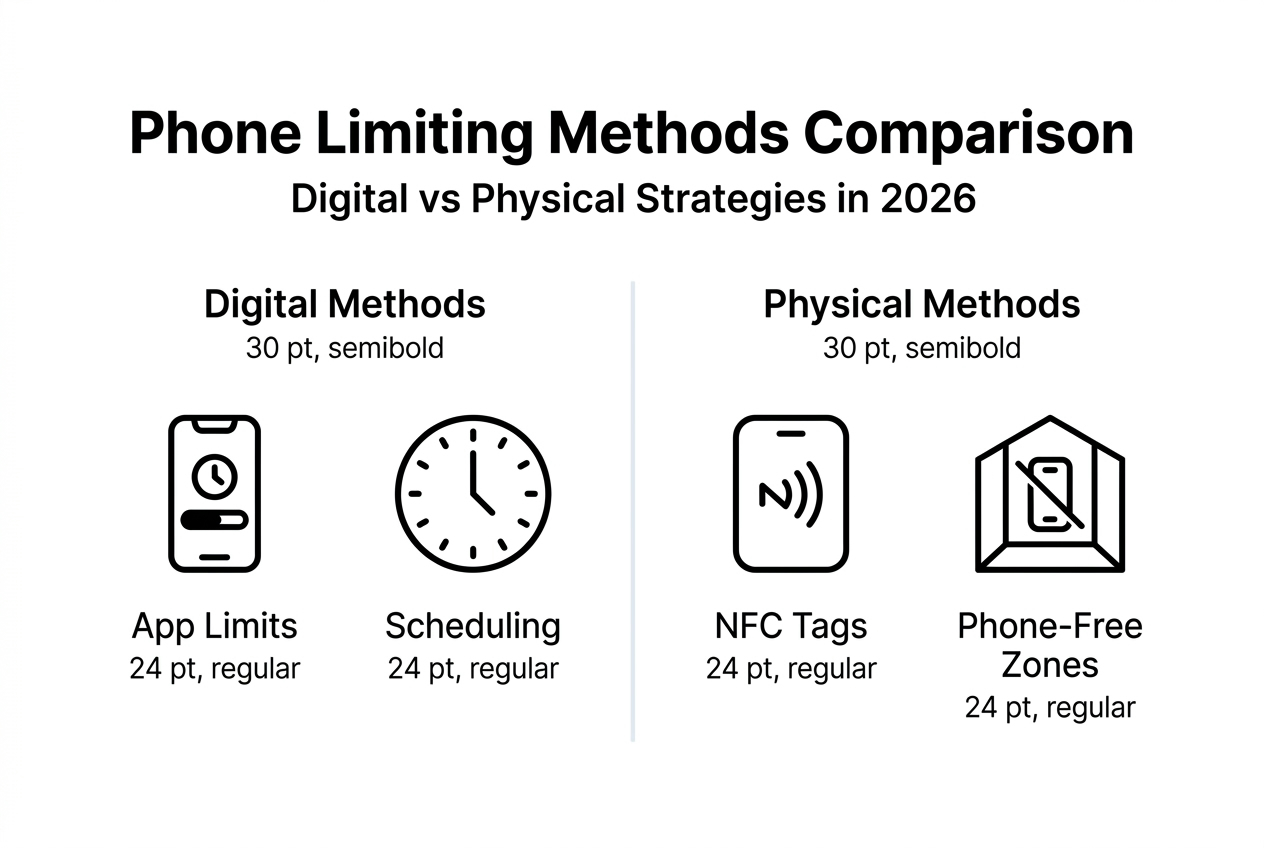
Physical interventions like NFC tags provide tangible cues that break automatic phone checking habits through embodied cognition. When you must physically interact with an object to unlock your phone, it creates a moment of awareness that interrupts autopilot behavior. Hybrid approaches combining digital and physical methods achieve the highest adherence, reducing usage by 30 to 35%.
Behavioral science explains that embodied cognition strengthens habit disruption through physical action requirements. Your brain processes physical barriers differently than digital ones, creating stronger pause moments. The physical phone blockers advantages include forcing deliberate choice rather than automatic behavior.
Pro Tip: Use physical cues alongside app limits to maximize success in reducing phone use. Start with one physical tag in your workspace and gradually expand to other locations as the habit strengthens.
Practical strategies to limit phone use for mental wellness and productivity
Implementing effective phone boundaries requires systematic steps that address both awareness and intervention. Follow these strategies to build lasting change:
1. Recognize and measure your actual phone use with tracking tools to counter underestimation and establish baseline data.
2. Understand how phone design exploits addictive dopamine loops through infinite scrolling and variable rewards to motivate change.
3. Implement physical cues such as NFC tags to physically interrupt habitual checking and create awareness moments.
4. Set scheduled phone limits to reduce anxiety and improve focus during critical work or family time.
5. Combine digital limits with physical methods for best adherence and mental wellness benefits that compound over time.
6. Maintain consistency over weeks for sustainable improvement, tracking progress to reinforce positive changes.
Start with the easiest intervention first to build confidence and momentum. Reducing screen time naturally becomes easier as you experience the benefits firsthand. Focus on replacing phone time with meaningful activities rather than simply creating voids.
Create specific implementation intentions like "When I arrive home, I will place my phone on the NFC tag until dinner." This concrete planning dramatically increases follow-through compared to vague goals. The mindful phone use guide offers additional family-focused strategies for creating healthy boundaries together.
Social and relational impacts of phone dependency
Excessive phone use leads to fewer meaningful face-to-face interactions, even when physically present with others. Heavy phone use correlates with 25% less perceived social support and higher loneliness among users. Users report feeling more isolated despite constant digital connection, highlighting the paradox of social media.
Reducing phone dependency enhances emotional well-being and relationship quality through present engagement. When you put your phone away during conversations, you signal value and respect to others. Intentional phone use promotes deeper, more satisfying connections that fulfill genuine social needs.
Key relational improvements include:
- Increased eye contact and nonverbal communication during interactions
- Better emotional attunement to family members and friends
- Reduced conflict over phone use during shared time
- Stronger feelings of connection and belonging
" The irony of smartphone dependency is that the more connected we are digitally, the more isolated we feel emotionally. Real relationships require undivided attention. "
Phone reduction helps restore social bonds and reduces loneliness through quality interaction. Mindful phone use for families creates shared experiences that strengthen relationships across generations. Your presence becomes the greatest gift you can offer to loved ones when phones no longer compete for attention.
Discover tools to manage your phone use effectively
After learning why phone limits matter and comparing strategies, you're ready to take action with practical solutions. Well O'Clock offers innovative NFC-based tools that help break automatic phone checking habits through physical intervention.
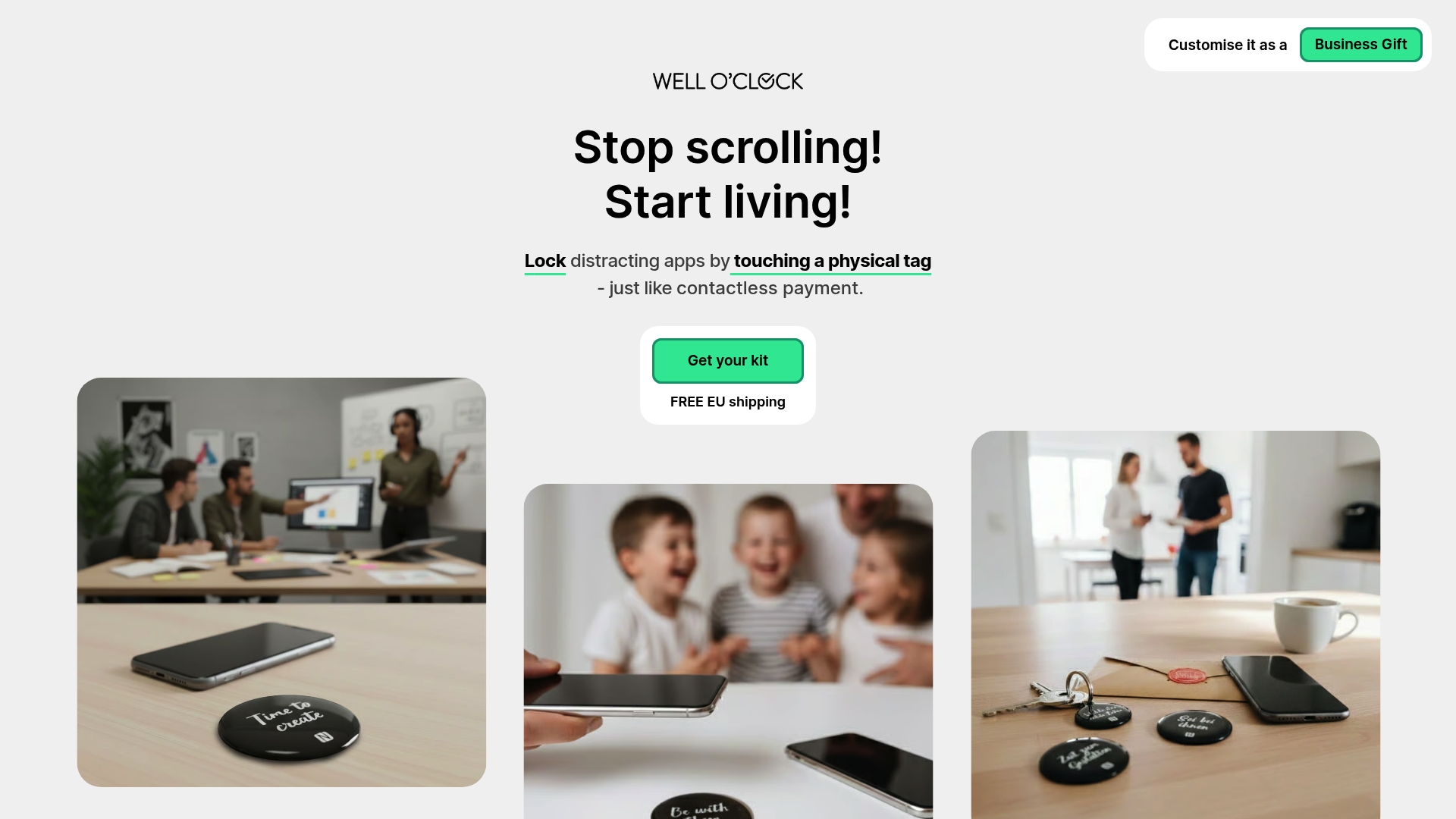
Combine physical interventions with scheduling features for best results in reducing usage by 30% or more. These tools are designed specifically to reduce screen time, anxiety, and boost productivity through tangible habit interruption. Visit the Well O'Clock homepage to explore products and start regaining control over your phone use today. The system works by creating physical barriers that force mindful decisions rather than autopilot scrolling.
FAQ
What are effective ways to reduce phone-induced anxiety?
Scheduled phone limits combined with physical cues like NFC tags effectively reduce anxiety from phone overuse. These interventions create structured boundaries that prevent cognitive overload and constant stimulation. Balanced phone use combined with mindfulness practices improves mental health within weeks.
How does phone use before bed affect sleep quality?
Phone use before bed disrupts melatonin production and delays sleep onset by exposing you to stimulating blue light. Reducing phone use 1 hour before sleep improves sleep efficiency by 25%, allowing natural circadian rhythms to function properly. Limiting screen time before bed improves overall sleep quality significantly.
Why do digital-only phone limits often fail?
Digital app limits lack tangible prompts, reducing user adherence because they're easily overridden within the same device. Physical cues produce 30% higher adherence than digital limits alone by creating embodied awareness moments. Hybrid physical and digital interventions offer superior effectiveness for sustained behavior change.
How can I accurately track my phone usage to set limits?
Use built-in phone tracking features or third-party apps to measure real usage and confront self-deception. Users under-report screen time by about 40% compared to actual data, making objective tracking essential. Review daily reports to set realistic limits and monitor progress as you reduce screen time naturally.
Can limiting phone use actually improve productivity at work?
Yes, limiting phone use dramatically improves productivity by reducing task-switching costs that fragment attention. Workers who implement phone boundaries complete tasks 40% faster with fewer errors. Protecting focus time from phone interruptions allows deep work and meaningful progress on complex projects.

Mak Kordić
Co founder
Mak Kordić is the founder and CEO of CNJ Digital, an agency based in Ljubljana, where he and his team develop UX/UI and digital products for demanding B2B projects. Over his career, he has led and co-created hundreds of digital solutions and worked with international clients.








Why limit phone use to boost mental health in 2026
Mak Kordić
,
March 19, 2026
Spending over three hours daily on your phone can increase anxiety by 30%. This statistic highlights the urgent need to address our relationship with mobile devices. This article explains why limiting phone use matters for mental wellness and productivity, offering evidence-based strategies to regain control. You'll discover how excessive phone use impacts your brain, sleep, and relationships, plus practical methods to break free from digital dependency.
Table of Contents
- Understanding The Need To Limit Phone Use
- How Excessive Phone Use Affects Mental Health And Anxiety
- The Impact Of Phone Use On Sleep And Productivity
- Common Misconceptions About Phone Use And Productivity
- Comparison Of Limiting Strategies: Digital Versus Physical Methods
- Practical Strategies To Limit Phone Use For Mental Wellness And Productivity
- Social And Relational Impacts Of Phone Dependency
- Discover Tools To Manage Your Phone Use Effectively
Understanding the need to limit phone use
Smartphone use has grown globally, becoming deeply integrated into daily life across all age groups. Global smartphone dependency affects mental health and well-being broadly, creating widespread concern among health professionals. High smartphone dependency contributes to anxiety, disrupted sleep, productivity loss, and social strain in measurable ways.
Common problems include:
- Mental health decline through constant social comparison and information overload
- Impaired focus from frequent task switching and notification interruptions
- Poor sleep quality caused by blue light exposure and cognitive stimulation
- Relationship difficulties due to reduced face-to-face interaction quality
Recognizing these issues is the first step to intentional phone use reduction. Understanding the scope of excessive phone usage effects empowers you to take meaningful action. The challenge isn't eliminating phone use entirely but establishing healthy boundaries that protect your mental wellness.
How excessive phone use affects mental health and anxiety
Heavy phone use triggers cognitive overload, increasing stress and anxiety levels throughout the day. Your brain processes vast amounts of information from notifications, messages, and social feeds, exhausting mental resources. High phone use correlates with increased anxiety due to cognitive overload and constant social media exposure.
Social media amplifies negative emotional experiences through comparison and curated content. Seeing others' highlight reels triggers feelings of inadequacy and missing out. Dopamine-driven notifications reinforce compulsive checking behaviors, creating a cycle that worsens mental health over time.
Key psychological pathways include:
- Reward anticipation from notifications activating dopamine release
- Fear of missing out driving compulsive checking patterns
- Negative social comparison reducing self-esteem
- Interrupted attention causing chronic stress responses
" The constant ping of notifications hijacks your brain's reward system, making it nearly impossible to resist checking your phone even when you know you shouldn't. "
Mental health improvements begin as usage is consciously limited through structured interventions. Understanding the effects of excessive phone use on your emotional state helps motivate sustainable behavior change. Your anxiety levels can decrease significantly within weeks of implementing phone use boundaries.
The impact of phone use on sleep and productivity
Blue light from phones delays circadian rhythm and suppresses melatonin production, making it harder to fall asleep naturally. Limiting phone use before bedtime improves sleep efficiency by 25% by reducing both blue light and cognitive stimulation. Cognitive stimulation from bedtime phone use hampers sleep initiation, keeping your mind alert when it should be winding down.
Mobile Phones and Your Health Effects on Brain, Sleep
Frequent task switching on phones reduces sustained attention and lowers productivity by up to 40%. Each time you check your phone during work, it takes several minutes to regain full focus on the original task. This constant fragmentation prevents deep work and meaningful progress on important projects.
Structured phone limits can improve both sleep quality and work output through consistent boundaries. Creating phone-free zones during critical work periods protects your cognitive resources. Better sleep translates directly into sharper thinking and emotional regulation the next day.
Pro Tip: Schedule phone-free periods 60 minutes before sleep to enhance rest and next-day focus. This simple boundary allows your brain to naturally prepare for quality sleep while improving morning productivity.
Common misconceptions about phone use and productivity
Multitasking with phones reduces efficiency by causing frequent task-switching costs that fragment attention. Your brain cannot truly multitask but instead rapidly switches between activities, losing time and accuracy with each transition. Many users inaccurately perceive and underestimate their phone use by 40%, reducing motivation to change habits.
Digital notification controls alone are insufficient for sustained usage control because they lack tangible prompts. You can easily override app timers or ignore warnings when the urge to check strikes. Effective phone use reduction requires awareness and combined strategies beyond technology defaults.
Widespread myths include:
- Believing you can effectively work while checking social media periodically
- Trusting your perception of how much time you spend on your phone
- Assuming notification settings provide adequate usage control
- Thinking willpower alone can overcome designed addictive features
" Your phone was engineered by teams of psychologists and designers to be as engaging as possible. Relying solely on willpower to limit use is like trying to diet in a candy store. "
Understanding phone addiction impacts helps you recognize when unconscious habits control your behavior. The disconnect between perceived and actual phone use undermines self-control efforts until confronted with objective data. Breaking free requires honest assessment combined with proven intervention strategies.
Comparison of limiting strategies: digital versus physical methods
Digital-only app limits are easy to access but offer limited effectiveness, achieving approximately 12% reduction in phone use. These software solutions face inherent weaknesses because they exist within the same device you're trying to avoid. Physical cues achieve 30% higher adherence rates than digital-only limits for reducing phone use.
Physical interventions like NFC tags provide tangible cues that break automatic phone checking habits through embodied cognition. When you must physically interact with an object to unlock your phone, it creates a moment of awareness that interrupts autopilot behavior. Hybrid approaches combining digital and physical methods achieve the highest adherence, reducing usage by 30 to 35%.
Behavioral science explains that embodied cognition strengthens habit disruption through physical action requirements. Your brain processes physical barriers differently than digital ones, creating stronger pause moments. The physical phone blockers advantages include forcing deliberate choice rather than automatic behavior.
Pro Tip: Use physical cues alongside app limits to maximize success in reducing phone use. Start with one physical tag in your workspace and gradually expand to other locations as the habit strengthens.
Practical strategies to limit phone use for mental wellness and productivity
Implementing effective phone boundaries requires systematic steps that address both awareness and intervention. Follow these strategies to build lasting change:
1. Recognize and measure your actual phone use with tracking tools to counter underestimation and establish baseline data.
2. Understand how phone design exploits addictive dopamine loops through infinite scrolling and variable rewards to motivate change.
3. Implement physical cues such as NFC tags to physically interrupt habitual checking and create awareness moments.
4. Set scheduled phone limits to reduce anxiety and improve focus during critical work or family time.
5. Combine digital limits with physical methods for best adherence and mental wellness benefits that compound over time.
6. Maintain consistency over weeks for sustainable improvement, tracking progress to reinforce positive changes.
Start with the easiest intervention first to build confidence and momentum. Reducing screen time naturally becomes easier as you experience the benefits firsthand. Focus on replacing phone time with meaningful activities rather than simply creating voids.
Create specific implementation intentions like "When I arrive home, I will place my phone on the NFC tag until dinner." This concrete planning dramatically increases follow-through compared to vague goals. The mindful phone use guide offers additional family-focused strategies for creating healthy boundaries together.
Social and relational impacts of phone dependency
Excessive phone use leads to fewer meaningful face-to-face interactions, even when physically present with others. Heavy phone use correlates with 25% less perceived social support and higher loneliness among users. Users report feeling more isolated despite constant digital connection, highlighting the paradox of social media.
Reducing phone dependency enhances emotional well-being and relationship quality through present engagement. When you put your phone away during conversations, you signal value and respect to others. Intentional phone use promotes deeper, more satisfying connections that fulfill genuine social needs.
Key relational improvements include:
- Increased eye contact and nonverbal communication during interactions
- Better emotional attunement to family members and friends
- Reduced conflict over phone use during shared time
- Stronger feelings of connection and belonging
" The irony of smartphone dependency is that the more connected we are digitally, the more isolated we feel emotionally. Real relationships require undivided attention. "
Phone reduction helps restore social bonds and reduces loneliness through quality interaction. Mindful phone use for families creates shared experiences that strengthen relationships across generations. Your presence becomes the greatest gift you can offer to loved ones when phones no longer compete for attention.
Discover tools to manage your phone use effectively
After learning why phone limits matter and comparing strategies, you're ready to take action with practical solutions. Well O'Clock offers innovative NFC-based tools that help break automatic phone checking habits through physical intervention.
Combine physical interventions with scheduling features for best results in reducing usage by 30% or more. These tools are designed specifically to reduce screen time, anxiety, and boost productivity through tangible habit interruption. Visit the Well O'Clock homepage to explore products and start regaining control over your phone use today. The system works by creating physical barriers that force mindful decisions rather than autopilot scrolling.
FAQ
What are effective ways to reduce phone-induced anxiety?
Scheduled phone limits combined with physical cues like NFC tags effectively reduce anxiety from phone overuse. These interventions create structured boundaries that prevent cognitive overload and constant stimulation. Balanced phone use combined with mindfulness practices improves mental health within weeks.
How does phone use before bed affect sleep quality?
Phone use before bed disrupts melatonin production and delays sleep onset by exposing you to stimulating blue light. Reducing phone use 1 hour before sleep improves sleep efficiency by 25%, allowing natural circadian rhythms to function properly. Limiting screen time before bed improves overall sleep quality significantly.
Why do digital-only phone limits often fail?
Digital app limits lack tangible prompts, reducing user adherence because they're easily overridden within the same device. Physical cues produce 30% higher adherence than digital limits alone by creating embodied awareness moments. Hybrid physical and digital interventions offer superior effectiveness for sustained behavior change.
How can I accurately track my phone usage to set limits?
Use built-in phone tracking features or third-party apps to measure real usage and confront self-deception. Users under-report screen time by about 40% compared to actual data, making objective tracking essential. Review daily reports to set realistic limits and monitor progress as you reduce screen time naturally.
Can limiting phone use actually improve productivity at work?
Yes, limiting phone use dramatically improves productivity by reducing task-switching costs that fragment attention. Workers who implement phone boundaries complete tasks 40% faster with fewer errors. Protecting focus time from phone interruptions allows deep work and meaningful progress on complex projects.
Mak Kordić
Co founder
Mak Kordić is the founder and CEO of CNJ Digital, an agency based in Ljubljana, where he and his team develop UX/UI and digital products for demanding B2B projects. Over his career, he has led and co-created hundreds of digital solutions and worked with international clients.
Why limit phone use to boost mental health in 2026
Mak Kordić
,
March 19, 2026
Spending over three hours daily on your phone can increase anxiety by 30%. This statistic highlights the urgent need to address our relationship with mobile devices. This article explains why limiting phone use matters for mental wellness and productivity, offering evidence-based strategies to regain control. You'll discover how excessive phone use impacts your brain, sleep, and relationships, plus practical methods to break free from digital dependency.
Table of Contents
- Understanding The Need To Limit Phone Use
- How Excessive Phone Use Affects Mental Health And Anxiety
- The Impact Of Phone Use On Sleep And Productivity
- Common Misconceptions About Phone Use And Productivity
- Comparison Of Limiting Strategies: Digital Versus Physical Methods
- Practical Strategies To Limit Phone Use For Mental Wellness And Productivity
- Social And Relational Impacts Of Phone Dependency
- Discover Tools To Manage Your Phone Use Effectively
Understanding the need to limit phone use
Smartphone use has grown globally, becoming deeply integrated into daily life across all age groups. Global smartphone dependency affects mental health and well-being broadly, creating widespread concern among health professionals. High smartphone dependency contributes to anxiety, disrupted sleep, productivity loss, and social strain in measurable ways.
Common problems include:
- Mental health decline through constant social comparison and information overload
- Impaired focus from frequent task switching and notification interruptions
- Poor sleep quality caused by blue light exposure and cognitive stimulation
- Relationship difficulties due to reduced face-to-face interaction quality
Recognizing these issues is the first step to intentional phone use reduction. Understanding the scope of excessive phone usage effects empowers you to take meaningful action. The challenge isn't eliminating phone use entirely but establishing healthy boundaries that protect your mental wellness.
How excessive phone use affects mental health and anxiety
Heavy phone use triggers cognitive overload, increasing stress and anxiety levels throughout the day. Your brain processes vast amounts of information from notifications, messages, and social feeds, exhausting mental resources. High phone use correlates with increased anxiety due to cognitive overload and constant social media exposure.
Social media amplifies negative emotional experiences through comparison and curated content. Seeing others' highlight reels triggers feelings of inadequacy and missing out. Dopamine-driven notifications reinforce compulsive checking behaviors, creating a cycle that worsens mental health over time.
Key psychological pathways include:
- Reward anticipation from notifications activating dopamine release
- Fear of missing out driving compulsive checking patterns
- Negative social comparison reducing self-esteem
- Interrupted attention causing chronic stress responses
" The constant ping of notifications hijacks your brain's reward system, making it nearly impossible to resist checking your phone even when you know you shouldn't. "
Mental health improvements begin as usage is consciously limited through structured interventions. Understanding the effects of excessive phone use on your emotional state helps motivate sustainable behavior change. Your anxiety levels can decrease significantly within weeks of implementing phone use boundaries.
The impact of phone use on sleep and productivity
Blue light from phones delays circadian rhythm and suppresses melatonin production, making it harder to fall asleep naturally. Limiting phone use before bedtime improves sleep efficiency by 25% by reducing both blue light and cognitive stimulation. Cognitive stimulation from bedtime phone use hampers sleep initiation, keeping your mind alert when it should be winding down.
Mobile Phones and Your Health Effects on Brain, Sleep
Frequent task switching on phones reduces sustained attention and lowers productivity by up to 40%. Each time you check your phone during work, it takes several minutes to regain full focus on the original task. This constant fragmentation prevents deep work and meaningful progress on important projects.
Structured phone limits can improve both sleep quality and work output through consistent boundaries. Creating phone-free zones during critical work periods protects your cognitive resources. Better sleep translates directly into sharper thinking and emotional regulation the next day.
Pro Tip: Schedule phone-free periods 60 minutes before sleep to enhance rest and next-day focus. This simple boundary allows your brain to naturally prepare for quality sleep while improving morning productivity.
Common misconceptions about phone use and productivity
Multitasking with phones reduces efficiency by causing frequent task-switching costs that fragment attention. Your brain cannot truly multitask but instead rapidly switches between activities, losing time and accuracy with each transition. Many users inaccurately perceive and underestimate their phone use by 40%, reducing motivation to change habits.
Digital notification controls alone are insufficient for sustained usage control because they lack tangible prompts. You can easily override app timers or ignore warnings when the urge to check strikes. Effective phone use reduction requires awareness and combined strategies beyond technology defaults.
Widespread myths include:
- Believing you can effectively work while checking social media periodically
- Trusting your perception of how much time you spend on your phone
- Assuming notification settings provide adequate usage control
- Thinking willpower alone can overcome designed addictive features
" Your phone was engineered by teams of psychologists and designers to be as engaging as possible. Relying solely on willpower to limit use is like trying to diet in a candy store. "
Understanding phone addiction impacts helps you recognize when unconscious habits control your behavior. The disconnect between perceived and actual phone use undermines self-control efforts until confronted with objective data. Breaking free requires honest assessment combined with proven intervention strategies.
Comparison of limiting strategies: digital versus physical methods
Digital-only app limits are easy to access but offer limited effectiveness, achieving approximately 12% reduction in phone use. These software solutions face inherent weaknesses because they exist within the same device you're trying to avoid. Physical cues achieve 30% higher adherence rates than digital-only limits for reducing phone use.
Physical interventions like NFC tags provide tangible cues that break automatic phone checking habits through embodied cognition. When you must physically interact with an object to unlock your phone, it creates a moment of awareness that interrupts autopilot behavior. Hybrid approaches combining digital and physical methods achieve the highest adherence, reducing usage by 30 to 35%.
Behavioral science explains that embodied cognition strengthens habit disruption through physical action requirements. Your brain processes physical barriers differently than digital ones, creating stronger pause moments. The physical phone blockers advantages include forcing deliberate choice rather than automatic behavior.
Pro Tip: Use physical cues alongside app limits to maximize success in reducing phone use. Start with one physical tag in your workspace and gradually expand to other locations as the habit strengthens.
Practical strategies to limit phone use for mental wellness and productivity
Implementing effective phone boundaries requires systematic steps that address both awareness and intervention. Follow these strategies to build lasting change:
1. Recognize and measure your actual phone use with tracking tools to counter underestimation and establish baseline data.
2. Understand how phone design exploits addictive dopamine loops through infinite scrolling and variable rewards to motivate change.
3. Implement physical cues such as NFC tags to physically interrupt habitual checking and create awareness moments.
4. Set scheduled phone limits to reduce anxiety and improve focus during critical work or family time.
5. Combine digital limits with physical methods for best adherence and mental wellness benefits that compound over time.
6. Maintain consistency over weeks for sustainable improvement, tracking progress to reinforce positive changes.
Start with the easiest intervention first to build confidence and momentum. Reducing screen time naturally becomes easier as you experience the benefits firsthand. Focus on replacing phone time with meaningful activities rather than simply creating voids.
Create specific implementation intentions like "When I arrive home, I will place my phone on the NFC tag until dinner." This concrete planning dramatically increases follow-through compared to vague goals. The mindful phone use guide offers additional family-focused strategies for creating healthy boundaries together.
Social and relational impacts of phone dependency
Excessive phone use leads to fewer meaningful face-to-face interactions, even when physically present with others. Heavy phone use correlates with 25% less perceived social support and higher loneliness among users. Users report feeling more isolated despite constant digital connection, highlighting the paradox of social media.
Reducing phone dependency enhances emotional well-being and relationship quality through present engagement. When you put your phone away during conversations, you signal value and respect to others. Intentional phone use promotes deeper, more satisfying connections that fulfill genuine social needs.
Key relational improvements include:
- Increased eye contact and nonverbal communication during interactions
- Better emotional attunement to family members and friends
- Reduced conflict over phone use during shared time
- Stronger feelings of connection and belonging
" The irony of smartphone dependency is that the more connected we are digitally, the more isolated we feel emotionally. Real relationships require undivided attention. "
Phone reduction helps restore social bonds and reduces loneliness through quality interaction. Mindful phone use for families creates shared experiences that strengthen relationships across generations. Your presence becomes the greatest gift you can offer to loved ones when phones no longer compete for attention.
Discover tools to manage your phone use effectively
After learning why phone limits matter and comparing strategies, you're ready to take action with practical solutions. Well O'Clock offers innovative NFC-based tools that help break automatic phone checking habits through physical intervention.
Combine physical interventions with scheduling features for best results in reducing usage by 30% or more. These tools are designed specifically to reduce screen time, anxiety, and boost productivity through tangible habit interruption. Visit the Well O'Clock homepage to explore products and start regaining control over your phone use today. The system works by creating physical barriers that force mindful decisions rather than autopilot scrolling.
FAQ
What are effective ways to reduce phone-induced anxiety?
Scheduled phone limits combined with physical cues like NFC tags effectively reduce anxiety from phone overuse. These interventions create structured boundaries that prevent cognitive overload and constant stimulation. Balanced phone use combined with mindfulness practices improves mental health within weeks.
How does phone use before bed affect sleep quality?
Phone use before bed disrupts melatonin production and delays sleep onset by exposing you to stimulating blue light. Reducing phone use 1 hour before sleep improves sleep efficiency by 25%, allowing natural circadian rhythms to function properly. Limiting screen time before bed improves overall sleep quality significantly.
Why do digital-only phone limits often fail?
Digital app limits lack tangible prompts, reducing user adherence because they're easily overridden within the same device. Physical cues produce 30% higher adherence than digital limits alone by creating embodied awareness moments. Hybrid physical and digital interventions offer superior effectiveness for sustained behavior change.
How can I accurately track my phone usage to set limits?
Use built-in phone tracking features or third-party apps to measure real usage and confront self-deception. Users under-report screen time by about 40% compared to actual data, making objective tracking essential. Review daily reports to set realistic limits and monitor progress as you reduce screen time naturally.
Can limiting phone use actually improve productivity at work?
Yes, limiting phone use dramatically improves productivity by reducing task-switching costs that fragment attention. Workers who implement phone boundaries complete tasks 40% faster with fewer errors. Protecting focus time from phone interruptions allows deep work and meaningful progress on complex projects.
Mak Kordić
Co founder
Mak Kordić is the founder and CEO of CNJ Digital, an agency based in Ljubljana, where he and his team develop UX/UI and digital products for demanding B2B projects. Over his career, he has led and co-created hundreds of digital solutions and worked with international clients.