
Best practices for mindful technology use that boost wellness
Mak Kordić
,
May 26, 2026


The average person checks their phone 96 times a day and racks up over 7 hours of screen time, yet a single interruption takes 23 minutes to recover from mentally. That math adds up to a life lived in constant reaction mode, where focus is fragmented and stress quietly builds. The good news is that you do not need to throw your phone in a lake to feel better. This article walks you through a research-backed road map for building healthier digital habits, one practical step at a time.
Table of Contents
- What is mindful technology use?
- Criteria for healthier digital habits
- Top best practices for mindful technology use
- Comparison of popular digital wellness strategies
- How to sustain mindful habits long term
- Physical and mental health rewards of mindful tech use
- Start your mindful tech journey with Well O'Clock
- Frequently asked questions
What is mindful technology use?
Mindful technology use means engaging with your devices on purpose, not on autopilot. It is the difference between opening Instagram because you chose to and opening it because your thumb just did it for you. Understanding why mindful tech habits matter starts with recognizing that the goal is not to quit technology but to make it serve your life rather than consume it.
A useful way to think about this is to split your tech use into two buckets:
- Essential use: Work communication, navigation, health tracking, video calls with family
- Optional use: Endless social scrolling, autoplay video, notification rabbit holes
Essential use tends to have a clear start and end point. Optional use rarely does. Intentional engagement enhances wellbeing precisely because it keeps you in the driver's seat instead of the passenger seat.
" The goal is not to use less technology for its own sake, but to use technology in ways that support your values and goals. "
Once you see your habits through this lens, the path forward becomes much clearer.
Criteria for healthier digital habits
Understanding the concept is one thing. Here is how to build your own healthier tech habits step by step.
Building better digital habits starts with an honest look at where you are right now. Most people dramatically underestimate how much time they spend on their phones. Your device's built-in screen time tracker is the fastest reality check available.
1. Audit your baseline. Check your weekly screen time report and note which apps consume the most time. No judgment, just data.
2. Separate high-value from low-value activities. Learning a skill, creating content, or connecting meaningfully with someone counts as high-value. Passive scrolling rarely does. Passive use lowers well-being more than total time on a device, which means content and context matter more than raw minutes.
3. Prioritize active engagement. Creation, learning, and intentional communication beat passive consumption every time. Shift your ratio gradually.
4. Set realistic goals. Cutting four hours of screen time overnight is a recipe for failure. Aim for 20 to 30 minutes less per day and build from there. Explore natural screen time reduction strategies that fit your lifestyle.
5. Track progress weekly. Use your phone's built-in tools or a dedicated screen time management approach to measure improvement over time.
Pro Tip: Screenshot your weekly screen time report every Sunday. After four weeks, you will have a clear picture of your trend and a powerful motivator to keep going.
Top best practices for mindful technology use
With a personal framework in place, you can now put proven best practices into daily action.
These are not vague suggestions. Each one has measurable impact when applied consistently.
1. Do a digital declutter. Remove or temporarily pause any app you have not used intentionally in the past two weeks. Fewer icons mean fewer temptations.
2. Create tech-free zones. The bedroom and the dinner table are the two highest-impact places to start. Physical space shapes behavior more than willpower does.
3. Batch your notifications. Turn off non-essential alerts and check messages at set times, such as 9 a.m., 1 p.m., and 5 p.m. This alone can reclaim hours of fragmented attention each week.
4. Use the 20-20-20 rule. Every 20 minutes, look at something 20 feet away for 20 seconds. It reduces eye strain and gives your brain a micro-reset.
5. Set an intention before every session. Before you unlock your phone, ask yourself: is this active or passive use? That one-second pause interrupts autopilot behavior.
6. Curate your feeds actively. Unfollow accounts that leave you feeling worse. Follow accounts that teach, inspire, or genuinely connect you with people you care about.
The data backs this up hard. App blockers reduce compulsive checking by 61%,, yet while 80% of people say they set rules for themselves, only 12% actually use built-in limits. That gap is where most people lose the battle. Learning how to minimize device distractions closes that gap with structure instead of willpower.

A 3-week reduction to under 2 hours of daily screen time produced measurable improvements in well-being, depression scores, stress levels, and sleep quality. Three weeks is not a long time to test a life-changing habit. Building smart workflows for healthy phone use makes that three-week window much easier to sustain.
Environment design outperforms willpower for long-term adherence, and group or family accountability makes habits stick even better. That is why tech-free zones score so high on sustainability. They change the environment rather than relying on you to make the right choice every single time. If you have kids at home, check out screen time strategies for families for approaches that work across age groups.
How to sustain mindful habits long term
Knowing which strategies work is just the beginning. Here is how to make mindful tech habits stick for the long haul.
The research is clear: habits rebound without ongoing strategies even after you see real improvements. Sustainability requires a system, not just motivation.
- Use physical reminders. A book on your nightstand, a journal on your desk, or a sticky note on your phone charger all serve as cues to choose offline activities.
- Find an accountability partner. Share your weekly screen time numbers with a friend or partner. Social commitment dramatically increases follow-through.
- Rotate offline alternatives. If your go-to break is always the same walk or the same book, it gets stale. Keep a short list of five to ten offline activities you genuinely enjoy.
- Treat slip-ups as data. A bad week does not erase your progress. Ask what triggered the relapse and adjust your environment accordingly.
Built-in tools like Screen Time and Digital Wellbeing, combined with gradual reduction goals and replacement activities like exercise, reading, or hobbies, form the most effective long-term system. Understanding why breaking screen addiction matters for mental clarity can also keep you motivated when the novelty of a new habit wears off.
Pro Tip: Set a monthly "digital review" on your calendar. Spend 10 minutes looking at your screen time trends, celebrating wins, and adjusting one habit that is not working.
" Small, consistent improvements compound over time. You do not need a perfect week. You need a slightly better one. "
For a deeper look at how reduced screen time connects to output, explore the link between productivity and screen reduction.
Physical and mental health rewards of mindful tech use
Wondering if these efforts are worth it? Here is a look at the science-backed rewards you can anticipate.
The benefits are not just psychological. Cutting screen time reduces obesity and diabetes risk, frees up time for physical activity, and directly boosts mood. Your body and your brain both benefit.
The ripple effect is real. When you reclaim even 30 minutes a day from passive screen use, that time tends to flow naturally into movement, conversation, or rest. All three are things most people say they want more of. Learning more about how screen time impacts wellness and focus gives you the full picture of what is at stake and what you stand to gain.
Start your mindful tech journey with Well O'Clock
Ready to put these tips into action? Here is how you can go further.
Well O'Clock was built specifically for people who know they want to change their digital habits but need more than a good intention to make it happen. The platform combines physical NFC tags with a mobile app so you can literally tap a tag to lock distracting apps, creating a real-world interruption that breaks the autopilot loop no amount of willpower can reliably stop.
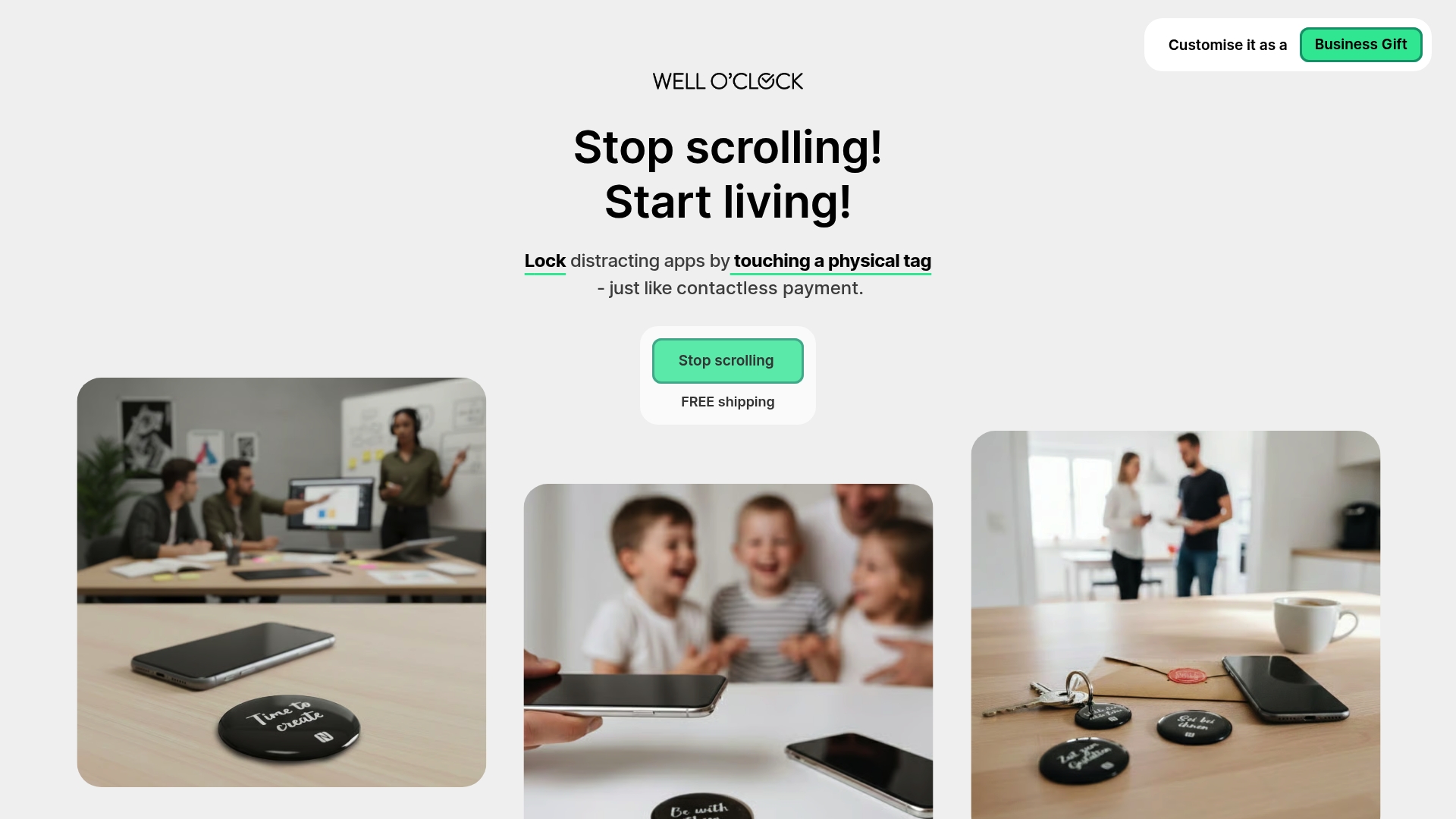
Whether you are just starting to think about your screen time or you have already tried app blockers and found them too easy to dismiss, Well O'Clock gives you a tangible, outside-the-phone solution that works with your environment rather than against your habits. If you want to go deeper on the why behind all of this, the guide on mindful tech habits is a great next read. Your phone should work for you. Well O'Clock helps make that happen.
Frequently asked questions
What is the 20-20-20 rule for screen breaks?
Every 20 minutes, look at something 20 feet away for at least 20 seconds to reduce eye strain. This simple eye break also gives your brain a brief reset between focused tasks.
How long does it take to see benefits from less screen time?
A 3-week reduction to under 2 hours daily can produce measurable improvements in well-being, mood, and sleep quality. Most people notice a difference in focus and energy within the first week.
Does mindful tech use mean I have to quit social media?
No. Mindful use is about setting intentions and curating positive experiences, not full elimination. Intentional engagement enhances wellbeing without requiring you to delete every account.
Can families benefit from tech-free zones?
Absolutely. Tech-free zones boost mood and social connection, especially at meals and bedtime, where device-free time has the strongest positive effect on family relationships.
Which app features help most with digital well-being?
App blockers reduce compulsive checking by 61%, making them the single most effective built-in tool. Usage trackers and grayscale display settings also help reduce the visual pull of your phone.

Mak Kordić
Co founder
Mak Kordić is the founder and CEO of CNJ Digital, an agency based in Ljubljana, where he and his team develop UX/UI and digital products for demanding B2B projects. Over his career, he has led and co-created hundreds of digital solutions and worked with international clients.








Best practices for mindful technology use that boost wellness
Mak Kordić
,
May 26, 2026
The average person checks their phone 96 times a day and racks up over 7 hours of screen time, yet a single interruption takes 23 minutes to recover from mentally. That math adds up to a life lived in constant reaction mode, where focus is fragmented and stress quietly builds. The good news is that you do not need to throw your phone in a lake to feel better. This article walks you through a research-backed road map for building healthier digital habits, one practical step at a time.
Table of Contents
- What is mindful technology use?
- Criteria for healthier digital habits
- Top best practices for mindful technology use
- Comparison of popular digital wellness strategies
- How to sustain mindful habits long term
- Physical and mental health rewards of mindful tech use
- Start your mindful tech journey with Well O'Clock
- Frequently asked questions
What is mindful technology use?
Mindful technology use means engaging with your devices on purpose, not on autopilot. It is the difference between opening Instagram because you chose to and opening it because your thumb just did it for you. Understanding why mindful tech habits matter starts with recognizing that the goal is not to quit technology but to make it serve your life rather than consume it.
A useful way to think about this is to split your tech use into two buckets:
- Essential use: Work communication, navigation, health tracking, video calls with family
- Optional use: Endless social scrolling, autoplay video, notification rabbit holes
Essential use tends to have a clear start and end point. Optional use rarely does. Intentional engagement enhances wellbeing precisely because it keeps you in the driver's seat instead of the passenger seat.
" The goal is not to use less technology for its own sake, but to use technology in ways that support your values and goals. "
Once you see your habits through this lens, the path forward becomes much clearer.
Criteria for healthier digital habits
Understanding the concept is one thing. Here is how to build your own healthier tech habits step by step.
Building better digital habits starts with an honest look at where you are right now. Most people dramatically underestimate how much time they spend on their phones. Your device's built-in screen time tracker is the fastest reality check available.
1. Audit your baseline. Check your weekly screen time report and note which apps consume the most time. No judgment, just data.
2. Separate high-value from low-value activities. Learning a skill, creating content, or connecting meaningfully with someone counts as high-value. Passive scrolling rarely does. Passive use lowers well-being more than total time on a device, which means content and context matter more than raw minutes.
3. Prioritize active engagement. Creation, learning, and intentional communication beat passive consumption every time. Shift your ratio gradually.
4. Set realistic goals. Cutting four hours of screen time overnight is a recipe for failure. Aim for 20 to 30 minutes less per day and build from there. Explore natural screen time reduction strategies that fit your lifestyle.
5. Track progress weekly. Use your phone's built-in tools or a dedicated screen time management approach to measure improvement over time.
Pro Tip: Screenshot your weekly screen time report every Sunday. After four weeks, you will have a clear picture of your trend and a powerful motivator to keep going.
Top best practices for mindful technology use
With a personal framework in place, you can now put proven best practices into daily action.
These are not vague suggestions. Each one has measurable impact when applied consistently.
1. Do a digital declutter. Remove or temporarily pause any app you have not used intentionally in the past two weeks. Fewer icons mean fewer temptations.
2. Create tech-free zones. The bedroom and the dinner table are the two highest-impact places to start. Physical space shapes behavior more than willpower does.
3. Batch your notifications. Turn off non-essential alerts and check messages at set times, such as 9 a.m., 1 p.m., and 5 p.m. This alone can reclaim hours of fragmented attention each week.
4. Use the 20-20-20 rule. Every 20 minutes, look at something 20 feet away for 20 seconds. It reduces eye strain and gives your brain a micro-reset.
5. Set an intention before every session. Before you unlock your phone, ask yourself: is this active or passive use? That one-second pause interrupts autopilot behavior.
6. Curate your feeds actively. Unfollow accounts that leave you feeling worse. Follow accounts that teach, inspire, or genuinely connect you with people you care about.
The data backs this up hard. App blockers reduce compulsive checking by 61%,, yet while 80% of people say they set rules for themselves, only 12% actually use built-in limits. That gap is where most people lose the battle. Learning how to minimize device distractions closes that gap with structure instead of willpower.
A 3-week reduction to under 2 hours of daily screen time produced measurable improvements in well-being, depression scores, stress levels, and sleep quality. Three weeks is not a long time to test a life-changing habit. Building smart workflows for healthy phone use makes that three-week window much easier to sustain.
Environment design outperforms willpower for long-term adherence, and group or family accountability makes habits stick even better. That is why tech-free zones score so high on sustainability. They change the environment rather than relying on you to make the right choice every single time. If you have kids at home, check out screen time strategies for families for approaches that work across age groups.
How to sustain mindful habits long term
Knowing which strategies work is just the beginning. Here is how to make mindful tech habits stick for the long haul.
The research is clear: habits rebound without ongoing strategies even after you see real improvements. Sustainability requires a system, not just motivation.
- Use physical reminders. A book on your nightstand, a journal on your desk, or a sticky note on your phone charger all serve as cues to choose offline activities.
- Find an accountability partner. Share your weekly screen time numbers with a friend or partner. Social commitment dramatically increases follow-through.
- Rotate offline alternatives. If your go-to break is always the same walk or the same book, it gets stale. Keep a short list of five to ten offline activities you genuinely enjoy.
- Treat slip-ups as data. A bad week does not erase your progress. Ask what triggered the relapse and adjust your environment accordingly.
Built-in tools like Screen Time and Digital Wellbeing, combined with gradual reduction goals and replacement activities like exercise, reading, or hobbies, form the most effective long-term system. Understanding why breaking screen addiction matters for mental clarity can also keep you motivated when the novelty of a new habit wears off.
Pro Tip: Set a monthly "digital review" on your calendar. Spend 10 minutes looking at your screen time trends, celebrating wins, and adjusting one habit that is not working.
" Small, consistent improvements compound over time. You do not need a perfect week. You need a slightly better one. "
For a deeper look at how reduced screen time connects to output, explore the link between productivity and screen reduction.
Physical and mental health rewards of mindful tech use
Wondering if these efforts are worth it? Here is a look at the science-backed rewards you can anticipate.
The benefits are not just psychological. Cutting screen time reduces obesity and diabetes risk, frees up time for physical activity, and directly boosts mood. Your body and your brain both benefit.
The ripple effect is real. When you reclaim even 30 minutes a day from passive screen use, that time tends to flow naturally into movement, conversation, or rest. All three are things most people say they want more of. Learning more about how screen time impacts wellness and focus gives you the full picture of what is at stake and what you stand to gain.
Start your mindful tech journey with Well O'Clock
Ready to put these tips into action? Here is how you can go further.
Well O'Clock was built specifically for people who know they want to change their digital habits but need more than a good intention to make it happen. The platform combines physical NFC tags with a mobile app so you can literally tap a tag to lock distracting apps, creating a real-world interruption that breaks the autopilot loop no amount of willpower can reliably stop.
Whether you are just starting to think about your screen time or you have already tried app blockers and found them too easy to dismiss, Well O'Clock gives you a tangible, outside-the-phone solution that works with your environment rather than against your habits. If you want to go deeper on the why behind all of this, the guide on mindful tech habits is a great next read. Your phone should work for you. Well O'Clock helps make that happen.
Frequently asked questions
What is the 20-20-20 rule for screen breaks?
Every 20 minutes, look at something 20 feet away for at least 20 seconds to reduce eye strain. This simple eye break also gives your brain a brief reset between focused tasks.
How long does it take to see benefits from less screen time?
A 3-week reduction to under 2 hours daily can produce measurable improvements in well-being, mood, and sleep quality. Most people notice a difference in focus and energy within the first week.
Does mindful tech use mean I have to quit social media?
No. Mindful use is about setting intentions and curating positive experiences, not full elimination. Intentional engagement enhances wellbeing without requiring you to delete every account.
Can families benefit from tech-free zones?
Absolutely. Tech-free zones boost mood and social connection, especially at meals and bedtime, where device-free time has the strongest positive effect on family relationships.
Which app features help most with digital well-being?
App blockers reduce compulsive checking by 61%, making them the single most effective built-in tool. Usage trackers and grayscale display settings also help reduce the visual pull of your phone.
Mak Kordić
Co founder
Mak Kordić is the founder and CEO of CNJ Digital, an agency based in Ljubljana, where he and his team develop UX/UI and digital products for demanding B2B projects. Over his career, he has led and co-created hundreds of digital solutions and worked with international clients.
Best practices for mindful technology use that boost wellness
Mak Kordić
,
May 26, 2026
The average person checks their phone 96 times a day and racks up over 7 hours of screen time, yet a single interruption takes 23 minutes to recover from mentally. That math adds up to a life lived in constant reaction mode, where focus is fragmented and stress quietly builds. The good news is that you do not need to throw your phone in a lake to feel better. This article walks you through a research-backed road map for building healthier digital habits, one practical step at a time.
Table of Contents
- What is mindful technology use?
- Criteria for healthier digital habits
- Top best practices for mindful technology use
- Comparison of popular digital wellness strategies
- How to sustain mindful habits long term
- Physical and mental health rewards of mindful tech use
- Start your mindful tech journey with Well O'Clock
- Frequently asked questions
What is mindful technology use?
Mindful technology use means engaging with your devices on purpose, not on autopilot. It is the difference between opening Instagram because you chose to and opening it because your thumb just did it for you. Understanding why mindful tech habits matter starts with recognizing that the goal is not to quit technology but to make it serve your life rather than consume it.
A useful way to think about this is to split your tech use into two buckets:
- Essential use: Work communication, navigation, health tracking, video calls with family
- Optional use: Endless social scrolling, autoplay video, notification rabbit holes
Essential use tends to have a clear start and end point. Optional use rarely does. Intentional engagement enhances wellbeing precisely because it keeps you in the driver's seat instead of the passenger seat.
" The goal is not to use less technology for its own sake, but to use technology in ways that support your values and goals. "
Once you see your habits through this lens, the path forward becomes much clearer.
Criteria for healthier digital habits
Understanding the concept is one thing. Here is how to build your own healthier tech habits step by step.
Building better digital habits starts with an honest look at where you are right now. Most people dramatically underestimate how much time they spend on their phones. Your device's built-in screen time tracker is the fastest reality check available.
1. Audit your baseline. Check your weekly screen time report and note which apps consume the most time. No judgment, just data.
2. Separate high-value from low-value activities. Learning a skill, creating content, or connecting meaningfully with someone counts as high-value. Passive scrolling rarely does. Passive use lowers well-being more than total time on a device, which means content and context matter more than raw minutes.
3. Prioritize active engagement. Creation, learning, and intentional communication beat passive consumption every time. Shift your ratio gradually.
4. Set realistic goals. Cutting four hours of screen time overnight is a recipe for failure. Aim for 20 to 30 minutes less per day and build from there. Explore natural screen time reduction strategies that fit your lifestyle.
5. Track progress weekly. Use your phone's built-in tools or a dedicated screen time management approach to measure improvement over time.
Pro Tip: Screenshot your weekly screen time report every Sunday. After four weeks, you will have a clear picture of your trend and a powerful motivator to keep going.
Top best practices for mindful technology use
With a personal framework in place, you can now put proven best practices into daily action.
These are not vague suggestions. Each one has measurable impact when applied consistently.
1. Do a digital declutter. Remove or temporarily pause any app you have not used intentionally in the past two weeks. Fewer icons mean fewer temptations.
2. Create tech-free zones. The bedroom and the dinner table are the two highest-impact places to start. Physical space shapes behavior more than willpower does.
3. Batch your notifications. Turn off non-essential alerts and check messages at set times, such as 9 a.m., 1 p.m., and 5 p.m. This alone can reclaim hours of fragmented attention each week.
4. Use the 20-20-20 rule. Every 20 minutes, look at something 20 feet away for 20 seconds. It reduces eye strain and gives your brain a micro-reset.
5. Set an intention before every session. Before you unlock your phone, ask yourself: is this active or passive use? That one-second pause interrupts autopilot behavior.
6. Curate your feeds actively. Unfollow accounts that leave you feeling worse. Follow accounts that teach, inspire, or genuinely connect you with people you care about.
The data backs this up hard. App blockers reduce compulsive checking by 61%,, yet while 80% of people say they set rules for themselves, only 12% actually use built-in limits. That gap is where most people lose the battle. Learning how to minimize device distractions closes that gap with structure instead of willpower.
A 3-week reduction to under 2 hours of daily screen time produced measurable improvements in well-being, depression scores, stress levels, and sleep quality. Three weeks is not a long time to test a life-changing habit. Building smart workflows for healthy phone use makes that three-week window much easier to sustain.
Environment design outperforms willpower for long-term adherence, and group or family accountability makes habits stick even better. That is why tech-free zones score so high on sustainability. They change the environment rather than relying on you to make the right choice every single time. If you have kids at home, check out screen time strategies for families for approaches that work across age groups.
How to sustain mindful habits long term
Knowing which strategies work is just the beginning. Here is how to make mindful tech habits stick for the long haul.
The research is clear: habits rebound without ongoing strategies even after you see real improvements. Sustainability requires a system, not just motivation.
- Use physical reminders. A book on your nightstand, a journal on your desk, or a sticky note on your phone charger all serve as cues to choose offline activities.
- Find an accountability partner. Share your weekly screen time numbers with a friend or partner. Social commitment dramatically increases follow-through.
- Rotate offline alternatives. If your go-to break is always the same walk or the same book, it gets stale. Keep a short list of five to ten offline activities you genuinely enjoy.
- Treat slip-ups as data. A bad week does not erase your progress. Ask what triggered the relapse and adjust your environment accordingly.
Built-in tools like Screen Time and Digital Wellbeing, combined with gradual reduction goals and replacement activities like exercise, reading, or hobbies, form the most effective long-term system. Understanding why breaking screen addiction matters for mental clarity can also keep you motivated when the novelty of a new habit wears off.
Pro Tip: Set a monthly "digital review" on your calendar. Spend 10 minutes looking at your screen time trends, celebrating wins, and adjusting one habit that is not working.
" Small, consistent improvements compound over time. You do not need a perfect week. You need a slightly better one. "
For a deeper look at how reduced screen time connects to output, explore the link between productivity and screen reduction.
Physical and mental health rewards of mindful tech use
Wondering if these efforts are worth it? Here is a look at the science-backed rewards you can anticipate.
The benefits are not just psychological. Cutting screen time reduces obesity and diabetes risk, frees up time for physical activity, and directly boosts mood. Your body and your brain both benefit.
The ripple effect is real. When you reclaim even 30 minutes a day from passive screen use, that time tends to flow naturally into movement, conversation, or rest. All three are things most people say they want more of. Learning more about how screen time impacts wellness and focus gives you the full picture of what is at stake and what you stand to gain.
Start your mindful tech journey with Well O'Clock
Ready to put these tips into action? Here is how you can go further.
Well O'Clock was built specifically for people who know they want to change their digital habits but need more than a good intention to make it happen. The platform combines physical NFC tags with a mobile app so you can literally tap a tag to lock distracting apps, creating a real-world interruption that breaks the autopilot loop no amount of willpower can reliably stop.
Whether you are just starting to think about your screen time or you have already tried app blockers and found them too easy to dismiss, Well O'Clock gives you a tangible, outside-the-phone solution that works with your environment rather than against your habits. If you want to go deeper on the why behind all of this, the guide on mindful tech habits is a great next read. Your phone should work for you. Well O'Clock helps make that happen.
Frequently asked questions
What is the 20-20-20 rule for screen breaks?
Every 20 minutes, look at something 20 feet away for at least 20 seconds to reduce eye strain. This simple eye break also gives your brain a brief reset between focused tasks.
How long does it take to see benefits from less screen time?
A 3-week reduction to under 2 hours daily can produce measurable improvements in well-being, mood, and sleep quality. Most people notice a difference in focus and energy within the first week.
Does mindful tech use mean I have to quit social media?
No. Mindful use is about setting intentions and curating positive experiences, not full elimination. Intentional engagement enhances wellbeing without requiring you to delete every account.
Can families benefit from tech-free zones?
Absolutely. Tech-free zones boost mood and social connection, especially at meals and bedtime, where device-free time has the strongest positive effect on family relationships.
Which app features help most with digital well-being?
App blockers reduce compulsive checking by 61%, making them the single most effective built-in tool. Usage trackers and grayscale display settings also help reduce the visual pull of your phone.
Mak Kordić
Co founder
Mak Kordić is the founder and CEO of CNJ Digital, an agency based in Ljubljana, where he and his team develop UX/UI and digital products for demanding B2B projects. Over his career, he has led and co-created hundreds of digital solutions and worked with international clients.