
Outside-the-phone interventions: 91% see real gains
Mak Kordić
,
April 21, 2026


Simply putting your phone down isn't the full answer. Research shows that outside-the-phone interventions like exercise, in-person socializing, nature time, and mindfulness are what actually drive lasting mental health improvements during a digital detox. Cutting screen time creates space, but what fills that space determines whether you feel genuinely better or just restless. This article breaks down the science of why replacement beats restriction, which interventions work best, and how to build a plan that actually sticks.
Table of Contents
- Why screens aren't the whole story: Understanding the limits of digital detox
- What are outside-the-phone interventions?
- Evidence: How outside-the-phone interventions amplify mental wellness and productivity gains
- Mechanisms: Why outside-the-phone interventions work
- Personalizing your interventions: One size doesn't fit all
- From research to reality: How to implement outside-the-phone interventions in your life
- Support your outside-the-phone journey
- Frequently asked questions
Why screens aren't the whole story: Understanding the limits of digital detox
Most people assume that less phone time automatically means better mental health. The reality is more nuanced. Reducing screen time to 2 hours per day for three weeks does improve depressive symptoms, stress, sleep, and overall well-being, but the effect sizes are small to medium. That's meaningful progress, but it's not transformation.
The bigger problem is what happens after the detox ends. Without a replacement habit, most people slide right back to their old patterns. Well-being after disconnection tends to fade quickly when nothing fills the void that screens once occupied. This is the classic digital detox disappointment: you feel great for a week, then you're back to scrolling by week three.
The core mistake is framing screen reduction as purely subtractive. You focus on what to avoid rather than what to add. That approach leaves your brain without a satisfying alternative, which makes relapse almost inevitable.
" The biggest gains come not from what you stop doing, but from what you intentionally start doing instead. "
Here are the most common pitfalls people run into with screen-only detoxes:
- Removing apps without scheduling anything to replace the habit
- Setting time limits but not filling that time with engaging alternatives
- Treating screen reduction as a short-term challenge rather than a lifestyle shift
- Ignoring the emotional triggers that drive phone use in the first place
Understanding screen time and wellness as a two-sided equation, what you remove AND what you add, is the foundation for real change.
What are outside-the-phone interventions?
An outside-the-phone intervention is any intentional offline activity that replaces screen-based behavior. It's not just "doing something else." It's a deliberate substitute that meets the same psychological needs your phone was filling, whether that's stimulation, connection, relaxation, or a sense of accomplishment.
Physical exercise, in-person socializing, nature time, hobbies, mindfulness, journaling, and brisk walking are the most studied and effective examples. Each one targets a different dimension of well-being, which is why combining several of them produces the strongest results.
Think of it this way: your phone is a slot machine that delivers unpredictable rewards. To break that loop, you need activities that deliver predictable rewards, real connection, physical energy, creative satisfaction, or calm. These creative screen-free activities don't just kill time. They rebuild your capacity for focus and presence.
Here's a quick breakdown of the most effective options and what they target:
- Physical exercise: Reduces cortisol, boosts mood, improves sleep quality
- In-person socializing: Builds trust, reduces loneliness, satisfies connection needs
- Nature time: Lowers stress hormones, restores attention, improves mood
- Mindfulness or meditation: Trains focus, reduces anxiety, builds emotional regulation
- Creative hobbies: Provides flow states, builds self-efficacy, reduces rumination
- Journaling: Processes emotions, improves self-awareness, supports sleep
Prioritizing offline time for your mental health isn't about rejecting technology. It's about reclaiming the activities that make you feel most alive.
Evidence: How outside-the-phone interventions amplify mental wellness and productivity gains
The data here is striking. When people pair screen reduction with intentional offline activities, the results go well beyond what screen reduction alone achieves. Digital detox paired with offline activities shows the largest improvements in cortisol levels, heart rate variability, stress, and anxiety compared to simply cutting phone time.

Cortisol is your primary stress hormone. Heart rate variability is a key marker of nervous system resilience. Both improve significantly more when offline activities are part of the equation. That's not a small detail. It means your body is physically recovering in ways that screen reduction alone can't trigger.
91% of participants who blocked mobile internet and replaced that time with offline activities improved in at least one outcome, including attention, mental health, and well-being. Average screen time dropped by 2.5 hours per day.
The productivity boost from combining both approaches is also well-documented. Families who adopt this model report key benefits including stronger relationships, better sleep, and more time for meaningful activities. Disconnecting for mind and body works best when it's an active choice, not just an absence.
Pro Tip: Don't wait until you feel overwhelmed to start. Even replacing 30 minutes of scrolling with a walk or a phone call produces measurable mood improvements within days.
Mechanisms: Why outside-the-phone interventions work
The science behind why these interventions work comes down to a concept called displacement. When you reduce screen time, your brain doesn't just rest. It fills that space with something. The question is whether that something is restorative or just another low-value distraction.
Research shows that improvements from screen reduction are mediated by three key factors: increased physical activity accounts for 30.9 to 38.9% of the benefit, a regular bedtime accounts for 18.4 to 23.9%, and longer sleep duration accounts for 4.16 to 7.24%. These aren't side effects. They're the actual mechanisms driving the improvement.
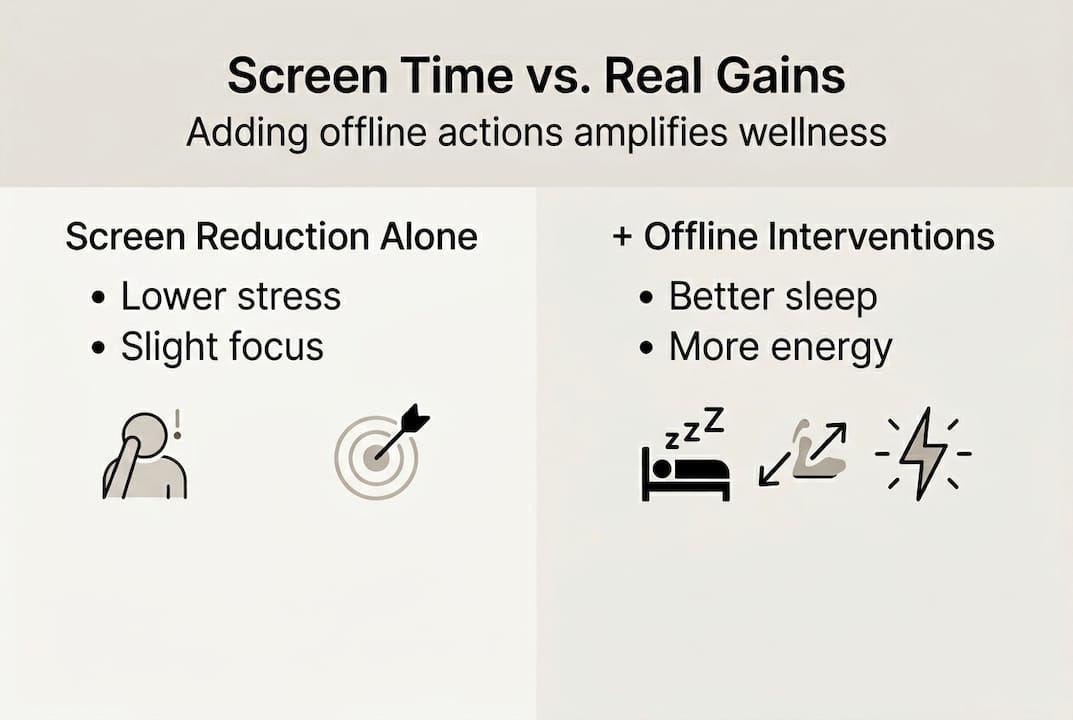
This is a dose-response relationship. The more consistently you engage in these activities, the bigger the gains. It's not magic. It's biology responding to better inputs.
Here are the top mediating activities ranked by their impact on mental health and productivity:
- Physical activity: The single strongest mediator. Even 20 to 30 minutes of moderate exercise daily produces significant gains.
- Consistent sleep schedule: Going to bed at the same time each night regulates cortisol and improves mood stability.
- Social contact: Face-to-face interaction activates oxytocin pathways that digital communication simply can't replicate.
- Mindfulness practice: Even five minutes of focused breathing reduces stress and improves attention span.
Breaking screen addiction for mental clarity isn't about willpower. It's about engineering your environment so that better activities are easier to access than your phone.
Pro Tip: Schedule your offline activity before you unplug. If your calendar says "7pm: walk with neighbor," you're far more likely to follow through than if you just decide to "use your phone less."
Personalizing your interventions: One size doesn't fit all
Not everyone responds to digital detox the same way. Your starting point, personality, and daily context all shape which interventions will work best for you. This isn't a one-size-fits-all prescription.
High FoMO individuals (those with strong fear of missing out) benefit most from structured restrictions paired with social alternatives. For them, the offline activity must satisfy the social connection need that FoMO amplifies. Adolescents and young adults face dose-response risks starting at just two to four hours of daily screen time, making early intervention especially important.
For younger users, monitoring screen time is a critical first step before choosing interventions. Spending 4 to 6 hours or more per day on non-school digital media is linked to poor self-esteem, low mood, poor sleep, and low trust in others.
" The biggest benefit comes from pairing intentional offline activities with screen reduction, not from abstaining alone. "
Here's how to adapt your approach based on your situation:
1. High FoMO: Prioritize in-person social plans. Replace scrolling time with scheduled meetups or group activities.
2. High stress or anxiety: Lead with nature walks and mindfulness. These lower cortisol fastest.
3. Low motivation or depression: Start with physical exercise. The mood boost is rapid and builds momentum.
4. Creative burnout: Choose hobbies with a tangible output, like cooking, drawing, or building something.
5. Sleep problems: Focus on a consistent bedtime routine and eliminate screens at least one hour before sleep.
From research to reality: How to implement outside-the-phone interventions in your life
Knowing what works is only half the battle. The other half is building a system that makes these behaviors automatic rather than effortful. That's where habit stacking and scheduling become essential tools.
Partial detoxes such as setting app limits, switching to grayscale, or turning off notifications are more sustainable than total abstinence. Community-wide rules, like a household no-phone dinner policy, boost physical activity by 11% compared to individual efforts alone. Small, consistent changes outperform dramatic overhauls every time.
Here's a step-by-step plan to integrate effective interventions into your daily routine:
1. Audit your screen time. Identify your highest-use apps and the times of day you reach for your phone out of habit.
2. Choose two to three offline replacements. Pick activities that match your personality and schedule. Don't try to overhaul everything at once.
3. Schedule them before you unplug. Block time in your calendar for your chosen activities. Treat them like appointments.
4. Use environmental cues. Place your running shoes by the door. Keep a book on your pillow. Make the offline activity the path of least resistance.
5. Start with partial limits. Use app timers or notification blocks rather than going cold turkey. Gradual change sticks better.
6. Track your progress. Note changes in mood, sleep, and energy each week. Feedback loops keep you motivated.
Practical tips for busy families and a step-by-step productivity improvement plan can help you customize this framework for your specific situation. Setting healthy tech boundaries is a skill, and like any skill, it improves with practice.
Pro Tip: Track changes in mood, sleep, and energy for the first two weeks. Even a simple one-to-ten daily rating gives you enough data to see what's working and adjust quickly.
Support your outside-the-phone journey
Building new habits is always easier when you have the right tools in your corner. If you've read this far, you already understand that reducing screen time is only the starting point. What you do with that reclaimed time is where the real transformation happens.
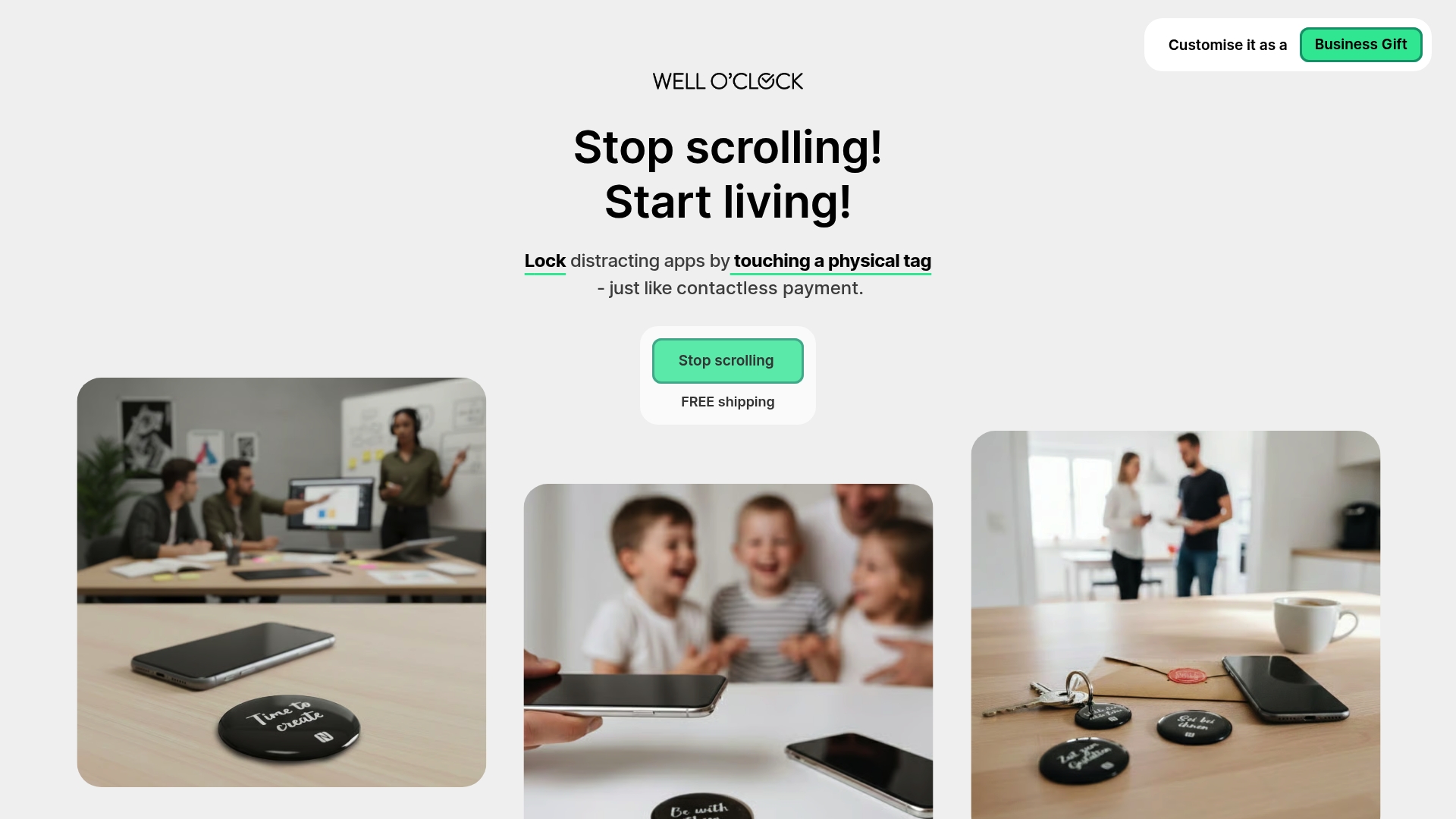
Well O'Clock is built specifically for people who want a tangible, outside-the-phone solution to break autopilot phone habits. The system combines physical NFC tags with a mobile app, so you can lock distracting apps with a single tap on a physical object. It's a real-world interrupt that makes the right choice the easy choice. Whether you're working on your own wellness or building better habits for your whole household, discover personalized wellness plans and tools designed to make your offline time count.
Frequently asked questions
What's the most effective outside-the-phone intervention for improving mood?
Physical exercise and in-person socializing show the highest impact on mood, supported by both clinical studies and user reports. These two activities address the biological and social roots of low mood most directly.
How long do benefits from outside-the-phone interventions last?
Benefits appear during and shortly after the intervention but fade quickly without sustained habits to replace screen time. The key is making offline activities a permanent part of your routine, not a temporary experiment.
Is reducing phone use alone enough to lower stress and anxiety?
Phone reduction helps moderately, but pairing with offline activities yields significantly greater reductions in stress and anxiety. The combination approach is consistently more effective than restriction alone.
Who benefits most from outside-the-phone interventions?
People with high FoMO and those spending 4+ hours daily on digital media see the greatest gains from structured offline interventions. Adolescents and young adults are also a high-priority group.
How should I start if total digital detox isn't realistic?
Begin with partial detoxes and manageable changes like app limits or notification blocks, then gradually add enjoyable offline activities. Sustainable progress beats dramatic overhauls every time.

Mak Kordić
Co founder
Mak Kordić is the founder and CEO of CNJ Digital, an agency based in Ljubljana, where he and his team develop UX/UI and digital products for demanding B2B projects. Over his career, he has led and co-created hundreds of digital solutions and worked with international clients.








Outside-the-phone interventions: 91% see real gains
Mak Kordić
,
April 21, 2026
Simply putting your phone down isn't the full answer. Research shows that outside-the-phone interventions like exercise, in-person socializing, nature time, and mindfulness are what actually drive lasting mental health improvements during a digital detox. Cutting screen time creates space, but what fills that space determines whether you feel genuinely better or just restless. This article breaks down the science of why replacement beats restriction, which interventions work best, and how to build a plan that actually sticks.
Table of Contents
- Why screens aren't the whole story: Understanding the limits of digital detox
- What are outside-the-phone interventions?
- Evidence: How outside-the-phone interventions amplify mental wellness and productivity gains
- Mechanisms: Why outside-the-phone interventions work
- Personalizing your interventions: One size doesn't fit all
- From research to reality: How to implement outside-the-phone interventions in your life
- Support your outside-the-phone journey
- Frequently asked questions
Why screens aren't the whole story: Understanding the limits of digital detox
Most people assume that less phone time automatically means better mental health. The reality is more nuanced. Reducing screen time to 2 hours per day for three weeks does improve depressive symptoms, stress, sleep, and overall well-being, but the effect sizes are small to medium. That's meaningful progress, but it's not transformation.
The bigger problem is what happens after the detox ends. Without a replacement habit, most people slide right back to their old patterns. Well-being after disconnection tends to fade quickly when nothing fills the void that screens once occupied. This is the classic digital detox disappointment: you feel great for a week, then you're back to scrolling by week three.
The core mistake is framing screen reduction as purely subtractive. You focus on what to avoid rather than what to add. That approach leaves your brain without a satisfying alternative, which makes relapse almost inevitable.
" The biggest gains come not from what you stop doing, but from what you intentionally start doing instead. "
Here are the most common pitfalls people run into with screen-only detoxes:
- Removing apps without scheduling anything to replace the habit
- Setting time limits but not filling that time with engaging alternatives
- Treating screen reduction as a short-term challenge rather than a lifestyle shift
- Ignoring the emotional triggers that drive phone use in the first place
Understanding screen time and wellness as a two-sided equation, what you remove AND what you add, is the foundation for real change.
What are outside-the-phone interventions?
An outside-the-phone intervention is any intentional offline activity that replaces screen-based behavior. It's not just "doing something else." It's a deliberate substitute that meets the same psychological needs your phone was filling, whether that's stimulation, connection, relaxation, or a sense of accomplishment.
Physical exercise, in-person socializing, nature time, hobbies, mindfulness, journaling, and brisk walking are the most studied and effective examples. Each one targets a different dimension of well-being, which is why combining several of them produces the strongest results.
Think of it this way: your phone is a slot machine that delivers unpredictable rewards. To break that loop, you need activities that deliver predictable rewards, real connection, physical energy, creative satisfaction, or calm. These creative screen-free activities don't just kill time. They rebuild your capacity for focus and presence.
Here's a quick breakdown of the most effective options and what they target:
- Physical exercise: Reduces cortisol, boosts mood, improves sleep quality
- In-person socializing: Builds trust, reduces loneliness, satisfies connection needs
- Nature time: Lowers stress hormones, restores attention, improves mood
- Mindfulness or meditation: Trains focus, reduces anxiety, builds emotional regulation
- Creative hobbies: Provides flow states, builds self-efficacy, reduces rumination
- Journaling: Processes emotions, improves self-awareness, supports sleep
Prioritizing offline time for your mental health isn't about rejecting technology. It's about reclaiming the activities that make you feel most alive.
Evidence: How outside-the-phone interventions amplify mental wellness and productivity gains
The data here is striking. When people pair screen reduction with intentional offline activities, the results go well beyond what screen reduction alone achieves. Digital detox paired with offline activities shows the largest improvements in cortisol levels, heart rate variability, stress, and anxiety compared to simply cutting phone time.
Cortisol is your primary stress hormone. Heart rate variability is a key marker of nervous system resilience. Both improve significantly more when offline activities are part of the equation. That's not a small detail. It means your body is physically recovering in ways that screen reduction alone can't trigger.
91% of participants who blocked mobile internet and replaced that time with offline activities improved in at least one outcome, including attention, mental health, and well-being. Average screen time dropped by 2.5 hours per day.
The productivity boost from combining both approaches is also well-documented. Families who adopt this model report key benefits including stronger relationships, better sleep, and more time for meaningful activities. Disconnecting for mind and body works best when it's an active choice, not just an absence.
Pro Tip: Don't wait until you feel overwhelmed to start. Even replacing 30 minutes of scrolling with a walk or a phone call produces measurable mood improvements within days.
Mechanisms: Why outside-the-phone interventions work
The science behind why these interventions work comes down to a concept called displacement. When you reduce screen time, your brain doesn't just rest. It fills that space with something. The question is whether that something is restorative or just another low-value distraction.
Research shows that improvements from screen reduction are mediated by three key factors: increased physical activity accounts for 30.9 to 38.9% of the benefit, a regular bedtime accounts for 18.4 to 23.9%, and longer sleep duration accounts for 4.16 to 7.24%. These aren't side effects. They're the actual mechanisms driving the improvement.
This is a dose-response relationship. The more consistently you engage in these activities, the bigger the gains. It's not magic. It's biology responding to better inputs.
Here are the top mediating activities ranked by their impact on mental health and productivity:
- Physical activity: The single strongest mediator. Even 20 to 30 minutes of moderate exercise daily produces significant gains.
- Consistent sleep schedule: Going to bed at the same time each night regulates cortisol and improves mood stability.
- Social contact: Face-to-face interaction activates oxytocin pathways that digital communication simply can't replicate.
- Mindfulness practice: Even five minutes of focused breathing reduces stress and improves attention span.
Breaking screen addiction for mental clarity isn't about willpower. It's about engineering your environment so that better activities are easier to access than your phone.
Pro Tip: Schedule your offline activity before you unplug. If your calendar says "7pm: walk with neighbor," you're far more likely to follow through than if you just decide to "use your phone less."
Personalizing your interventions: One size doesn't fit all
Not everyone responds to digital detox the same way. Your starting point, personality, and daily context all shape which interventions will work best for you. This isn't a one-size-fits-all prescription.
High FoMO individuals (those with strong fear of missing out) benefit most from structured restrictions paired with social alternatives. For them, the offline activity must satisfy the social connection need that FoMO amplifies. Adolescents and young adults face dose-response risks starting at just two to four hours of daily screen time, making early intervention especially important.
For younger users, monitoring screen time is a critical first step before choosing interventions. Spending 4 to 6 hours or more per day on non-school digital media is linked to poor self-esteem, low mood, poor sleep, and low trust in others.
" The biggest benefit comes from pairing intentional offline activities with screen reduction, not from abstaining alone. "
Here's how to adapt your approach based on your situation:
1. High FoMO: Prioritize in-person social plans. Replace scrolling time with scheduled meetups or group activities.
2. High stress or anxiety: Lead with nature walks and mindfulness. These lower cortisol fastest.
3. Low motivation or depression: Start with physical exercise. The mood boost is rapid and builds momentum.
4. Creative burnout: Choose hobbies with a tangible output, like cooking, drawing, or building something.
5. Sleep problems: Focus on a consistent bedtime routine and eliminate screens at least one hour before sleep.
From research to reality: How to implement outside-the-phone interventions in your life
Knowing what works is only half the battle. The other half is building a system that makes these behaviors automatic rather than effortful. That's where habit stacking and scheduling become essential tools.
Partial detoxes such as setting app limits, switching to grayscale, or turning off notifications are more sustainable than total abstinence. Community-wide rules, like a household no-phone dinner policy, boost physical activity by 11% compared to individual efforts alone. Small, consistent changes outperform dramatic overhauls every time.
Here's a step-by-step plan to integrate effective interventions into your daily routine:
1. Audit your screen time. Identify your highest-use apps and the times of day you reach for your phone out of habit.
2. Choose two to three offline replacements. Pick activities that match your personality and schedule. Don't try to overhaul everything at once.
3. Schedule them before you unplug. Block time in your calendar for your chosen activities. Treat them like appointments.
4. Use environmental cues. Place your running shoes by the door. Keep a book on your pillow. Make the offline activity the path of least resistance.
5. Start with partial limits. Use app timers or notification blocks rather than going cold turkey. Gradual change sticks better.
6. Track your progress. Note changes in mood, sleep, and energy each week. Feedback loops keep you motivated.
Practical tips for busy families and a step-by-step productivity improvement plan can help you customize this framework for your specific situation. Setting healthy tech boundaries is a skill, and like any skill, it improves with practice.
Pro Tip: Track changes in mood, sleep, and energy for the first two weeks. Even a simple one-to-ten daily rating gives you enough data to see what's working and adjust quickly.
Support your outside-the-phone journey
Building new habits is always easier when you have the right tools in your corner. If you've read this far, you already understand that reducing screen time is only the starting point. What you do with that reclaimed time is where the real transformation happens.
Well O'Clock is built specifically for people who want a tangible, outside-the-phone solution to break autopilot phone habits. The system combines physical NFC tags with a mobile app, so you can lock distracting apps with a single tap on a physical object. It's a real-world interrupt that makes the right choice the easy choice. Whether you're working on your own wellness or building better habits for your whole household, discover personalized wellness plans and tools designed to make your offline time count.
Frequently asked questions
What's the most effective outside-the-phone intervention for improving mood?
Physical exercise and in-person socializing show the highest impact on mood, supported by both clinical studies and user reports. These two activities address the biological and social roots of low mood most directly.
How long do benefits from outside-the-phone interventions last?
Benefits appear during and shortly after the intervention but fade quickly without sustained habits to replace screen time. The key is making offline activities a permanent part of your routine, not a temporary experiment.
Is reducing phone use alone enough to lower stress and anxiety?
Phone reduction helps moderately, but pairing with offline activities yields significantly greater reductions in stress and anxiety. The combination approach is consistently more effective than restriction alone.
Who benefits most from outside-the-phone interventions?
People with high FoMO and those spending 4+ hours daily on digital media see the greatest gains from structured offline interventions. Adolescents and young adults are also a high-priority group.
How should I start if total digital detox isn't realistic?
Begin with partial detoxes and manageable changes like app limits or notification blocks, then gradually add enjoyable offline activities. Sustainable progress beats dramatic overhauls every time.
Mak Kordić
Co founder
Mak Kordić is the founder and CEO of CNJ Digital, an agency based in Ljubljana, where he and his team develop UX/UI and digital products for demanding B2B projects. Over his career, he has led and co-created hundreds of digital solutions and worked with international clients.
Outside-the-phone interventions: 91% see real gains
Mak Kordić
,
April 21, 2026
Simply putting your phone down isn't the full answer. Research shows that outside-the-phone interventions like exercise, in-person socializing, nature time, and mindfulness are what actually drive lasting mental health improvements during a digital detox. Cutting screen time creates space, but what fills that space determines whether you feel genuinely better or just restless. This article breaks down the science of why replacement beats restriction, which interventions work best, and how to build a plan that actually sticks.
Table of Contents
- Why screens aren't the whole story: Understanding the limits of digital detox
- What are outside-the-phone interventions?
- Evidence: How outside-the-phone interventions amplify mental wellness and productivity gains
- Mechanisms: Why outside-the-phone interventions work
- Personalizing your interventions: One size doesn't fit all
- From research to reality: How to implement outside-the-phone interventions in your life
- Support your outside-the-phone journey
- Frequently asked questions
Why screens aren't the whole story: Understanding the limits of digital detox
Most people assume that less phone time automatically means better mental health. The reality is more nuanced. Reducing screen time to 2 hours per day for three weeks does improve depressive symptoms, stress, sleep, and overall well-being, but the effect sizes are small to medium. That's meaningful progress, but it's not transformation.
The bigger problem is what happens after the detox ends. Without a replacement habit, most people slide right back to their old patterns. Well-being after disconnection tends to fade quickly when nothing fills the void that screens once occupied. This is the classic digital detox disappointment: you feel great for a week, then you're back to scrolling by week three.
The core mistake is framing screen reduction as purely subtractive. You focus on what to avoid rather than what to add. That approach leaves your brain without a satisfying alternative, which makes relapse almost inevitable.
" The biggest gains come not from what you stop doing, but from what you intentionally start doing instead. "
Here are the most common pitfalls people run into with screen-only detoxes:
- Removing apps without scheduling anything to replace the habit
- Setting time limits but not filling that time with engaging alternatives
- Treating screen reduction as a short-term challenge rather than a lifestyle shift
- Ignoring the emotional triggers that drive phone use in the first place
Understanding screen time and wellness as a two-sided equation, what you remove AND what you add, is the foundation for real change.
What are outside-the-phone interventions?
An outside-the-phone intervention is any intentional offline activity that replaces screen-based behavior. It's not just "doing something else." It's a deliberate substitute that meets the same psychological needs your phone was filling, whether that's stimulation, connection, relaxation, or a sense of accomplishment.
Physical exercise, in-person socializing, nature time, hobbies, mindfulness, journaling, and brisk walking are the most studied and effective examples. Each one targets a different dimension of well-being, which is why combining several of them produces the strongest results.
Think of it this way: your phone is a slot machine that delivers unpredictable rewards. To break that loop, you need activities that deliver predictable rewards, real connection, physical energy, creative satisfaction, or calm. These creative screen-free activities don't just kill time. They rebuild your capacity for focus and presence.
Here's a quick breakdown of the most effective options and what they target:
- Physical exercise: Reduces cortisol, boosts mood, improves sleep quality
- In-person socializing: Builds trust, reduces loneliness, satisfies connection needs
- Nature time: Lowers stress hormones, restores attention, improves mood
- Mindfulness or meditation: Trains focus, reduces anxiety, builds emotional regulation
- Creative hobbies: Provides flow states, builds self-efficacy, reduces rumination
- Journaling: Processes emotions, improves self-awareness, supports sleep
Prioritizing offline time for your mental health isn't about rejecting technology. It's about reclaiming the activities that make you feel most alive.
Evidence: How outside-the-phone interventions amplify mental wellness and productivity gains
The data here is striking. When people pair screen reduction with intentional offline activities, the results go well beyond what screen reduction alone achieves. Digital detox paired with offline activities shows the largest improvements in cortisol levels, heart rate variability, stress, and anxiety compared to simply cutting phone time.
Cortisol is your primary stress hormone. Heart rate variability is a key marker of nervous system resilience. Both improve significantly more when offline activities are part of the equation. That's not a small detail. It means your body is physically recovering in ways that screen reduction alone can't trigger.
91% of participants who blocked mobile internet and replaced that time with offline activities improved in at least one outcome, including attention, mental health, and well-being. Average screen time dropped by 2.5 hours per day.
The productivity boost from combining both approaches is also well-documented. Families who adopt this model report key benefits including stronger relationships, better sleep, and more time for meaningful activities. Disconnecting for mind and body works best when it's an active choice, not just an absence.
Pro Tip: Don't wait until you feel overwhelmed to start. Even replacing 30 minutes of scrolling with a walk or a phone call produces measurable mood improvements within days.
Mechanisms: Why outside-the-phone interventions work
The science behind why these interventions work comes down to a concept called displacement. When you reduce screen time, your brain doesn't just rest. It fills that space with something. The question is whether that something is restorative or just another low-value distraction.
Research shows that improvements from screen reduction are mediated by three key factors: increased physical activity accounts for 30.9 to 38.9% of the benefit, a regular bedtime accounts for 18.4 to 23.9%, and longer sleep duration accounts for 4.16 to 7.24%. These aren't side effects. They're the actual mechanisms driving the improvement.
This is a dose-response relationship. The more consistently you engage in these activities, the bigger the gains. It's not magic. It's biology responding to better inputs.
Here are the top mediating activities ranked by their impact on mental health and productivity:
- Physical activity: The single strongest mediator. Even 20 to 30 minutes of moderate exercise daily produces significant gains.
- Consistent sleep schedule: Going to bed at the same time each night regulates cortisol and improves mood stability.
- Social contact: Face-to-face interaction activates oxytocin pathways that digital communication simply can't replicate.
- Mindfulness practice: Even five minutes of focused breathing reduces stress and improves attention span.
Breaking screen addiction for mental clarity isn't about willpower. It's about engineering your environment so that better activities are easier to access than your phone.
Pro Tip: Schedule your offline activity before you unplug. If your calendar says "7pm: walk with neighbor," you're far more likely to follow through than if you just decide to "use your phone less."
Personalizing your interventions: One size doesn't fit all
Not everyone responds to digital detox the same way. Your starting point, personality, and daily context all shape which interventions will work best for you. This isn't a one-size-fits-all prescription.
High FoMO individuals (those with strong fear of missing out) benefit most from structured restrictions paired with social alternatives. For them, the offline activity must satisfy the social connection need that FoMO amplifies. Adolescents and young adults face dose-response risks starting at just two to four hours of daily screen time, making early intervention especially important.
For younger users, monitoring screen time is a critical first step before choosing interventions. Spending 4 to 6 hours or more per day on non-school digital media is linked to poor self-esteem, low mood, poor sleep, and low trust in others.
" The biggest benefit comes from pairing intentional offline activities with screen reduction, not from abstaining alone. "
Here's how to adapt your approach based on your situation:
1. High FoMO: Prioritize in-person social plans. Replace scrolling time with scheduled meetups or group activities.
2. High stress or anxiety: Lead with nature walks and mindfulness. These lower cortisol fastest.
3. Low motivation or depression: Start with physical exercise. The mood boost is rapid and builds momentum.
4. Creative burnout: Choose hobbies with a tangible output, like cooking, drawing, or building something.
5. Sleep problems: Focus on a consistent bedtime routine and eliminate screens at least one hour before sleep.
From research to reality: How to implement outside-the-phone interventions in your life
Knowing what works is only half the battle. The other half is building a system that makes these behaviors automatic rather than effortful. That's where habit stacking and scheduling become essential tools.
Partial detoxes such as setting app limits, switching to grayscale, or turning off notifications are more sustainable than total abstinence. Community-wide rules, like a household no-phone dinner policy, boost physical activity by 11% compared to individual efforts alone. Small, consistent changes outperform dramatic overhauls every time.
Here's a step-by-step plan to integrate effective interventions into your daily routine:
1. Audit your screen time. Identify your highest-use apps and the times of day you reach for your phone out of habit.
2. Choose two to three offline replacements. Pick activities that match your personality and schedule. Don't try to overhaul everything at once.
3. Schedule them before you unplug. Block time in your calendar for your chosen activities. Treat them like appointments.
4. Use environmental cues. Place your running shoes by the door. Keep a book on your pillow. Make the offline activity the path of least resistance.
5. Start with partial limits. Use app timers or notification blocks rather than going cold turkey. Gradual change sticks better.
6. Track your progress. Note changes in mood, sleep, and energy each week. Feedback loops keep you motivated.
Practical tips for busy families and a step-by-step productivity improvement plan can help you customize this framework for your specific situation. Setting healthy tech boundaries is a skill, and like any skill, it improves with practice.
Pro Tip: Track changes in mood, sleep, and energy for the first two weeks. Even a simple one-to-ten daily rating gives you enough data to see what's working and adjust quickly.
Support your outside-the-phone journey
Building new habits is always easier when you have the right tools in your corner. If you've read this far, you already understand that reducing screen time is only the starting point. What you do with that reclaimed time is where the real transformation happens.
Well O'Clock is built specifically for people who want a tangible, outside-the-phone solution to break autopilot phone habits. The system combines physical NFC tags with a mobile app, so you can lock distracting apps with a single tap on a physical object. It's a real-world interrupt that makes the right choice the easy choice. Whether you're working on your own wellness or building better habits for your whole household, discover personalized wellness plans and tools designed to make your offline time count.
Frequently asked questions
What's the most effective outside-the-phone intervention for improving mood?
Physical exercise and in-person socializing show the highest impact on mood, supported by both clinical studies and user reports. These two activities address the biological and social roots of low mood most directly.
How long do benefits from outside-the-phone interventions last?
Benefits appear during and shortly after the intervention but fade quickly without sustained habits to replace screen time. The key is making offline activities a permanent part of your routine, not a temporary experiment.
Is reducing phone use alone enough to lower stress and anxiety?
Phone reduction helps moderately, but pairing with offline activities yields significantly greater reductions in stress and anxiety. The combination approach is consistently more effective than restriction alone.
Who benefits most from outside-the-phone interventions?
People with high FoMO and those spending 4+ hours daily on digital media see the greatest gains from structured offline interventions. Adolescents and young adults are also a high-priority group.
How should I start if total digital detox isn't realistic?
Begin with partial detoxes and manageable changes like app limits or notification blocks, then gradually add enjoyable offline activities. Sustainable progress beats dramatic overhauls every time.
Mak Kordić
Co founder
Mak Kordić is the founder and CEO of CNJ Digital, an agency based in Ljubljana, where he and his team develop UX/UI and digital products for demanding B2B projects. Over his career, he has led and co-created hundreds of digital solutions and worked with international clients.